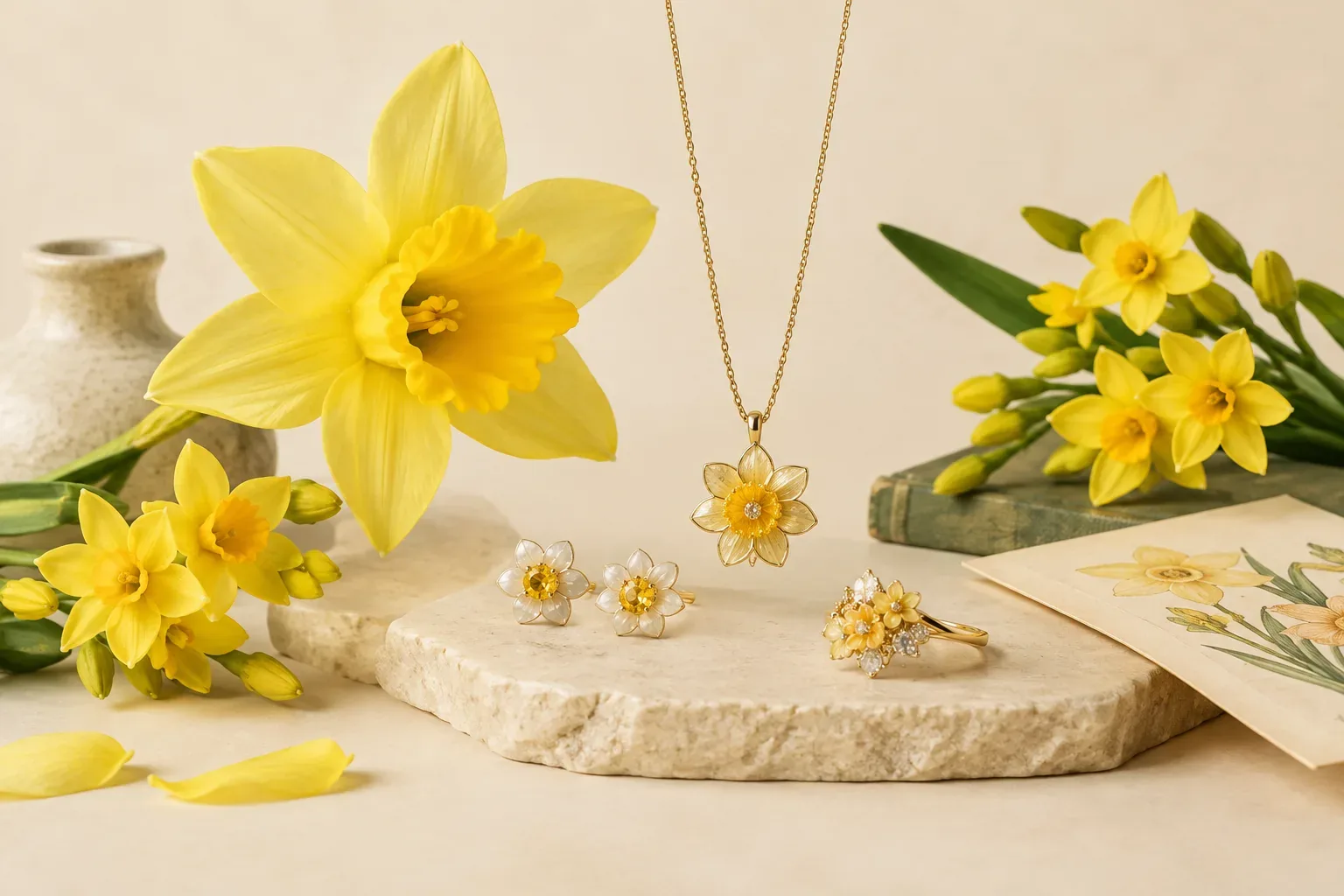
Meaning at a glance
Concise answer: The March birth flower meaning centers on two related spring-blooming plants commonly called daffodils and jonquils. Terminology varies by region and horticultural usage, and printed flower-language traditions have shifted over time. Historical sources tie these flowers to spring and renewal, while modern personal interpretations range widely; jewelry makers translate the motif through metal silhouettes, enamels, carving, and color-matching gemstones. No single, universal meaning applies—context and the giver’s intent shape significance.
Direct answer: what the March birth flower means
The concise answer is that March’s birth flowers are commonly represented by the daffodil and the closely related jonquil; both are early spring-blooming members of the Narcissus group. Terminology and emphasis differ by horticultural tradition and culture. Historical printed flower-language systems assigned varying meanings at different times, while contemporary readers commonly associate these flowers with spring, renewal, and hopeful beginnings. Jewelry that references daffodils or jonquils draws on those seasonal and emotional associations, but it is important to recognize there is no single, universally accepted symbolic meaning.
What the historical record actually shows
Evidence collected by cultural institutions shows how human relationships with seasonal plants and their symbolic uses change across time and place. The Smithsonian Libraries and Archives’ project Blooming Flowers traces seasonal and cultural histories and makes clear that societies have long attached significance to the arrival of particular blooms, but those associations evolve with horticulture, trade, and taste. That research supports describing daffodils and jonquils as culturally prominent spring flowers rather than as stable carriers of one fixed meaning.
Printed flower dictionaries, bouquet guides, and other emblems of the 18th and 19th centuries helped formalize and popularize floral symbolism in some regions. The Library of Congress documents how print culture amplified flower-language traditions and how meanings varied by period and by the authority of particular printed sources. That variability is important: a meaning listed in one Victorian floral dictionary might not match the meaning used in another region or era.
From a botanical and horticultural perspective, the Royal Horticultural Society provides context on identification and seasonality. Horticultural sources place daffodils and related Narcissus varieties firmly in the early-to-mid spring bulb calendar in temperate regions. Their regular appearance at a specific season is a major reason they became associated with springtime ideas such as rebirth, renewal, and the end of winter.
Documented historical meanings versus modern personal interpretations
Documented historical meanings for flowers come primarily from printed and cultural sources rather than from any single ancient prescription. Institutions that study print culture show that floristic meanings were often assigned, cataloged, and sold to readers, which means documented meanings are best read as historically situated recipes rather than universal truths. The Library of Congress’ material on floriography highlights how these assigned meanings were shaped by the authors and audiences of their time.
Modern personal interpretation often emphasizes the daffodil’s visual and seasonal cues—its clear yellow or white petals, central trumpet, and dependable springing-up after winter. Today many people view daffodils and jonquils as symbols of renewal, optimism, new beginnings, or friendship, but these are contemporary, widely held readings rather than historically universal meanings. Some communities or individuals retain older, more specific associations; others treat the flowers simply as attractive motifs without heavy symbolic freight.
Terminology: daffodil and jonquil explained
Botanical and horticultural usage draws a distinction in form and scent even when popular speech treats the names interchangeably. In general terms, "daffodil" is the common name for many members of the Narcissus genus, while "jonquil" is used for particular Narcissus forms with clustered flowers and a strong fragrance in some horticultural traditions. The Royal Horticultural Society’s documentation on bulbs and seasonality is useful for identification and shows why different growers or regional guides may prefer one name or the other.
Because terminology varies with geography and horticultural practice, jewelry descriptions that label a piece as "daffodil" or "jonquil" may be referencing common appearance, scent, or local naming conventions rather than precise botanical classification. When precise plant identity matters to you or the recipient, ask the maker or consult horticultural references.
How the motif and traditions appear in jewelry
Designers translate daffodils and jonquils into jewelry through silhouette, relief carving, engraved lines, and color. Metalwork can suggest the trumpet-and-petal shape in small pendants, brooches, and earrings. Enamel is often used to recreate the flower’s bright yellow hues and delicate shading. In contemporary work, some makers use pressed or dried blooms preserved under resin as a literal floral keepsake; other makers stylize the blossom into a minimalist or Art Nouveau-inspired motif.
Gemstones and color choices are another route to evoke the flowers. Yellow or warm-hued stones and gold settings often echo spring color palettes, while pale or translucent stones can suggest petal texture. Designers may also pair the motif with complementary elements—leaves in green enamel, small white stones for accents, or a curved stem rendered in metal—to make a readable botanical composition. These choices are aesthetic and interpretive rather than symbolic decrees.
Practical guidance for selecting or gifting daffodil and jonquil jewelry
Consider the recipient’s relationship to floral symbolism and to jewelry style. If the recipient values clear botanical reference or has a horticultural interest, choose pieces that make the flower botanically recognizable or that come with notes about the design’s inspiration. If they prefer subtlety, select a stylized or abstract motif that captures the idea of spring without literalism.
Think about occasion and setting. A small pendant, stud earrings, or a brooch can be appropriate for everyday wear or workplace settings, while larger, more ornate pieces suit celebratory looks. Materials matter for durability and care: solid metals, secure gemstone settings, and well-attached clasps will stand up to daily wear more reliably than very delicate constructions. If you are unsure about metal allergies, choose hypoallergenic metals or ask the maker for metal content.
Respect cultural differences and personal preference. Because flower meanings change by culture and time, avoid assuming that the recipient shares your symbolic reading. When the meaning is important to you, make it explicit: include a short note about why you chose daffodil or jonquil imagery—mentioning spring, new beginnings, memory, or friendship as fits your intent. Such a statement helps the piece carry the meaning you intend without presuming universality.
Caring for daffodil-themed jewelry and final thoughts
Care depends on materials: enamel and inlaid motifs benefit from careful storage to prevent chipping; plated finishes may show wear over time while solid gold or silver will age more gracefully. Preserved botanical pieces require protection from moisture and light to maintain color. Ask the maker about recommended cleaning methods and storage.
In sum, the march birth flower meaning for daffodils and jonquils is best approached as a flexible cultural shorthand shaped by seasonality, print history, and personal intent. Historical sources like the Smithsonian and Library of Congress remind us that flower-language is mutable, and horticultural authorities like the Royal Horticultural Society explain the seasonal rhythms that underlie many modern readings. Use jewelry to express the specific meaning you want to convey rather than to rely on any single, assumed symbolism.
Frequently asked questions
Are daffodils and jonquils the same flower?
They are closely related; "daffodil" is a common name for many Narcissus species and varieties, while "jonquil" is used in some horticultural traditions for certain Narcissus forms—especially those with clustered blooms and a strong scent. Usage varies by region and grower.
What did daffodils mean historically?
Historical meanings were assigned by printed flower-language traditions and popular culture, and they varied by time and place. Cultural institutions show that such meanings are historically situated rather than universal; many modern readers trace meanings to springtime associations like renewal.
Is it appropriate to gift daffodil jewelry for a March birthday?
Yes; daffodil-themed jewelry is a thoughtful seasonal choice for a March birthday. Make your intent clear if you want it to carry a specific meaning, and consider the recipient’s style and metal sensitivities when selecting a piece.
How can I make sure the floral motif is botanically accurate?
If botanical accuracy matters, ask the maker for details about the reference used in the design or for botanical illustrations that inspired the piece. Horticultural authorities can help with identification if the maker’s description is unclear.
What materials are best for everyday wear?
Durable metals with secure settings are best for everyday wear. Solid precious metals and well-set stones generally withstand daily use better than very thin or plated constructions; ask the maker about care recommendations for enamel or preserved-flower pieces.
Can wearing daffodil jewelry have different meanings in different cultures?
Yes. Because flower-language and symbolism change across cultures and time, meanings attached to daffodils or jonquils are not universal. Consider cultural context and individual preference when choosing or interpreting symbolic jewelry.
Sources and further reading
- Blooming Flowers: A Seasonal History of Plants and People — Smithsonian Libraries and Archives
- Flowers and Their Meanings — Library of Congress
- Plants of the World — Royal Horticultural Society