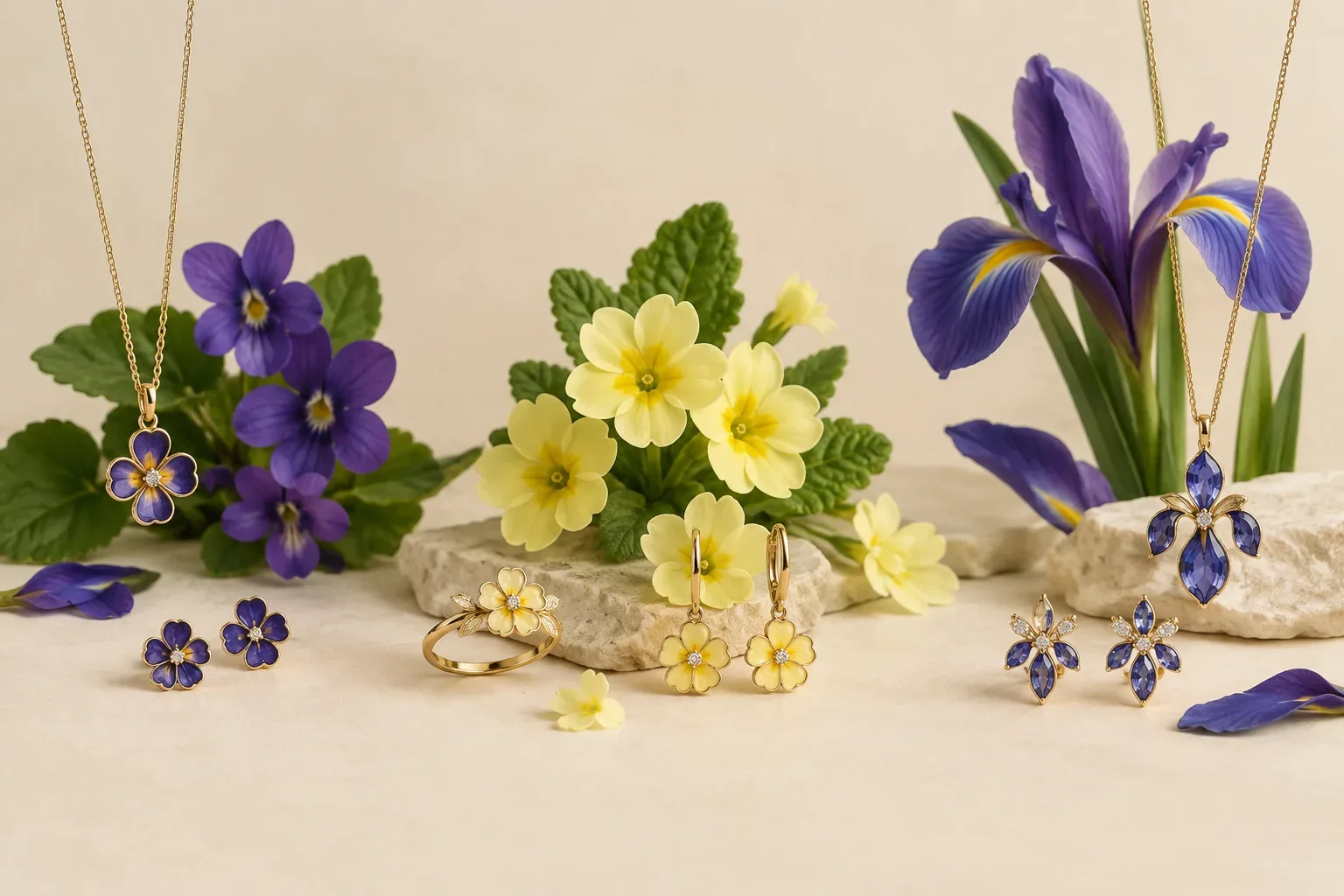
Meaning at a glance
February’s birth-flower associations link three distinct plants—the violet (Viola), the primrose (Primula), and the iris (Iris)—through seasonal flowering and layers of cultural meaning; botanical identity and historical floriography are not the same, and each flower translates into jewelry as motifs, color palettes, and techniques that can be chosen to reflect historical references or personal meaning.
Quick answer
The modern February birth-flower group—violet, primrose, and iris—combines three different genera that commonly flower in late winter or early spring and that have been given social meanings in printed floriography and cultural histories. Botanically, these are separate plants with distinct appearances and seasonal habits; historically, their symbolic values come from a mix of regional traditions and the printed language of flowers rather than any single universal meaning. In jewelry, each appears as a motif, a color reference, or an emblematic form used to convey modesty, new beginnings, or messages depending on the piece and the giver’s intent.
What the historical evidence says and which sources describe it
Seasonality and cultural relationships between people and plants are long-studied subjects. The Smithsonian Libraries and Archives documents how seasonal histories of plants shaped social practices around flowers and explains why certain plants are highlighted in particular months because of when they appear in gardens and markets.
The Library of Congress has noted that printed floriography and popular print culture helped fix particular flower meanings for audiences in different periods and places. Floriography guides and gift books translated botanical names into social messages that readers used in correspondence, bouquets, and decorative arts, so many of the symbolic meanings most people recognize today circulated through printed sources rather than a single living tradition.
For plant identification, habit, and seasonality—essential when distinguishing botanical identity from symbolic meaning—the Royal Horticultural Society provides professional botanical context, showing how genera such as Viola, Primula, and Iris differ in form, range, and typical flowering time.
Botanical identity versus floriography: keeping the categories separate
Botanical identity concerns the plant’s genus, species, form, and natural seasonal habits. Violets belong to the genus Viola; primroses to the genus Primula; and irises to the genus Iris. These genera are distinct in leaf shape, flower structure, and garden culture, which matters if you want jewelry that references a specific plant appearance rather than a generic ‘purple flower.’ The Royal Horticultural Society’s materials are useful for distinguishing these botanical features and understanding when each flower naturally blooms.
Floriography is the cultural practice of assigning social meanings to flowers and then communicating those meanings through prints, books, and arranged bouquets. The Library of Congress highlights how print culture spread fixed meanings for flowers in different eras and literatures. These assigned meanings are not botanical facts; they are historically situated interpretations that can vary by region and time.
When you read a short phrase such as “violets = modesty,” understand that this is a floriographic shorthand that circulated through printed guides and social custom rather than a universal botanical truth. The Smithsonian’s work on seasonal plant histories reminds us that some of the reason a flower became meaningful is simply that it arrived at a socially significant time of year.
Documented historical meanings (what sources support) versus modern personal interpretations
Documentation in the Library of Congress and similar print-culture records shows that many flower meanings familiar today were articulated in printed floriography guides and popular literature. These sources assigned evocative attributes to flowers—qualities like modesty, affection, early love, or messages—so much of what people assume about flower symbolism reflects the tastes and social codes of the periods when those guides circulated.
The Smithsonian’s seasonal histories also provide context for why particular flowers were highlighted in months like February: early-blooming species have long been noticed and taken as signals of seasonal change, which then fed into symbolic language and celebration.
Modern interpretations are often personal and flexible. A giver might choose a violet motif to honor a family memory, select a primrose to celebrate a youthful milestone, or use an iris as a shorthand for hope or communication. These contemporary meanings are legitimate personal layers that sit alongside historical associations, but they should not be presented as fixed or universal facts.
How each flower motif translates into jewelry
Violet: Jewelry that references violets tends to emphasize small clustered blossoms, heart-shaped leaves, and a restrained palette of pale to deep purples. Designers translate the violet’s modest scale into delicate studs, tiny cluster pendants, or enamel accents. Violet tones are often suggested by amethyst-colored gems or purple enameling rather than by botanical realism, and metalwork that emphasizes fine detail suits the flower’s small, intimate profile.
Primrose: Primroses are commonly represented as single rounded flowers with a clear center and radiating petals. In jewelry, the primrose motif appears as small rosette pendants, openwork brooches, and rings that mimic the flat bloom shape. Color choices for primrose-inspired pieces range from soft yellows and creams to pale pinks, and designers may use cabochons, painted enamel, or inlay to suggest a primrose’s simple, fresh look.
Iris: The iris’s sculptural, ruffled petals and taller silhouette lend themselves to bolder jewelry statements. Iris motifs appear in longer drop earrings, larger pendants, and stylized Art Nouveau–inspired brooches where the flower’s linear form can be exaggerated. The iris is often linked to blue and purple palettes, and jewelers may use sapphires, tanzanite, or colored glass to suggest its rich tones, though stylized metalwork alone can convey the iris’s dramatic shape.
Translating tradition and meaning into design choices
If you want a historically aware piece, choose techniques and motifs that echo the period when a meaning was popular. Enamel and painted miniatures recall Victorian printed-flower traditions; delicate cluster work reflects the modesty historically associated with violets in floriography; larger flowing forms can reference Arts and Crafts or Art Nouveau treatments that celebrated natural forms.
If you prefer botanical accuracy, buy or commission pieces based on botanical illustrations or photographs and ask for specific leaf shapes, petal counts, or color gradations. The Royal Horticultural Society’s botanical references can help you identify the features that most clearly distinguish a violet from a primrose or an iris.
Practical guidance for selecting and gifting February flower jewelry
Match the piece to the recipient’s relationship and taste. Choose a modest, small-scale violet pendant or stud for someone who favors subtlety and personal symbolism. For someone who likes fresh, optimistic motifs, a primrose rosette or small cluster ring communicates new beginnings. For a person who enjoys statement pieces, an iris pendant or elongated brooch can be appropriate.
Be mindful that the symbolic language of flowers is culturally and historically situated. If you rely on a specific floriographic meaning, consider whether the recipient would appreciate that historic layer. Alternatively, explain your personal intention with a short note that makes your gifting choice clear without assuming a shared symbolic vocabulary.
Consider materials and care. Fine metals, durable enamel, and securely set stones will keep a floral motif readable over time. Smaller motifs are often more practical for daily wear; larger, sculptural pieces tend to be seasonal statement items. Ask the maker about repair and cleaning recommendations, especially for intricate enamel or filigree work.
When in doubt, personalize. Engraving a date, initial, or brief phrase alongside a flower motif lets the recipient know why you chose that flower now, whether to mark a birthday, a new chapter, or a memory.
Frequently asked questions
Why are multiple flowers associated with February?
Multiple flowers are associated with February because botanical seasonality, regional traditions, and printed floriography all contributed different candidates; institutions that document plant histories and print culture show that more than one early-blooming plant can be celebrated for the month depending on local gardens and published guides.
Is the violet the only official February birth flower?
There is no single universal official birth flower for February; different traditions and modern lists include violet, primrose, and iris. The idea of a single official flower is a modern cultural designation rather than a botanical fact.
Can I wear floral jewelry year-round or only in the flower’s season?
You can wear floral jewelry year-round. While some people prefer seasonally themed pieces, floral motifs function as personal or stylistic choices and need not be restricted to the flower’s natural blooming period.
How can I make sure a flower motif is botanically accurate?
If botanical accuracy matters, consult botanical illustrations or horticultural references and look for key identifying features—petal shape, leaf form, and bloom arrangement—when selecting or commissioning a piece. The Royal Horticultural Society’s resources are helpful for identifying distinguishing plant features.
Should I explain the floriographic meaning when gifting floral jewelry?
It’s considerate to explain your intent if you are relying on a historical or symbolic meaning that the recipient might not know. A short note that states why you chose that flower will make the gift’s significance clear without assuming a shared symbolic vocabulary.
Sources and further reading
- Blooming Flowers: A Seasonal History of Plants and People — Smithsonian Libraries and Archives
- Flowers and Their Meanings — Library of Congress
- Plants of the World — Royal Horticultural Society