Meaning at a glance
Pair kite-cut wedding bands by prioritizing complementary profiles, controlled gap tolerance, and a metal choice that balances durability with color harmony; verify gemstone origin and treatments only with a qualified gemological laboratory and ask sellers for written disclosure and professional measurements before purchase.
Quick answer
A kite cut wedding band pairing should be chosen by matching edge geometry and ring profile rather than by symbolic assumptions: select a band whose kite facets and points sit flush or with a deliberate small gap relative to the engagement ring, choose a metal that balances daily wear with desired color, and verify any claims about origin or treatment through written seller disclosures and, if needed, a gemological laboratory. This approach delivers a predictable fit, durable everyday wear, and clear limits on what a shopper can confirm without professional testing.
What a kite cut looks like and why shape matters
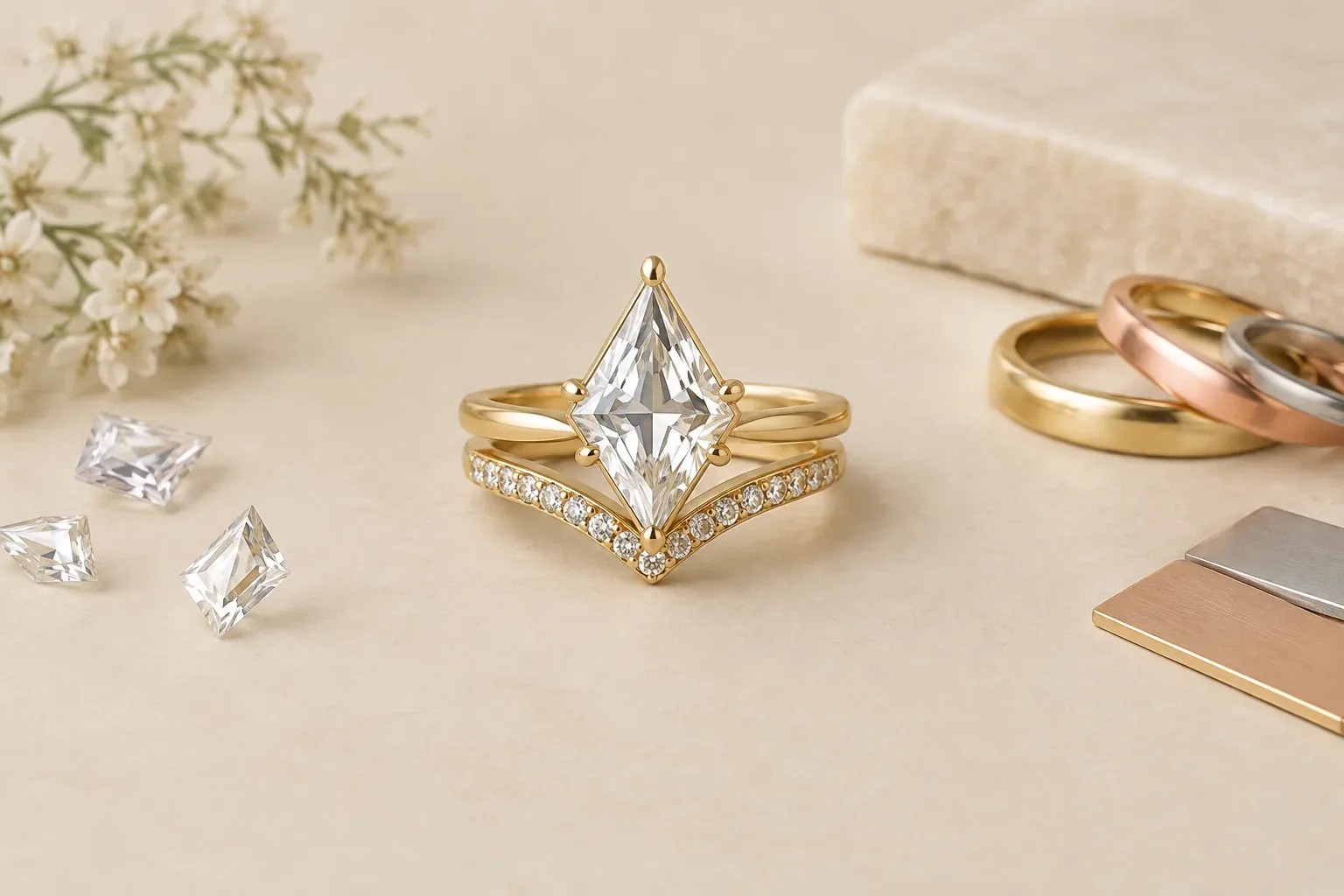
Kite cut refers to a four-sided stone outline where two opposite sides taper to points, producing an elongated diamond or kite-like silhouette. In wedding and stacking contexts the cut is used as an accent or as a repeating motif in a full eternity or semicircle band. The geometry of the kite cut—its proportions, point sharpness and table size—affects how it nests against other rings and how much open 'gap' appears between stones when paired with another profile.
Because kite cuts create directional points, pairing decisions should emphasize physical fit first: will the kite points clash with prongs or shoulders on the engagement ring, will the band rock under pressure at the points, and does the engagement ring have the negative space to accept a kite profile without bending or compressing gemstones?
Historical evidence — what the approved sources show
Among the specifically approved sources for this article, there is no documented historical evidence linking kite-cut stones to a named cultural symbol or fixed belief system. The sources used here—Imaginaire Digital, Jewelers Mutual, the Gemological Institute of America (GIA), and the U.S. Federal Trade Commission (FTC)—focus on modern market trends, consumer protection, gem treatment and disclosure, and do not record a historical cultural meaning for the kite cut as a motif.
Because the approved evidence set emphasizes contemporary search trends and consumer issues rather than historical symbolism, any claims tying the kite cut to a specific culture or period are not supported by these sources and should be treated as modern interpretations rather than documented history.
Documented history vs modern personal interpretation
Documented history, as represented in the approved sources, does not assign a cultural or ritual meaning to the kite cut. Imaginaire Digital and Jewelers Mutual report on current consumer demand and aesthetic trends, not on ancient symbolic systems. The GIA and FTC provide technical and legal guidance about gem treatments and buyer protections rather than symbolic meanings.
Modern personal interpretation is common in jewelry: today’s buyers, designers, and social media communities often ascribe personal symbolism to shapes, including kite cuts. Those interpretations are valid as individual or cultural practices, but they should be distinguished from historical documentation. If symbolic meaning is important to you or a gift recipient, treat it as a personal or contemporary meaning rather than an established historical fact.
How the kite motif and kite-cut gemstones appear in jewelry
In contemporary jewelry the kite cut usually appears as an accent stone, a repeating motif in a band, or as a geometric element in modern settings. Jewelers use kite-shaped stones to create angular, artful profiles that emphasize directionality and rhythm in a band. Kite cuts are often set bezel-style, in shared prongs, or channel settings to protect their points and maintain alignment.
Designers also pair kite cuts with round, oval, or tapered baguette stones to create controlled negative space and visual contrast. The kite shape can be used to emphasize the center stone’s axis or to create a jagged, rhythmic edge for a wedding band that stacks with a companion engagement ring.
Shape and gap: fitting considerations and trade-offs
Start by assessing the engagement ring’s shoulder profile and the table orientation of its center stone. If the engagement ring has low-profile shoulders and a flat band, a kite-cut band with shallow settings and slightly blunted points is more likely to sit flush. If the engagement ring has high shoulders, prongs, or curving shanks, you may need a band with a deliberate small gap or a contoured profile to avoid interference.
Accepting a small, planned gap between rings can reduce stress on stone points and prongs and avoid metal-on-metal collisions. The trade-off is that a gap will be visible; some wearers prefer a tiny visible channel for breathability and cleaning access, while others prefer a tight nest for a seamless look. If a tight fit is essential, expect higher fabrication precision and potentially higher costs to create a custom contoured band.
Metal choices: durability, color harmony, and maintenance
Choose metal based on three priorities: scratch resistance, color match, and maintenance. Platinum is extremely durable, resists metal loss over time and is a common choice when durability and secure stone setting are top priorities. Gold alloys—14K and 18K—offer color warmth and a lighter feel; 18K is richer in color but softer, while 14K offers better scratch resistance for daily wear.
Mixed-metal combinations can be tasteful but require design attention where two metals meet to avoid galvanic wear and visible seams. Rhodium plating can make white gold appear like platinum, but it wears and requires periodic replating, a maintenance trade-off noted in industry guidance about craftsmanship and consumer expectations.
Gemstone treatments, disclosure, and verification limits
If a kite-cut stone is a diamond, colored gemstone, or simulated material, the Gemological Institute of America (GIA) highlights that treatments and enhancements can affect durability and care. The U.S. Federal Trade Commission (FTC) advises consumers to seek clear written distinctions among natural, lab-created, treated, and imitation materials, and to insist on written seller disclosures when buying gemstones.
What a shopper can verify without a lab or qualified jeweler is limited. Visual inspection and documentation from the seller can show the stone’s cut, mount, and basic characteristics. However, origin (natural vs lab-grown), many treatment types, and precise clarity or optical properties require gemological testing. For such determinations you should plan to consult a qualified jeweler or an accredited gemological laboratory.
Practical selection and gifting guidance
Before purchase, have the engagement ring on hand for a test fit or request accurate CAD renderings and exact internal ring measurements. Ask the seller for a written description that includes metal alloy, karat weight, stone measurements, setting type, and any treatments or enhancements. Use those specifications to assess whether the kite-cut points will clear prongs and shoulders.
If gifting without access to the engagement ring, choose a band with a slight internal taper or a comfort fit that allows minor resizing and returns. Consider insurance and professional resizing; Jewelers Mutual highlights the market trend toward protecting investments with appropriate coverage. When in doubt, favor slightly larger internal diameter that a jeweler can tailor rather than a band that must be rebuilt to fit.
Care and long-term considerations
Caring for kite-cut stones centers on protecting points and edges. Avoid high-impact activities while wearing pointed stones, check settings periodically for loose prongs or chips, and ask your jeweler whether bezel or prong guards are advisable for the particular design. The GIA notes that treatments can affect cleaning and durability recommendations, so follow care instructions that match the stone’s material and treatment history.
Plan for occasional professional inspection and maintenance. If the band is plated or uses mixed metals, factor in the cost and frequency of replating or polishing. Keep written documentation of purchase, disclosures, and any lab reports in a safe place to support future resale or insurance claims.
Summary checklist for shoppers
Match geometry first, decide on an intentional gap or a custom contour, pick a metal that balances durability with color preference, insist on written disclosures for gemstone origin or treatment, and accept that certain verifications require a qualified jeweler or lab. Following this evidence-led approach produces a kite-cut pairing that is comfortable, durable, and transparent in terms of what you can verify independently.
Frequently asked questions
Will a kite-cut wedding band fit a round solitaire engagement ring?
Often yes, but fit depends on the engagement ring’s shoulder profile and the kite band’s setting depth. A band with shallow settings and slightly blunted kite points or a small deliberate gap will generally pair well. If you need a close, seamless fit, ask a jeweler for a custom contoured band.
How much gap between rings is acceptable?
There is no single 'acceptable' gap; common practical choices are either a tight nest for a seamless look or a small visible gap that reduces stress on points and prongs. If the gap is a functional choice to protect stones, be clear about that with the recipient or seller when gifting.
Which metal is best for everyday wear with kite-cut stones?
Platinum offers superior durability and resists metal loss, making it a strong choice for everyday wear. 14K gold balances color and scratch resistance, while 18K gold provides richer color but is softer. Consider maintenance trade-offs like rhodium replating for white gold.
Can I verify if a kite-cut stone is natural or treated at home?
No. Visual inspection and seller documentation can provide clues, but determining origin (natural vs lab-grown) or many treatment types requires testing by a qualified jeweler or an accredited gemological laboratory, as emphasized by the GIA and the FTC.
How should I care for a kite-cut wedding band?
Protect pointed kite facets from hard impacts, schedule periodic professional inspections for loose settings, follow care advice specific to the stone’s material and treatment history, and keep written purchase and disclosure documents for insurance and resale.
Sources and further reading
- Imaginaire Digital — Imaginaire Digital
- Jewelers Mutual — Jewelers Mutual
- Gemological Institute of America — Gemological Institute of America
- Federal Trade Commission — Federal Trade Commission