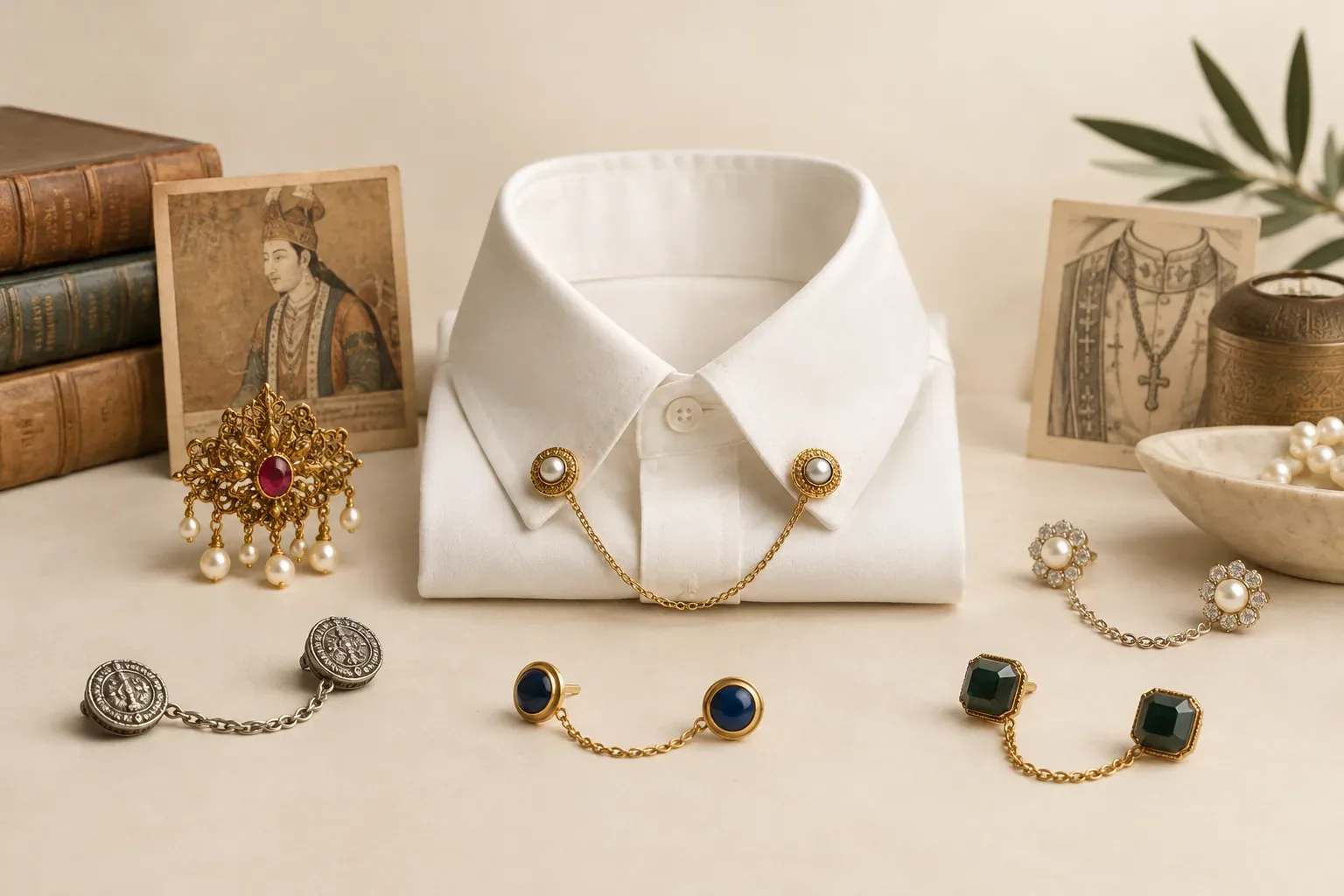
Meaning at a glance
This guide explains the documented history and changing contexts of jewelry worn with shirts, separates cultural and religious evidence from later popular interpretations, and gives practical guidance on proportion, color, and visual focus for choosing and gifting jewelry for button-down shirts.
What the historical evidence shows
Museum scholarship documents that jewelry’s role in relation to shirt-like garments has varied by period and culture. The Victoria and Albert Museum frames jewellery as a social object whose meanings change with context, and its surveys trace how different societies used neck, collar, and fastening ornaments for display, status, and personal memory rather than as a single static symbol.
Specific historical examples include Ancient Egyptian broad bead collars that sat over linen garments, Byzantine and medieval pendants and reliquaries worn near the chest for religious identification, and later European examples such as signet rings, portrait rings, brooches and lockets used in the Renaissance, Georgian, and Victorian periods. The Victoria and Albert Museum presents these examples as part of a long arc showing changing functions and meanings in different cultures, periods, and social settings.
Victorian Britain is particularly well documented for a set of practices that interacted with shirts and collars: for instance, brooches and lockets were commonly worn with high-necked shirts and were often used for sentimental or mourning purposes. The V&A discusses mourning, sentimental, and portrait jewellery as historically embedded practices in that cultural and temporal context rather than universal meanings.
Separating documented historical meanings from modern personal interpretations
Documented meanings are those that historians, curators, and primary sources attribute to objects in their original contexts. For example, the V&A’s exhibition and cataloguing work shows that certain brooches and lockets in nineteenth-century Britain were used in mourning practices and that some pendants served as devotional objects in Byzantine settings. Those usages are specific to time, place, and social norms and are what merit the label “documented.”
Modern wearers frequently repurpose historic motifs or attach personal meanings that differ from the original use. A modern wearer might choose a locket for sentimental reasons without intending any Victorian mourning reference, or wear a cross pendant as a fashion piece without religious intent. Those contemporary meanings are valid personal interpretations but should not be presented as the historic or cultural origin of the object.
When selecting or gifting jewelry, recognize this distinction. If an object carries a historically documented religious or cultural function—such as a devotional pendant from a particular faith tradition—note that its historic meaning is specific to that tradition and period. If you are unsure, consult reputable museum references or the specialist literature recommended in the internal resources below before treating that object as a cultural symbol in a modern context.
How motifs, gemstones, and traditions appear on shirt-compatible jewellery
Motifs that historically appeared near collars and shirts include religious pendants, heraldic devices, sentimental imagery such as portrait miniatures, and practical fastening pieces like collar pins and buttons with decorative fronts. These motifs are reproduced today in a wide range of forms designed to sit on or between shirt collars, on the placket, or at the chest.
Gemstones and materials used historically and today are catalogued in museum reference resources. The Victoria and Albert Museum’s A–Z of Gemstones describes how materials from pearls and coral to garnet, turquoise, and diamonds have been chosen for color, luster, and perceived value across cultures. Those mineral choices influence modern design decisions for shirt-worn pieces because gemstones’ scale, sparkle, and color determine how a piece reads against fabric.
Traditions such as wearing brooches for attachment or lockets for memory have been adapted into contemporary forms like collar pins, small pendant necklaces that tuck under collars, tie pins, and decorative studs on plackets. Designers also translate historic motifs—floral sprays, wreaths, or geometric medallions—into simplified, smaller-scale pieces that respect the proportions of modern shirts.
Proportion: sizing jewelry to the shirt
The single most important practical rule is proportion. Thin, closely turned collars and slim plackets call for smaller, flatter pieces so they do not overpower the shirt or distort the collar line. Classic collar pins, small studs, or narrow bar-style necklace pendants work well with contemporary slim collars.
Wider collars, spread collars, or shirts with open necklines can carry larger focal pieces—a medium pendant, a statement brooch pinned to the collar point, or a heavier chain that sits outside the shirt. Consider the shirt’s fabric and weave: lightweight fabrics like cotton poplin or silk will show the weight and texture of heavier jewelry and may sag under heavy pieces; heavier oxford or twill cloth can support a chunkier pendant or brooch.
Also think about button placement and placket width. A necklace that sits precisely in the shirt’s opening will become the visual focus, while pieces that align with the placket or sit on the collar points create a different emphasis. Test proportions in daylight or under typical lighting to ensure the piece reads as intended.
Color and metal choice: coordinating with shirt and hardware
Metal and gemstone color choices should respond to the shirt’s color, pattern, and the hardware you are already wearing, such as buttons, belt buckles, or watchbands. Warm metals like gold and rose gold typically harmonize with warm-toned shirts and buttons, while cool metals like silver, white gold, and platinum contrast or complement cooler shades.
Gemstone color can either harmonize or provide contrast. A small colored stone set close to the face reads like a deliberate accent; a stone that echoes a shirt’s pattern ties the outfit together. When pairing multiple metallic elements, prioritize consistency in finish—polished, matte, or brushed—so different pieces read as intentional companions rather than competing details.
Focus: where you want the eye to land
Decide whether the jewelry is the focal point, a supporting accent, or a unifying detail. A large pendant framed by an open neckline will be the focal point; a delicate chain tucked under the collar will act as an intimate supporting detail visible only in motion or at certain angles. Brooches or collar pins draw attention to the collar line and are well-suited to formal or statement looks.
For mixed-formality dressing, choose one dominant piece and keep other elements minimal. In professional settings favor low-profile pieces that respect dress codes; in social or creative settings you can be more experimental with scale and motif.
Practical and respectful selection and gifting guidance
When selecting or gifting jewelry for a button-down shirt, consider the recipient’s usual collar styles, daily activities, and any relevant cultural or religious affiliations. If a motif has a clear documented religious or cultural meaning, learn that meaning before gifting so you avoid unintended offense. Use museum references or specialist guides when uncertain and err on the side of asking the recipient about their preferences.
Budgetary and material transparency matters. The Federal Trade Commission recommends that consumers ask sellers whether gemstones have been treated, whether materials are natural or synthetic, and how any imitations are disclosed. Request written confirmation of treatments or lab reports for higher-value gemstones and prefer reputable sellers who provide clear information.
For gifts aimed at everyday wear choose durable settings and low-profile designs if the recipient leads an active life. For collectible or sentimental gifts such as lockets or portrait-style pieces, consider presentation options and provenance information—documented provenance enhances historical interest but is separate from contemporary sentimental meaning.
If the object is inspired by a specific cultural tradition, prefer makers from or affiliated with that culture where possible, or choose neutral motifs if you do not intend to invoke that cultural meaning. Respectful gifting recognizes the difference between appreciation and appropriation: a historical motif may be appropriate as a stylistic reference, but a sacred emblem should be handled with awareness of its ongoing significance.
Care, buying tips, and legal notes
Ask sellers for the composition, treatment history, and any certifications for gemstones and precious metals. The Federal Trade Commission’s consumer guidance encourages buyers to request disclosure of treatments, enhancements, and imitations to understand what they are purchasing and how to care for it.
For items meant to be worn with shirts—collar pins, brooches, and studs—check construction details like pin clasps, backing types, and the strength of soldered joins. These mechanical features determine whether a piece will damage fine fabrics or hold up under frequent wear.
If you are researching historical models or symbols, use museum resources such as the Victoria and Albert Museum’s overviews of jewelry history and gemstones for authoritative background rather than relying solely on popular or commercial descriptions. Those museum resources document how uses and meanings changed by era and culture and provide a foundation for respectful modern use.
Putting it together: example pairings
A slim white poplin shirt with a narrow collar reads fresh with a small, polished metal collar pin or a fine chain with a narrow vertical pendant tucked into the V of the open top buttons. The piece should be no wider than the collar points and sit flush with the fabric so it does not create bulky lines.
A spread-collar oxford in a warm tone pairs well with a medium-weight chain and a single gemstone pendant whose color either complements the shirt or provides a single contrasting accent. For formal shirts with French cuffs, coordinate cufflinks with collar hardware and choose a pendant that is lighter in scale.
For a patterned shirt use a single, solid-color metal accent to unify the outfit; for a monochrome shirt you can introduce a patterned or colored stone as the focal point. Always test how the piece moves when the wearer sits, leans, or bends, since jewelry that looks balanced standing may pull or twist in motion.
Summary
Selecting jewelry for button-down shirts is both a practical and cultural choice. Use documented historical sources to understand original meanings and contexts, recognize modern personal interpretations as distinct, and prioritize proportion, color harmony, and a single clear focal point when choosing or gifting pieces. When in doubt, consult reputable museum resources and ask sellers for material disclosures to make informed, respectful decisions.
Frequently asked questions
What necklace length works best with a standard button-down shirt?
For a standard button-down with an unbuttoned top, a short to medium chain that sits just at or above the collarbone is usually most flattering; for a closed collar choose collar pins or a short bar-style pendant that fits within the collar points. Always test how the pendant interacts with the placket and buttons.
Can I wear brooches on a shirt without looking dated?
Yes—small, well-placed brooches or collar pins can read modern when scaled to the shirt and paired with simple contemporary clothing. Choose low-profile designs in finishes that match other metal accessories to avoid a costume look.
Are there materials or motifs I should avoid when gifting?
Avoid gifting pieces that bear clearly religious, ethnic, or culturally specific symbols unless you know the recipient’s beliefs and preferences. Also ask the seller about gemstone treatments and imitations before buying, as the Federal Trade Commission recommends disclosure of such information.
How do I care for jewelry that I regularly wear with shirts?
Inspect fastenings and pins to prevent snagging, avoid high-friction contact on delicate fabrics, and clean metals and gemstones as recommended by the maker. For higher-value stones ask the seller about recommended cleaning and any special care related to treatments.
Sources and further reading
- Bedazzled: A History of Jewellery — Victoria and Albert Museum
- An A-Z of Gemstones — Victoria and Albert Museum
- Buying Gemstones, Diamonds, and Pearls — Federal Trade Commission