Meaning at a glance
This guide explains the documented history and changing contexts of huggie earrings, separates historical evidence from modern personal meanings, describes how motifs and gemstones are used on small hoops, and gives practical, respectful guidance for choosing size and fit in contemporary jewelry.
Direct answer — what this guide covers
Short answer: A useful huggie earrings size and fit guide focuses on a few measurable elements—the inner hoop diameter or opening, the hoop thickness, the hinge or clasp clearance, and how those dimensions relate to the wearer’s earlobe or piercing location—and treats documented history separately from later interpretations. This article uses museum documentation to explain historical contexts for small hoops and gemstones, and it offers practical modern guidance on measuring, choosing, and gifting huggies.
Why size and fit matter for huggie earrings
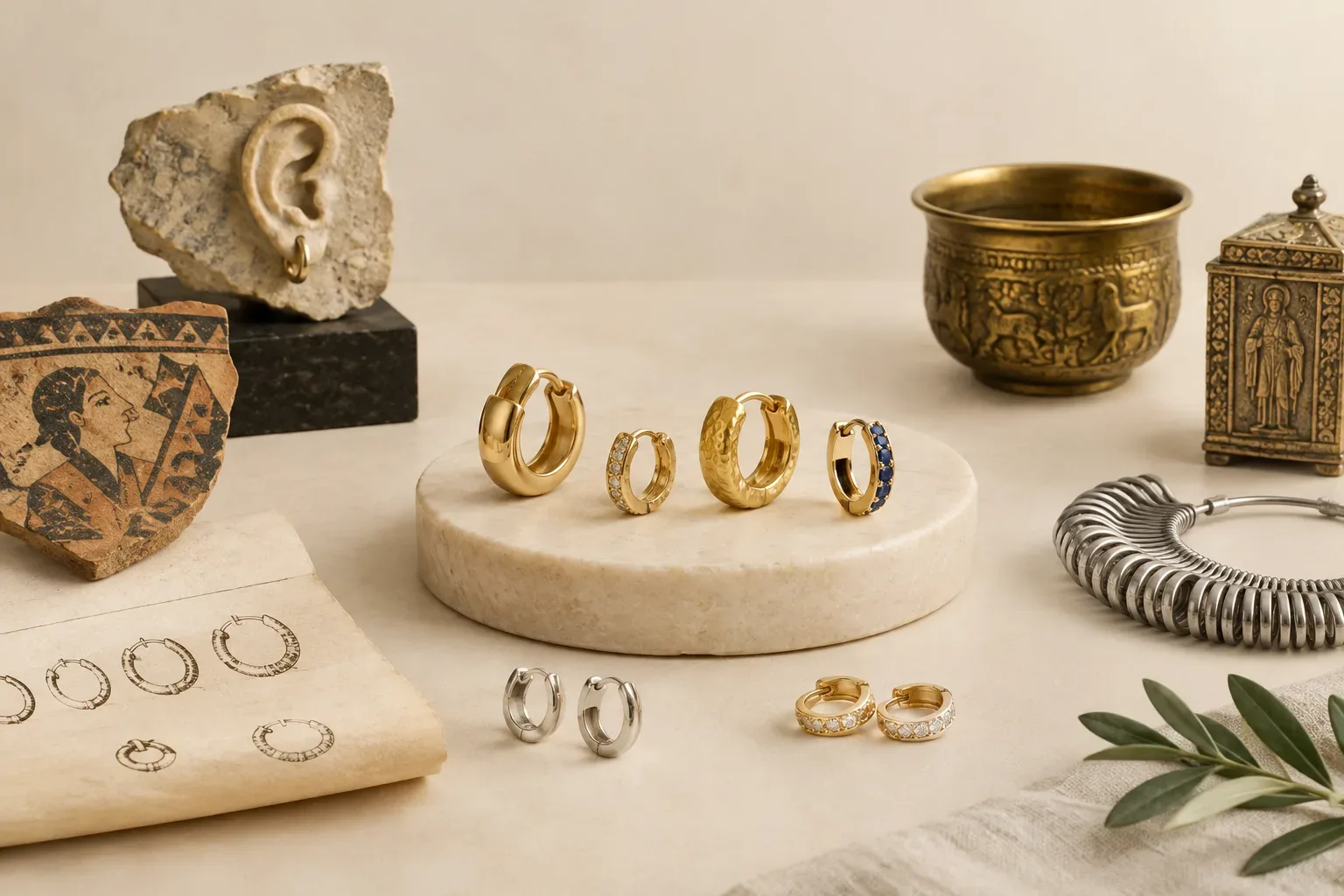
Huggie earrings are small, close-fitting hoops that 'hug' the earlobe or cartilage. Because they sit so near the skin, small differences in inner diameter, latch type, hoop thickness, and weight change comfort and appearance. A properly fitted huggie moves comfortably without pinching, does not rub the back of the ear, and allows the chosen motif or gemstone to sit as intended. Fit affects both wearability (for example, with multiple piercings or cartilage placements) and how a piece conveys style or meaning when worn.
Historical evidence: huggies and small hoops in documented jewellery history
Museum research shows that small hoops and close-fitting earrings have a long presence across cultures and periods, often changing form and social meaning as fashions and technologies evolved. The Victoria and Albert Museum describes broad patterns in jewellery history—how objects moved between functional, decorative, and symbolic roles as societies changed—and provides a framework for understanding why small hoop styles reappear in different eras.
Archaeological and museum collections introduce small hoop forms in a range of contexts: from ancient metalwork to later European and Asian traditions where hoops could be plain metal, ornamented, or set with stones. The V&A’s materials on jewellery history emphasize technique, material availability, and changing social contexts rather than a single continuous symbolic meaning for any one form.
Separating documented historical meanings from modern interpretations
Documented meanings for small hoops are typically tied to their cultural context, material, or use rather than the hoop shape alone. The V&A’s history shows that a hoop made of a prized metal or set with particular gemstones could signify wealth, status, identity, or protection in a given period, but those associations depend on the culture and time rather than the hoop’s geometry.
Modern readers and wearers often add personal or popular meanings—for example treating huggies as expressions of minimalism, intimacy, or everyday luxury. Those contemporary interpretations are valid as personal or market-driven meanings, but they should be presented as later, subjective layers rather than uncontested historical fact.
How motifs, gemstones, and traditions appear on huggie earrings
On huggies, motifs are commonly expressed in relief, engraving, or as small applied elements attached to the hoop. A motif such as a tiny star, heart, or floral form may be cast or punched into the metal so it reads at close range. Gemstones appear in small pavé or single-stone settings where the stone’s scale matches the huggie’s size; historically, gem use signalled material value and sometimes culturally specific meanings, as described in museum materials on gemstones.
The Victoria and Albert Museum’s A–Z of Gemstones explains how different gems have been used and perceived in historical jewellery, noting that materials and cutting techniques shape how stones appear at small scale. In modern huggies, gem choices are often governed by durability, proportion, and personal preference: harder stones resist wear in a close-fitting hoop, while softer stones may require protective settings.
Measurements that matter and how to take them
When assessing a huggie for fit, consider these measurable features and how to measure them against the wearer’s ear: inner hoop diameter (the size of the circular opening), hoop thickness (the width of the metal band), hinge or clasp clearance (space required for the post and mechanism to close securely), and overall weight. Inner diameter determines how closely a huggie will sit to the lobe or cartilage; hoop thickness affects how substantial the piece looks and whether it feels bulky against the skin; clasp clearance is essential for the earring to fasten without forcing the lobe.
To measure a wearer’s preference and anatomy, use a soft tape measure or a piece of thin thread to mark the distance across the visible part of the earlobe where the hoop will sit, and then compare that to the inner diameter of potential huggies. If possible, try huggies on over the lobe with the clasp open to judge clearance and rotation. For pierced cartilage placements, measure where the post will pass and ensure the clasp will not press uncomfortably against the ear.
Practical guidance for choosing huggie size
Fit choices depend on placement, personal comfort, and the desired visual effect. For a close 'huggie' look, select a piece whose inner diameter aligns with the visible plane of the earlobe so the hoop sits snugly without squeezing. For a slightly more relaxed appearance, choose a larger inner diameter. Hoop thickness should balance visibility and comfort—thinner bands are lighter but may show less detail for motifs or pavé, while thicker bands offer more presence and surface for engraving or stones.
Consider the clasp type when choosing size: hinged, click-top, and sleeper-style closures differ in required clearance and ease of use. A secure clasp that is easy to operate matters for daily wear and for gifting someone who may prefer low-maintenance jewellery.
Respectful selection and gifting guidance
When selecting a huggie as a gift, respect the recipient’s cultural background and personal tastes. Small hoops may carry specific cultural meanings in certain communities; consult reliable historical resources and, where appropriate, ask sensitively about preferences. The Victoria and Albert Museum resources can help trace historical uses and material significance, but they do not substitute for direct conversation with the recipient if the gift might intersect with identity or ritual.
Choose metals and stones with the wearer’s lifestyle in mind: hypoallergenic metals for sensitive skin, robust settings for daily wear, and secure clasps for active lifestyles. When gifting a piece meant to convey a particular sentiment, be clear that symbolic meanings are contemporary or personal rather than universal; encourage the recipient to view the jewellery on their own terms.
Material disclosure and care
Be aware of treatments, imitations, and trade practices when selecting gemstones or plated metals. The Federal Trade Commission offers consumer guidance about buying gemstones, diamonds, and pearls that emphasizes disclosure of treatments and synthetic materials. Ask sellers about stone treatments, plating thickness, and repair policies before purchase to make informed choices.
For care, close-fitting earrings experience friction against the skin; cleaning should be gentle and appropriate to the metal and stones. Regular inspection of the clasp and settings helps prevent loss of stones or accidental opening during wear.
Final thoughts: balancing history, meaning, and fit
Huggie earrings combine design, material, and intimate scale; their history shows recurring interest in small hoop forms across periods, while modern wearers add new personal and stylistic meanings. Use documented museum scholarship to understand historical contexts and material roles, use practical measurements and trial to ensure comfortable fit, and choose or gift with respect for both the recipient’s body and culture.
Frequently asked questions
How do I measure for the right huggie size?
Measure the visible plane of the earlobe where the hoop will sit using a soft tape or thread to determine a comfortable inner diameter. Also check hoop thickness, clasp clearance, and whether the clasp will press against the back of the ear. When possible, try similar pieces on to judge movement and comfort.
What features make a huggie comfortable for daily wear?
A comfortable huggie balances a secure, easy-to-operate clasp with a band thickness that feels good against the skin, a weight that doesn’t pull the lobe, and a smooth interior surface. Materials chosen for hypoallergenic properties and durable settings for stones help for everyday wear.
Can huggies be worn in cartilage piercings?
Yes, many huggies are designed for cartilage, but fit and clasp type matter. Measure the piercing location for clearance and ensure the hoop’s clasp won’t press uncomfortably against the opposite side of the ear. If in doubt, consult a trusted jeweller or try a temporary fitting.
How should I account for gemstones or motifs when choosing size?
Choose a hoop thickness and inner diameter that allow the motif or stone to be visible without overwhelming the ear. For small animated motifs or pavé, ensure there is enough surface area on the band for secure setting; for single stones, consider protective bezels or secure prongs to reduce wear.
Are there special considerations when gifting huggies across cultures?
Yes. Because jewellery meanings can be culture- and context-specific, research historically documented uses when relevant and be sensitive to the recipient’s customs. Use museum resources for historical background and ask the recipient about preferences when appropriate.
What should I ask a seller about gemstones or metal treatments?
Ask whether stones have been heat-treated, filled, or are synthetic, and whether metals are plated or solid. The Federal Trade Commission recommends seeking clear disclosure of treatments and imitations so you can make an informed choice.
Sources and further reading
- Bedazzled: A History of Jewellery — Victoria and Albert Museum
- An A-Z of Gemstones — Victoria and Albert Museum
- Buying Gemstones, Diamonds, and Pearls — Federal Trade Commission