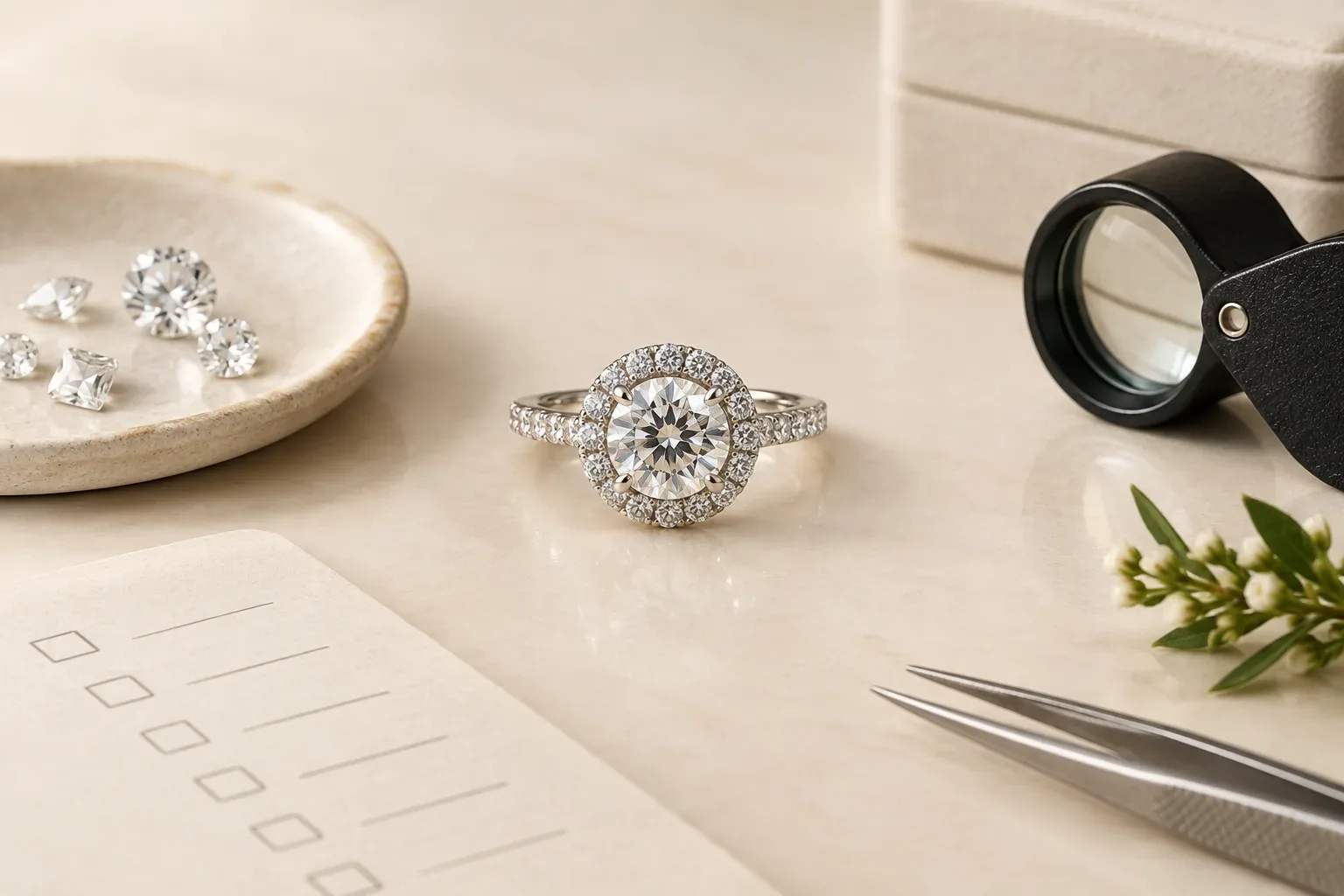
Meaning at a glance
This checklist defines the halo setting and gives clear decision criteria, practical trade-offs, safe-care guidance, and explicit limits on what only a qualified jeweler or gemological laboratory can verify, in line with industry guidance on treatments and disclosure.
Quick answer
A halo setting engagement ring checklist should give you a clear definition of the halo design, the top practical questions to ask about center stone type and treatments, metal and setting durability, ring proportions and style, care requirements, and an explicit list of what a jeweler or gemological laboratory must confirm before you rely on claims about origin or treatment.
What a "halo setting" means for shoppers
In consumer terms a halo setting is any ring design in which a central stone is visually framed by a surrounding ring of smaller stones or metalwork. That framing can be a single full circle, a partial crescent, or a decorative cluster that increases apparent size and sparkle. For the practical checklist below, treat the halo as part of the ring’s structural design: it affects how the ring looks, how it sits on the finger, and how the center stone is protected or exposed.
Historical evidence and limits in our sources
Among the approved sources provided for this article there is no primary historical research that documents the origin of the halo motif by culture or period. The contemporary sources in our reference set focus on modern market demand, craftsmanship trends, and consumer protections rather than historical provenance. Because those named sources do not present detailed historical claims about the halo motif, this article does not attribute the halo’s origin to any specific culture or century.
Documented meanings versus modern personal interpretation
Documented meanings that can be cited from our approved sources relate to current market and care issues rather than symbolic meanings. For example, Jewelers Mutual identifies a present-day emphasis on craftsmanship, versatility, and gender-neutral styling among consumer trends, which influences why people choose halo rings today. Imaginaire Digital’s search data shows ongoing consumer demand for engagement rings and related styles in the modern market. These are contemporary, evidence-led reasons people select halo designs, not historic symbolic meanings.
How the halo motif and gemstones appear in jewelry today
In modern ringmaking a halo is most commonly executed as a pavé or micro-pavé ring of small diamonds or gemstones set tightly around the center stone. Halos can be made in matching metal or contrasting metal, and they sometimes include a second, outer halo or decorative milgrain or filigree details. The halo’s practical effect is to increase visual diameter, enhance perceived brilliance, and create a distinct design silhouette.
Gemstones used in halos follow the same considerations as any accent stones: cutters and setters choose sizes and cuts that complement the center stone. Because treatments and durability vary by gem type, the Gemological Institute of America (GIA) guidance on treatments, detectability, and special care is relevant: consumers should expect disclosure of treatments and to ask about long-term care for any colored stones or treated diamonds.
A practical checklist of questions to ask before buying
Can you clearly define the center stone and the accent stones? Ask whether each stone is natural, lab-created, treated, or imitation and request written disclosure. The Federal Trade Commission (FTC) advises that consumers should get clear written distinctions between natural, lab-created, treated, and imitation materials.
Is there a gemological report or grading document for the center stone? For diamonds and many gemstones, a reputable seller should offer a lab report from an accredited laboratory for important attributes such as weight, cut grade (for diamonds), clarity, color, and known treatments. If no report is provided, plan to have the stone independently evaluated.
What specific treatments (if any) has the center stone or halo stones undergone? According to the GIA, treatments affect durability and care and may require disclosure because they change what maintenance the stones need and what you can expect in the long term.
Do the seller’s claims match written guarantees and return policies? Confirm the written return, upgrade, and repair terms, and whether the warranty covers settings, prongs, and any re-tipping required by a halo’s many small accent stones.
How secure is the halo’s construction and how will it affect wearability? Ask whether the halo is low-profile or high-set, how the prongs are configured, and whether the halo could catch on clothing. A closely set halo can protect the center stone visually but may introduce more small prongs that require future maintenance.
What metal is used and how does that affect durability and color? Metal choice alters both appearance and maintenance. Platinum is more durable but costs more; gold alloys vary in hardness and color. Ask about plating (for white gold) and how often replating might be necessary.
How will the ring sit with a wedding band? Some halo designs require a contoured band or an inset wedding band to sit flush. Ask to see matching band options or mock-ups of how the set will look.
What are the realistic trade-offs in size vs. brilliance vs. budget? If you want maximum apparent size, a wide halo increases visual diameter at lower cost than a larger center stone, but it can reduce emphasis on the center stone’s individual sparkle. Know which effect you prefer.
Can the seller show magnified images or videos of the exact ring you’ll buy? Request current, clear photography or a video of the actual ring, not just a stock image. This helps you inspect craftsmanship, prong strength, and uniformity of the halo stones.
What aftercare and insurance options do you need? Ask about recommended cleaning routines and whether the seller offers maintenance services. Jewelers Mutual highlights modern consumer interest in craftsmanship and durability, so include insurance and routine maintenance in your decision.
Practical trade-offs to consider
A larger halo increases perceived size but can increase the need for maintenance: more small stones and prongs mean more points of potential wear. If you favor a low-maintenance ring, choose a simpler halo profile with fewer exposed prongs.
A halo of small melee diamonds will add brilliance but also raises cost and complexity for repairs if stones are lost. Consider whether a plain metal halo or a bezel-style halo might better suit an active lifestyle.
Metal and setting choices affect long-term color and wear. White gold halos often need periodic rhodium plating to preserve a bright white finish, while platinum will retain color but may scratch differently. Balance the desired look against expected upkeep.
Safe care guidance
Follow specific care guidance for the center stone type and any treated stones. The GIA notes that treatments and durability influence care needs and detectability, so you should obtain written guidance for any non-standard material or treatment and ask whether routine ultrasonic or steam cleaning is safe.
Have a qualified jeweler check prongs and the halo’s small stones at least once a year, or sooner if the ring is subjected to knocks. Regular inspections reduce the risk of losing small accent stones and help keep the setting secure.
Use appropriate cleaning methods for the metal and stones recommended by the seller or a professional jeweler. Avoid generalizations about safe cleaning when the ring contains treated gems; ask specifically whether your ring is safe for home ultrasonic cleaning or whether professional cleaning is advised.
What only a qualified jeweler or a gemological laboratory can verify
You can verify appearance, fit, comfort, visible craftsmanship, and written seller policies yourself. What you cannot reliably verify without experts includes permanent confirmation of treatments, origin, and some authenticity claims. The GIA explains that detectability and disclosure of treatments require lab-grade equipment and expertise.
The FTC requires clear seller disclosure but does not replace laboratory verification: written claims are necessary, yet if you need certainty about whether a stone is natural, lab-grown, or treated, or to verify exact grading parameters, you must obtain a report from a recognized gemological laboratory or a qualified independent appraiser.
Ask the seller whether they will provide or accept the buyer commissioning an independent report. If the seller resists third-party verification or written disclosure, take that as a significant warning sign and consider walking away.
Practical and respectful selection or gifting guidance
When choosing a halo engagement ring as a gift, prioritize fit and lifestyle considerations. If you cannot size the ring in advance, choose a seller with a fair return or resizing policy and review timelines for resizing halo settings, which can be more complex than plain bands.
Respect personal meaning and style: a halo setting boldly changes a ring’s silhouette and is often chosen for visual impact. If you are uncertain, choose a model that can be altered later—for example, a halo that can be professionally removed or modified—or ask to see images of customization examples.
Budget transparently and consider both upfront cost and ongoing maintenance. A halo ring that uses many small diamonds may have a lower center-stone cost but higher cumulative repair costs if stones are dislodged. Discuss insurance and warranty options before purchase.
Frequently asked questions
Is a halo setting better for hiding a smaller center stone?
Yes, a halo setting can increase the perceived diameter of the center stone and add brilliance, making a smaller center stone appear larger; however, that effect comes with increased maintenance because more small stones and prongs are involved.
Can I verify a stone’s treatments or origin myself?
No. Permanent verification of treatments, origin, and certain authenticity claims requires a qualified gemological laboratory or an independent accredited appraiser; the GIA explains that detectability and disclosure depend on specialized testing.
What written disclosures should I expect from a seller?
Expect written disclosure that distinguishes natural, lab-created, treated, and imitation materials, a clear description of any known treatments, and written return, warranty, and repair policies; the FTC advises that these clear distinctions are a consumer right.
How often should I have a halo ring inspected?
Have a qualified jeweler inspect the setting at least once a year or sooner if the ring is subjected to knocks or shows signs of loose stones, because halos include many small stones and prongs that need periodic maintenance.
Are halo settings hard to resize?
Resizing can be more complex for halo settings because changes to the band may affect the halo’s proportions and prong positions; ask the seller about resizing options, costs, and timeline before purchase.
Sources and further reading
- Imaginaire Digital — Imaginaire Digital
- Jewelers Mutual — Jewelers Mutual
- Gemological Institute of America — Gemological Institute of America
- Federal Trade Commission — Federal Trade Commission