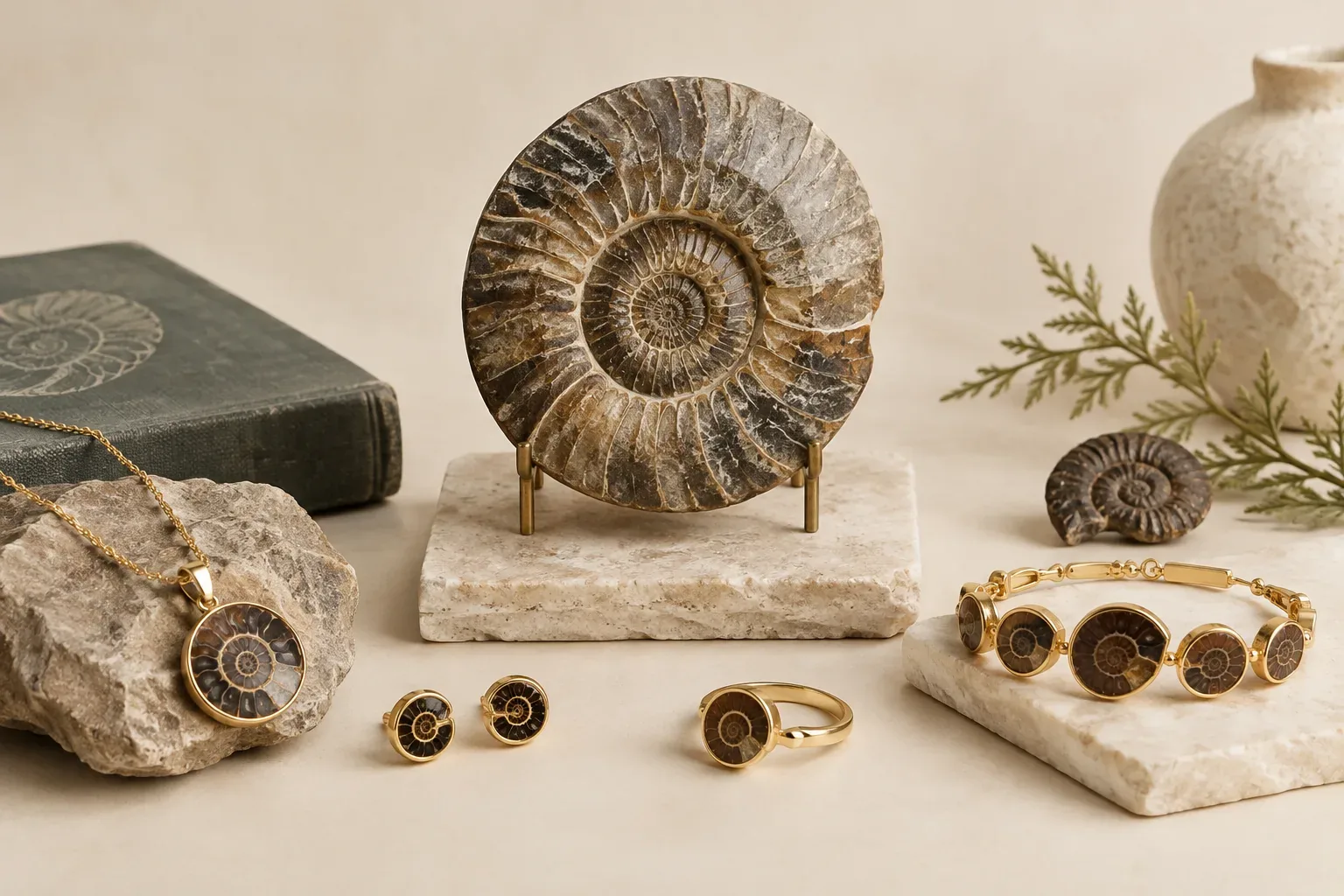
Meaning at a glance
Documented museum literature shows that goniatite and other fossil motifs entered decorative use as part of broader natural-history and collecting trends rather than as longstanding religious symbols; modern meanings are largely personal or revivalist. Buyers should verify identification and provenance, ask about treatments and imitations, and choose designs and gifts that respect the wearer and source communities.
Direct answer — the concise thesis
The documented record places goniatite motifs within the longer history of jewellery that borrows from natural forms, especially during periods when collecting and natural history were fashionable; there is little museum-documented evidence tying a distinct, ancient sacred meaning to goniatites. Modern attributions of meaning are largely personal, revivalist, or tied to the aesthetic and narrative value of fossils rather than to a single historical cultural symbolism. For practical wear and gifting, verify identification and provenance, request clear disclosure of any treatments or imitations, and choose settings and messages that respect both the recipient and the object's origins.
What the museum record says about natural motifs in jewellery
Surveys of jewellery history emphasize that designers and wearers have repeatedly drawn on natural materials and motifs—flowers, shells, minerals, and fossil forms—then reinterpreted their meanings as social fashions and personal statements changed. The Victoria and Albert Museum frames jewellery as an evolving cultural practice in which objects shift social meaning across periods and contexts, from elite display to sentimental keepsakes.
Within that broad context, fossils and fossil-like forms appear in decorative arts as part of wider collecting interests, scientific curiosity, and aesthetic trends rather than as universally fixed religious symbols. The V&A's work on gems and jewellery highlights how materials gain new cultural roles when they are reworked for adornment, and it is through those changing contexts that a fossil motif such as the goniatite becomes meaningful to particular makers and owners.
Historical evidence and specific periods
The most concrete museum-documented links between fossils and jewellery come from the modern period, especially the 18th and 19th centuries, when natural history collecting became widespread among European elites and artisans adapted collected specimens and fossil forms into jewellery and decorative objects. The V&A's resources on jewellery history describe these shifts in social meaning and practice without asserting an ancient, pan-cultural sacred function for fossil motifs.
There is no robust, museum-documented record in the sources consulted that assigns a single, continuous sacred or ritual meaning for goniatite forms across ancient cultures. Instead, the available evidence in jewellery and gemstone scholarship points to episodic interest tied to collecting, scientific curiosity, sentimentalism, and later revivalist aesthetics—contexts that can be precisely located in time and place in museum catalogues and exhibitions.
Distinguishing documented historical meanings from modern interpretations
Documented historical meanings recorded by museums and jewellery historians are tied to social practices: for example, fossils in jewellery often signified a connection to natural history collections, intellectual curiosity, or fashionable taste during the 18th and 19th centuries. These are contextual, historically specific readings based on exhibition and catalogue material rather than claims of ancient spiritual function.
Modern interpretations of goniatite jewellery meaning—such as symbolizing longevity, deep time, protection, or personal resilience—are largely contemporary and individual rather than universally documented. Such meanings can be meaningful and legitimate for the wearer, but they should be presented as personal or revivalist interpretations rather than as established historical facts.
How the goniatite motif or specimen appears in jewellery
In practice, goniatite material and motifs appear in jewellery in several common ways: as polished fossil cabochons set into bezels, as cut or inlaid pieces in rings and pendants, as carved or relief motifs inspired by the fossil's spiral form, or as cast metal reproductions that echo the shape rather than using original fossil material. Museum literature on gemstones and materials describes how jewellery makers historically adapted diverse natural substances for decorative use and how artisans chose treatments and settings appropriate to each material's characteristics.
Designers may also use fossil imagery as a repeating pattern or stylized element rather than a literal fossil specimen. Whether working with an actual fossil fragment or a stylized motif, artisans adapt mounting styles—bezels, bezels with film of resin for fragile pieces, or secure prong settings—to protect and showcase the material, a practice reflected in the broader history of jewellery craftsmanship recorded by museums.
Identification, treatments, and consumer protections
When buying jewellery that claims to include goniatite or other fossil material, ask for clear identification and provenance. The Victoria and Albert Museum's guidance on gemstones and jewellery underscores the importance of accurate identification to understand an object's cultural and material history. Museums and reputable dealers commonly provide labelling or certificates that describe materials, treatments, and workmanship.
Federal consumer guidance emphasizes that sellers should disclose material treatments, stabilizing processes, or imitations. The Federal Trade Commission advises consumers to request information about whether the material has been enhanced, dyed, stabilized, or reproduced. This is particularly relevant for fossils, which can be fragile and are sometimes stabilized or set into resins to make them wearable; disclosure helps buyers assess value and care requirements.
Practical and respectful selection or gifting guidance
Choose reputable sources. Buy from dealers, galleries, or makers who provide clear material descriptions and provenance, or who can show museum-standard documentation when available. For significant pieces, ask whether the seller provides a written description, a photograph of the raw specimen, or laboratory identification if relevant.
Consider the object's condition and setting. Fossil material can be brittle; select settings that protect edges and thin areas and ask whether the piece has been stabilized. For wearable pieces intended for daily wear, prefer robust mountings and consider the recipient's lifestyle.
Respect cultural and legal considerations. If the fossil comes from protected sites or was collected without appropriate permissions, it may carry ethical or legal complications. When in doubt, ask about collection locality and the chain of custody. Choose ethically sourced or museum-deaccessioned pieces where possible to avoid supporting illegal collecting.
Frame the gift with context. If you give goniatite jewellery as a present, include a note that explains what a goniatite is, whether the piece is a real fossil or a motif inspired by one, and any conservation needs. This respects the recipient and acknowledges the object's natural and cultural history rather than relying solely on modern symbolic claims.
Avoid asserting universal spiritual claims. Because museum evidence links fossil motifs primarily to aesthetic and collecting traditions rather than to a single ancient sacred meaning, present any spiritual or symbolic interpretation as personal or contemporary rather than historic fact.
Care and long-term stewardship
Follow care advice appropriate to the material. Fragile fossil pieces may need gentle cleaning, avoidance of ultrasonic cleaners, and protective settings to prevent chipping. Reputable dealers or conservators can provide specific care recommendations based on whether the piece has been stabilized or combined with other materials.
Think about conservation and heirs. For pieces with historical interest or significant provenance, consider documentation—photographs, receipts, a written description of provenance—and, if needed, professional assessment to ensure the piece is preserved for future appreciation.
Concluding guidance
In short: the museum record situates goniatite motifs within changing jewellery fashions and the modern interest in natural-history objects rather than as the bearer of a single ancient sacred meaning. Modern wearers and givers can legitimately attribute personal meaning to such pieces, but responsible selection and gifting require clear identification, disclosure of treatments, attention to ethical sourcing, and thoughtful framing of any symbolic claims.
For further reading on the wider history of jewellery and the practice of choosing meaningful pieces, explore the museum-curated histories and consumer guidance that inform how materials move from natural specimens to wearable objects.
Frequently asked questions
Does goniatite jewellery have a single historical meaning?
No. Museum-based studies of jewellery show that fossil motifs like goniatite are linked to changing fashions, collecting, and natural-history interests rather than to a single continuous sacred or cultural meaning. Modern attributions are typically personal or revivalist.
How can I tell if a piece contains a real goniatite fossil?
Ask the seller for clear identification and provenance. Reputable dealers or makers will describe whether the piece contains an authentic fossil, a stabilized specimen, a fossil fragment set into resin, or a stylized reproduction. Museums and professional sellers often provide documentation or labelling.
Are fossil pieces ever treated or imitated?
Yes. Fossils can be stabilized, repaired, mounted in resins, or reproduced in cast metal or composite materials. U.S. consumer guidance recommends that sellers disclose treatments and imitations so buyers can assess value and care needs.
Is it appropriate to wear goniatite jewellery every day?
It depends on the piece. Authentic fossil material may be brittle and better suited to occasional wear unless it has been purposefully stabilized and securely set. Consider the mount and the recipient's activities when deciding on everyday wear.
What should I ask before gifting goniatite jewellery?
Request clear material identification, provenance, and care instructions. Consider the recipient's taste and the piece's durability, and include a note explaining whether the object is an authentic fossil or a motif inspired by one to provide context and respect the object's history.
Where can I learn more about the history of natural-material jewellery?
Museum resources and curated histories of jewellery provide reliable context on how natural materials have been used and interpreted. The Victoria and Albert Museum's work on jewellery history and gemstones is a useful starting point.
Sources and further reading
- Bedazzled: A History of Jewellery — Victoria and Albert Museum
- An A-Z of Gemstones — Victoria and Albert Museum
- Buying Gemstones, Diamonds, and Pearls — Federal Trade Commission