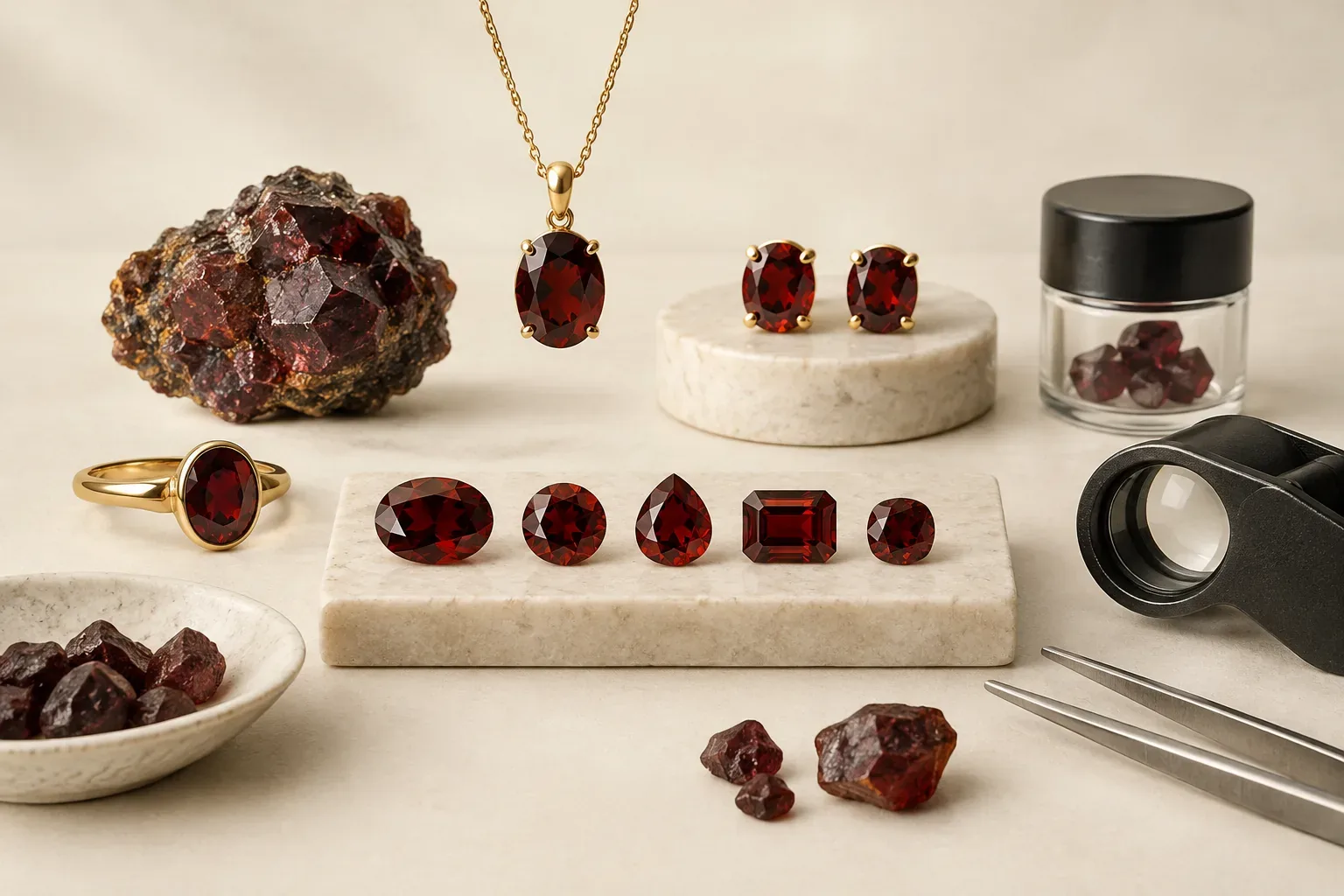
Meaning at a glance
This guide explains how to define and distinguish natural, lab-created, treated and imitation garnets, offers decision criteria and trade-offs for shoppers and gifters, gives safe care guidance tied to treatment concerns, and sets clear limits on what can be verified without a qualified jeweler or gemological laboratory.
Quick answer
A useful garnet authenticity guide gives clear definitions of natural, lab-created, treated and imitation materials; practical checks you can make at the point of sale; the paperwork and seller disclosures to insist on; sensible trade-offs between price and certainty; safe care based on known treatments; and the things only a qualified jeweler or a gemological laboratory can confirm. Follow documented disclosure rules and use independent testing when origin or hidden treatments matter to you.
What this guide covers and why it matters
Shoppers and gifters search for a garnet authenticity guide when they want to know whether a stone is genuinely a natural garnet, a laboratory-grown equivalent, been altered by treatment, or is a simulant made of glass or another material. This article focuses on decision-quality information: how the categories differ, what you can verify yourself, what paperwork to request, and the practical trade-offs in price, durability and appearance.
The advice below is guided by consumer-protection and gemological principles. The Federal Trade Commission emphasizes clear distinctions among natural, lab-created, treated, cultured and imitation materials and the importance of written seller disclosures. The Gemological Institute of America outlines how treatments affect detectability, durability and care, which directly shapes what shoppers should ask and expect.
Definitions: natural, lab-created, treated and imitation
Natural garnet: a gemstone formed by geological processes and mined from the earth. Sellers should disclose that a stone is natural and provide any available provenance or lab reports. A reputable seller will not sell a natural stone without clear disclosure and will be willing to show supporting documentation when the buyer requests it.
Lab-created garnet: a gemstone produced in a controlled environment with the same chemical composition and crystal structure as the natural mineral. Lab-created gems can be visually and physically similar to natural stones, but their origin is man-made. Because origin affects price for many buyers, the origin must be disclosed and documented when requested.
Treated garnet: a natural or lab-created stone that has undergone intentional alterations to improve its appearance, stability or color. Treatments can be subtle and not always apparent to the naked eye; the Gemological Institute of America warns that treatments, detectability and special care are common consumer concerns and should be disclosed.
Imitation or simulant: material that looks like garnet but does not share garnet's chemical or crystallographic identity. Simulants might be glass, synthetic spinel or other cheaper materials. Imitations can be attractive but should be sold as such, not misrepresented as true garnet.
Historical evidence and cultural usage (documented vs modern interpretation)
Documented evidence of garnet in jewellery markets and designs is best followed through trade and period reporting rather than folklore in this guide. Modern trade publications note that garnet continues to appear in fashion and birthstone-driven jewellery categories; for example, Professional Jeweller and the PRYA Jewellery Search Insights report a growth in birthstone necklaces as a contemporary jewellery trend, which connects to garnet's ongoing retail presence in those categories.
Separate from documented retail trends, many personal and cultural interpretations have developed around garnet—symbols of love, courage, or protection. Those meanings are modern personal or cultural attributions and are not interchangeable with documented trade history. Distinguish between period-specific or trade-documented uses (for example, garnet appearing in particular styles or as a birthstone in modern jewellery assortments) and individual or cultural symbolism that varies by community and wearer.
How garnet appears in jewellery and what that tells you about authenticity
In the marketplace garnet commonly appears as faceted stones in rings and earrings and as small, polished beads or clusters in necklaces and bracelets. Trade reports highlight a renewed interest in sculptural and cluster arrangements and in birthstone pieces, which often use smaller faceted or cabochon garnets. These settings can make identification harder because many small stones are mounted tightly and cannot be removed for close inspection.
Large single-stone settings, transparent faceted stones and pieces sold with lab reports or certificates give the buyer more leverage to request verification. When stones are set in complex clusters or combined with other materials, sellers should provide written disclosure about whether the stones are natural, treated or simulants.
Practical inspection and buyer-side checks
Start with clear seller disclosure and paperwork. The Federal Trade Commission advises consumers to insist on clear distinctions and written disclosures when buying gemstones. If a seller refuses to confirm whether a stone is natural, lab-created, treated or imitation in writing, treat that as a warning sign.
Do a visual inspection: look for overly uniform color in multiple stones of the same lot, which can suggest lab creation or simulant material. Look for bubbles or waviness under magnification, which often indicate glass. Natural garnets commonly show inclusions and small, irregular growth features; perfectly clean stones at very low prices should prompt questions. However, no visual check alone is definitive: the Gemological Institute of America emphasizes that some treatments and origins are only detectable with proper instruments.
Ask to see any existing gemological reports and understand the lab that issued them. If the stone is accompanied by a reputable laboratory report that states whether the material is natural, treated, or lab-grown, that reduces uncertainty significantly. If you need to know origin or whether certain heat or clarity treatments were applied, plan to obtain testing from a qualified gemological laboratory.
What only a qualified jeweler or gem lab can confirm
Certain issues cannot be reliably resolved at the point of sale. Detecting subtle heat treatments, diffusion, dyeing, or identifying the geological origin of a stone typically requires advanced spectroscopy, microscopy and specialist expertise. The Gemological Institute of America notes that detectability varies by treatment and that laboratories are the appropriate route for conclusive results.
If you require definitive proof of natural origin, treatment history or country of origin for insurance, resale value, or personal reasons, obtain a report from a recognized gemological laboratory. A trained gemologist can also advise you whether the stone’s setting or size will allow non-destructive testing or whether removal is necessary for assessment.
Trade-offs when choosing natural, lab-grown, treated or imitation garnets
Price versus certainty: natural, untreated garnets with verifiable documentation command higher prices. Lab-created stones offer control over color and clarity at lower cost but change the resale and sentimental value for some buyers. Imitations deliver fashion looks at budget prices but are not the same material and should be priced and disclosed accordingly.
Durability and care: some treatments can affect how a stone should be cleaned or worn. Because the Gemological Institute of America emphasizes that treatments influence detectability and care, always confirm whether a stone has been treated and follow care guidance from a qualified source. For everyday wear, choose settings and materials that protect the stone from knocks and chemicals regardless of its origin.
Selection and gifting guidance — practical and respectful
Decide what matters most to the recipient: natural origin, budget, optical perfection, or ethical sourcing. If origin or natural status matters, ask for written confirmation and, if appropriate for the price, a recent laboratory report. If you are buying a birthstone or sentimental piece where appearance and cost are the priority, a high-quality lab-created or well-disclosed treated stone can be an excellent choice.
Always ask the seller for clear, written disclosures and any supporting documentation before purchase. If you buy as a gift and the recipient may later want independent verification, retain the sales receipt and any certificates and mention the availability of lab testing in case they request it. Respect the recipient’s preferences: some people prefer natural stones for symbolic reasons, others appreciate the sustainability and uniformity of lab-created gems.
Care and maintenance
Follow the seller’s care instructions and verify whether the stone has had treatments that change cleaning recommendations; the Gemological Institute of America highlights that treatments affect durability and care. When in doubt, gentle cleaning with warm water, mild soap and a soft brush is a safe baseline. Avoid harsh chemicals, prolonged heat and aggressive ultrasonic or steam cleaners unless the seller or lab report explicitly states they are safe.
For set jewellery, periodic checks by a jeweler will protect settings and reveal any damage. Store garnet pieces separately from harder stones that could scratch them.
Final checklist before buying
Insist on written disclosure of whether the stone is natural, lab-created, treated or a simulant. Request and review any gemological reports. Assess the seller’s reputation and return policy. If the purchase price is substantial or if origin or treatment materially affects your decision, budget for an independent lab report. Remember that consumer-protection guidance from the Federal Trade Commission supports asking for and receiving clear written information about gemstones.
Frequently asked questions
Can I tell if a garnet is natural just by looking?
You can make preliminary judgments by looking for natural inclusions, color variations and signs of bubbles that indicate glass, but visual inspection alone is not definitive. For conclusive identification—especially to detect subtle treatments or origin—you need a qualified jeweler or a gemological laboratory report.
What paperwork should I ask for when buying a garnet?
Ask for written disclosure stating whether the stone is natural, lab-created, treated or a simulant. For higher-value purchases, request a gemological report from a recognized laboratory. Keep the sales receipt and any certificates in case you need independent verification later.
Are lab-created garnets less valuable?
Lab-created garnets typically cost less than comparable natural, untreated stones. Some buyers prefer natural stones for sentimental or investment reasons, while others choose lab-created stones for consistency of color, lower price and ethical considerations. Value depends on buyer priorities.
Do treatments make a garnet less durable?
Some treatments can affect how a stone should be cared for. The Gemological Institute of America advises that treatments influence detectability and special care, so always confirm any treatment and follow recommended cleaning and handling instructions.
Is an independent lab report necessary for a gift?
Not always. For modest purchases where appearance is the priority, clear seller disclosure and a good return policy may be sufficient. For expensive pieces, antiques, or when origin/treatment affects sentimental or resale value, an independent lab report provides certainty.
What are red flags when buying garnet online?
Red flags include vague or missing written disclosure about origin and treatments, prices that seem too good to be true for the described stone, sellers who refuse to provide photos or certificates, and unclear return policies. The Federal Trade Commission recommends insisting on clear distinctions and written disclosures.
How should I clean garnet jewellery?
When you do not have treatment information, use a conservative approach: warm water, mild soap and a soft brush, followed by gentle drying. Avoid harsh chemicals, and do not use ultrasonic or steam cleaners unless the seller or a lab report confirms they are safe for that specific stone and setting.
Can a jeweler test a garnet in-store?
Experienced jewelers can perform useful non-destructive tests and may identify many simulants and obvious treatments, but some analyses—such as spectroscopy to detect subtle treatments or to determine origin—require a gemological laboratory with specialized equipment.
Sources and further reading
- Imaginaire Digital — Imaginaire Digital
- Professional Jeweller / PRYA Jewellery Search Insights — Professional Jeweller / PRYA Jewellery Search Insights
- Gemological Institute of America — Gemological Institute of America
- Federal Trade Commission — Federal Trade Commission