Meaning at a glance
Fossil coral jewelry meaning is best understood by separating the limited documentary evidence from later tastes and personal symbolism: museum records show fossil and organic materials were used in particular historical contexts, modern makers and wearers add personal and spiritual interpretations, and buyers should seek clear disclosure about authenticity and treatments while respecting cultural contexts.
Quick answer
Fossil coral jewelry meaning should be read on two levels: the documented history of using fossil and organic materials in certain historical fashions, and the wide range of modern personal and spiritual interpretations that owners or makers now ascribe to those pieces. The authoritative museum record shows changing social contexts for natural-history materials in jewelry, while contemporary meanings are largely contemporary attributions rather than universal or ancient symbols (Victoria and Albert Museum).
What fossil coral is and how it fits into the gemstone tradition
In jewelry contexts, “fossil coral” refers to coral that has undergone mineral replacement or other processes that make it stable enough to be cut and polished for ornament. Within the broader history of gemcutting and jewellery making, coral and other organic or fossilized materials have been treated as gemstones when they can be shaped and set like hard stones.
Museums that interpret gemstones place organic and fossil materials in the same historical conversations as other gems: they identify how materials are recognized, worked, and worn across periods and styles rather than treating every material as carrying the same symbolic weight (Victoria and Albert Museum, An A–Z of Gemstones). That context helps explain why fossil coral appears occasionally in cabinet- and jewellery-making traditions rather than as a single, continuous symbolic motif.
Historical evidence and specific periods or cultures
The documentary record for fossil coral as a distinctive symbolic motif is limited and uneven. Curatorial work and exhibitions on the history of jewellery show that Western tastes for “natural history” objects and unusual organic materials were particularly visible in specific periods, notably in nineteenth-century Britain, when collectors and makers incorporated fossils and curiosities into decorative objects and jewellery (Victoria and Albert Museum, Bedazzled: A History of Jewellery).
Beyond those documented fashions, the surviving museum record emphasizes use and context rather than a single symbolic meaning attached to fossil coral. That is, curators record that makers used fossilized organic materials in certain styles or techniques and that tastes shifted across time; they do not present fossil coral as a single cross-cultural religious or symbolic emblem. For other cultures and periods, evidence for use of coral and fossil materials must be cited on a case-by-case basis from archaeological and museum sources rather than assumed.
Documented historic meanings versus modern personal and commercial interpretations
Where we have documentary evidence, museums tend to link the use of natural-history specimens in jewellery to fashions, collecting practices, scientific interest, commemoration, or sentimental display rather than to uniform mythic meaning. For example, nineteenth-century jewellery often reflected Victorian interests in collecting, taxonomy, and wonder at natural forms; curators at the Victoria and Albert Museum present these changing social contexts as the key to meaning rather than a fixed symbolism.
By contrast, many of the meanings associated with fossil coral today — ideas about grounding, ancestral connection, healing, or specific spiritual properties — are modern personal or commercial interpretations. These contemporary attributions can be meaningful to an individual wearer, but they should not be conflated with documented historical beliefs unless a specific cultural source is cited. If you want to use fossil coral for symbolic reasons, treat those meanings as personal or community-based choices rather than as universally historical facts.
How the fossil coral motif and material appear in jewellery
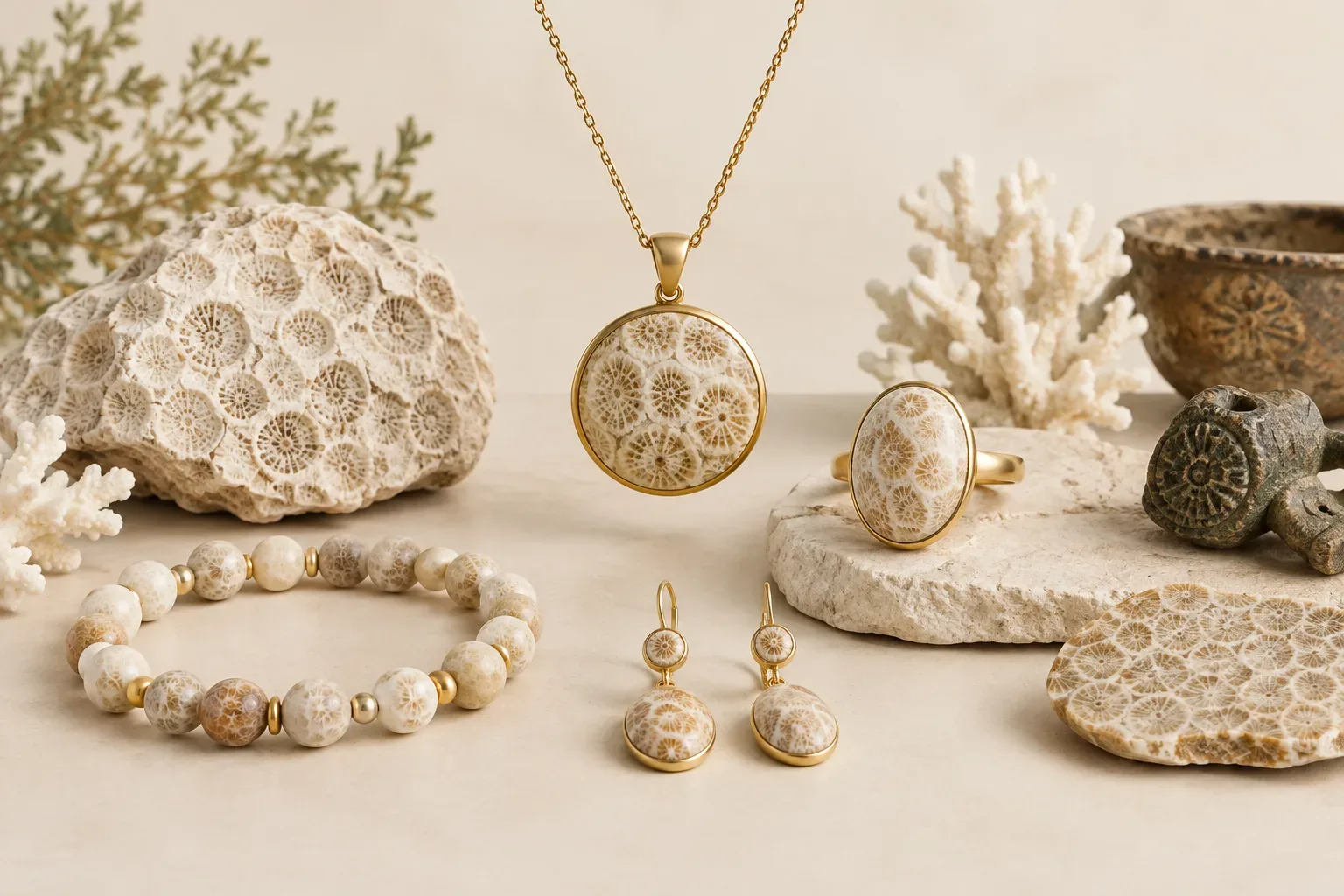
Fossil coral is most commonly encountered in jewellery as polished cabochons, beads, inlays, or small carved elements where the distinctive patterns or colors of the material are visible. Makers exploit the natural patterning and texture of the fossil to create focal pieces, pendants, or accent stones in rings and brooches.
Curatorial resources that explain gemstones stress that materials are chosen and fashioned to suit their physical properties, and that treatment and cutting decisions reflect both aesthetics and the material’s stability (Victoria and Albert Museum, An A–Z of Gemstones). That means fossil coral pieces in museum collections and contemporary markets will vary in finish, setting style, and overall design according to the period and maker’s intentions.
Practical and respectful selection and gifting guidance
Be clear about what you or the recipient value the piece for: its look, its natural history, an assigned personal meaning, or a combination. That clarity helps you choose the right form and price range and to communicate respect for any cultural associations the design may have.
Ask sellers for explicit information about authenticity, treatments, stabilization, and, if possible, provenance. U.S. consumer guidance from the Federal Trade Commission stresses the importance of material-treatment and imitation disclosure when buying gemstones and similar materials; sellers should disclose whether an item is dyed, stabilized, composite, or an outright imitation (Federal Trade Commission, Buying Gemstones, Diamonds, and Pearls).
Buy from dealers or makers who can document their claims and who are transparent about treatments and origin, or who offer a return policy and written statements. If the piece claims a specific historic or cultural meaning, ask for the documentary source. If the recipient has a cultural or religious background that could be affected by certain motifs, check sensitively with them before gifting, or choose a neutral design.
If you are buying as a collector, consider conservation needs and whether the piece is better suited to occasional wear or to display. If you are buying to wear, choose a setting that protects the fossil material from knocks and chemical exposure and that suits the intended frequency of wear.
Care, conservation, and ethical considerations
Treat fossil coral like other organic or stabilized materials: avoid exposure to strong chemicals, prolonged sunlight, and extremes of heat that can affect polish or adhesives. Have valuable pieces checked periodically by a qualified jewellery conservator or trusted jeweller.
Think about the wider ethics of sourcing. Fossil materials are not all equal: modern sellers use a range of descriptions (fossil coral, agatized coral, or simply ‘coral’), and some items may be dyed, consolidated with resins, or sold as composites. Because of the variety of treatments and imitations, clear disclosure is important for an ethical purchase and for accurate personal or cultural interpretation (Federal Trade Commission).
Frequently asked questions
What does fossil coral jewelry mean historically?
Historically, the documentary record does not support a single, universal symbolic meaning for fossil coral. Museum research shows fossil and other natural-history materials were used in particular fashions and contexts—especially during periods that prized natural curiosities—but curators emphasize changing social context rather than one fixed symbolic meaning (Victoria and Albert Museum).
Are modern spiritual or healing claims about fossil coral historically documented?
Most spiritual or healing claims associated with fossil coral are modern interpretations or personal attributions. They are meaningful for individuals or communities who adopt them, but they should not be conflated with historically documented beliefs unless a specific cultural source is cited.
How can I be sure a piece labelled ‘fossil coral’ is genuine?
Ask the seller for written disclosure about treatments, stabilization, or dyeing and for any provenance information. U.S. consumer guidance from the Federal Trade Commission recommends that sellers disclose material treatments and imitations when selling gemstones or similar materials (Federal Trade Commission). Buy from reputable dealers who provide documentation or a clear return policy.
Is fossil coral ethical to buy and wear?
Ethical considerations depend on source, treatment, and cultural context. Prefer sellers who are transparent about origin and processing. If a design draws on living cultural or religious traditions, research respectfully or ask the intended recipient about their preferences before gifting.
How should I care for fossil coral jewellery?
Treat fossil coral like other organic or stabilized gem materials: avoid harsh chemicals, prolonged heat, and rough knocks. Store pieces separately to avoid abrasion and have valuable items checked by a qualified jeweller or conservator as needed.
Sources and further reading
- Bedazzled: A History of Jewellery — Victoria and Albert Museum
- An A-Z of Gemstones — Victoria and Albert Museum
- Buying Gemstones, Diamonds, and Pearls — Federal Trade Commission