Meaning at a glance
This fossil coral jewelry buying guide explains what museum scholarship documents about gems and changing social meanings, separates documented historical evidence from contemporary personal interpretations, describes how the material is used in jewelry, and gives practical tips for verifying authenticity, checking for treatments, and caring for and gifting fossil coral pieces.
What museums document about gemstones and changing jewelry contexts
The Victoria and Albert Museum (V&A) presents the study of jewelry as a history of changing materials, techniques, and social meanings across distinct cultures and periods. The V&A's materials indicate that gemstones and ornamental materials appear in documented sources for Ancient Egypt, Classical Greece and Rome, medieval and Renaissance Europe, and into the 18th–19th century Victorian period, with each era and culture assigning different uses, values, and techniques to ornament (Victoria and Albert Museum).
That broader museum evidence is important context: it shows that the presence of a stone or motif in jewelry does not by itself prove a single symbolic meaning, because meanings and the social role of jewelry shifted across these identifiable cultures and periods (Victoria and Albert Museum). For fossil coral specifically, the archaeological and curatorial record is less universally documented than for materials such as gold or lapis; museums treat fossil and organic materials case by case within that larger history of gemstone use (Victoria and Albert Museum).
Documented historical meanings versus modern interpretations
Documented historical meanings derive from archaeological finds, curatorial catalogs, and period sources. The V&A emphasizes that in different cultures gemstones and ornaments served functions ranging from status display and religious use to personal adornment and commemoration, and that those functions changed over time. When a specific historical meaning for fossil coral is not clearly recorded in museum catalogs, it is best to treat later claims of ancient ritual or universal symbolism with caution (Victoria and Albert Museum).
Modern personal interpretations of fossil coral jewelry are diverse and subjective. Contemporary wearers may value fossil coral for its fossil patterns, its earthly origins, or as a way to evoke nature and deep time. These are valid personal meanings, but they are not equivalent to documented religious or cultural uses unless linked to primary historical evidence. Distinguishing documented history from personal belief helps buyers and gifters avoid asserting universal or ancient meanings where none are proven.
How the fossil coral motif and material appear in jewelry
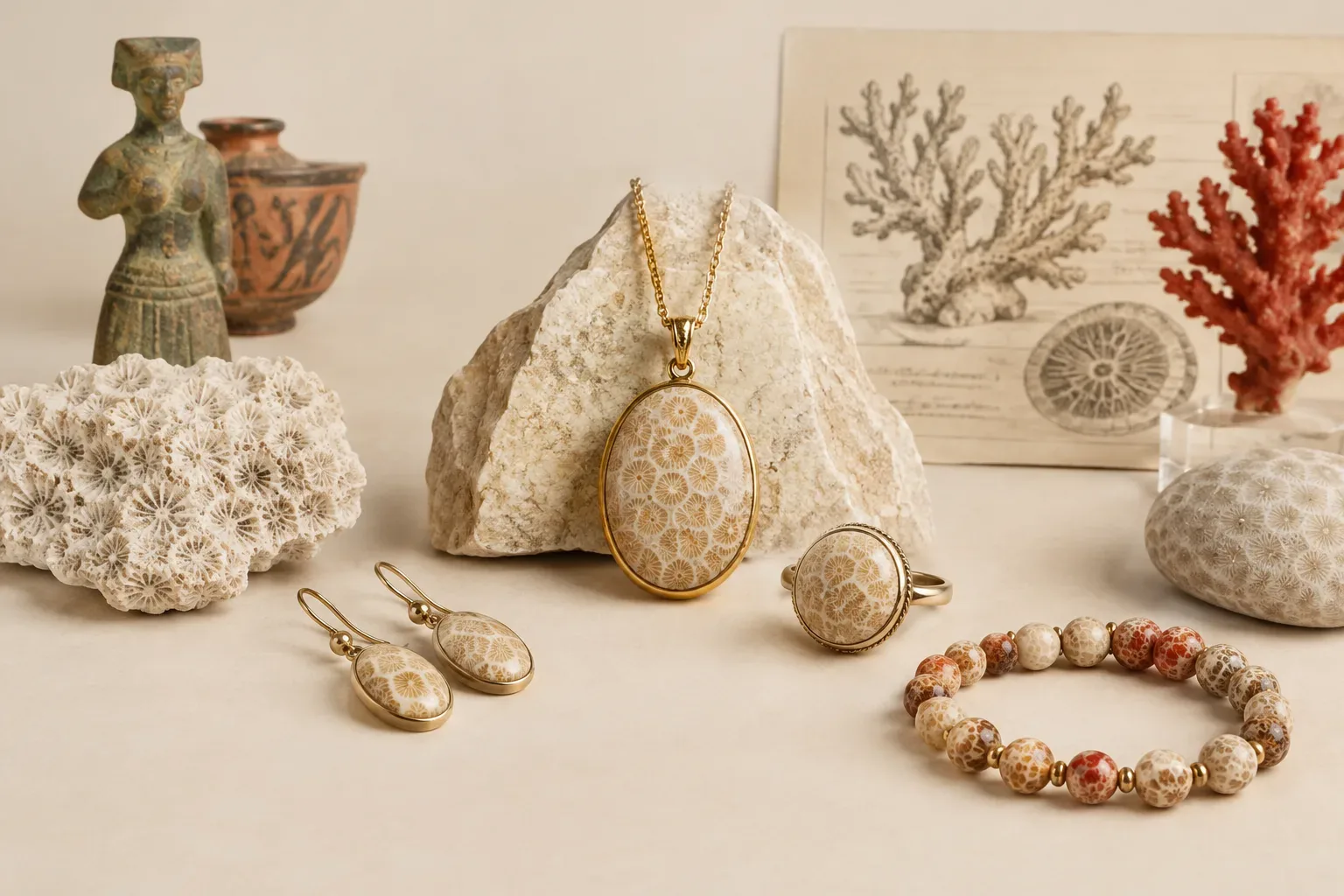
Within museum and trade descriptions of gemstones, organic and fossil materials are treated alongside minerals as decorative materials with specific handling and mounting needs (Victoria and Albert Museum). In contemporary jewelry, fossil coral commonly appears as polished decorative stones set into rings, pendants, beads, and inlays. Designers may emphasize the radial or floral-looking patterns that emerge from the coral's fossilized structure, treating them as a motif rather than a symbolic code tied to a single culture.
Because fossil coral is an organic-derived material (fossilized skeletal remains of ancient corals), jewelers often stabilize, cut, and polish it to meet wearability standards. The result is a range of finishes and settings that aim to show pattern and color while protecting the material from impact, chemicals, and abrasion. Museums and gemstone guides note that cut, polish, and the setting style all affect how a gem is perceived and preserved (Victoria and Albert Museum).
Authenticity, treatments, and consumer protections
The Federal Trade Commission (FTC) advises consumers buying gemstones to ask directly about treatments and any alterations that affect appearance or durability. The FTC expects sellers to disclose significant treatments such as dyeing, bleaching, stabilization, reconstitution, or other processes that change the material from its natural state (Federal Trade Commission).
For fossil coral specifically, a buyer should ask whether the material has been stabilized with resins, dyed to alter color, reconstituted from fragments, or combined with other materials. Request written disclosure and, when available and important to your purchase, a gemological report or lab identification. Written documentation helps protect you if a later dispute arises and is consistent with consumer-protection guidance from the FTC (Federal Trade Commission).
Practical buying and selection guidance
Decide what matters to you: natural, untreated fossil coral; stabilized but uncolored material; or a fashion piece where treatment and low price are acceptable. If you want an untreated specimen, state that up front and ask for a written guarantee. If you accept stabilization, ask what product was used and whether the treatment requires special care.
Look at pattern and integrity as you would with other patterned gemstones: prefer pieces with a clear, undamaged surface and setting that protects edges. Ask the seller to show the piece under magnification so you can see whether the pattern is natural and continuous or whether there are signs of reconstitution or dye concentration. Request clear images and provenance information for older or high-value pieces.
When buying online, choose reputable dealers with clear return policies, documented treatment disclosures, and positive reviews. The FTC recommends written disclosures for material treatments and encourages buyers to keep sales receipts and any lab reports. For high-value purchases, consider an independent appraisal or lab identification before finalizing the purchase.
Care and maintenance
Museums and gem guides emphasize that different gemstones require different care; organic and fossil materials often need gentler handling than hard silicate gems (Victoria and Albert Museum). Treat fossil coral as a relatively delicate material: avoid exposure to household chemicals, prolonged sunlight that could alter surface appearance, and hard knocks that can chip or fracture polished surfaces.
Clean fossil coral jewelry with a soft, damp cloth and mild soap if necessary, then dry thoroughly. Avoid ultrasonic cleaners, steam, and strong solvents unless you have explicit information from the maker that the item was stabilized in a way that tolerates such treatments. Store fossil coral pieces separately from harder gemstones and metals to prevent abrasion and scratches, and have prongs and settings checked periodically by a jeweler to prevent loss.
Respectful selection and gifting guidance
When selecting fossil coral jewelry as a gift, consider both the recipient’s aesthetic preferences and their cultural or ethical concerns. If the design or motif evokes cultural or religious symbols, research its origin and avoid presenting items as representing an ancient or sacred meaning unless you have reliable evidence. The V&A stresses the importance of historical context when assigning symbolic meanings to jewelry, so treat cultural attributions with care (Victoria and Albert Museum).
If you wish to convey natural history or environmental themes, be explicit in your gift message so the recipient understands that the meaning is personal or contemporary rather than a claim of ancient significance. For heirloom or investment purchases, document provenance and treatment status on the sale invoice and consider a third-party identification or appraisal.
Putting it together
A responsible approach to buying fossil coral jewelry blends respect for documented history, careful authentication, transparent treatment disclosure, and appropriate care. Use museum resources to understand how gem materials have been used and understood in different cultures and periods, and use FTC guidance to ensure sellers disclose necessary treatment information. When symbolism matters for gifting, be explicit about whether the meaning you intend is historical, personal, or aesthetic.
Frequently asked questions
How can I tell if a fossil coral piece is authentic?
Ask the seller for provenance, written disclosure of any treatments, and, when possible, a gemological identification. Inspect the pattern under magnification for continuity and natural variation rather than repeating or artificially regular designs. Keep receipts and written statements from the seller; the Federal Trade Commission recommends written disclosure of significant treatments for gemstones.
What treatments should I look for with fossil coral jewelry?
Common treatments to ask about include stabilization with resins, dyeing to alter color, and reconstitution from smaller fragments. The FTC expects sellers to disclose these kinds of treatments because they materially affect appearance and durability.
Is fossil coral considered a gemstone in museum or trade contexts?
Museums treat fossil and organic materials alongside other decorative stones when cataloging collections, and gem guides include organic-derived materials in discussions of ornament. The Victoria and Albert Museum’s resources on gemstones and jewelry history discuss how different materials have been used and categorized in different periods.
How should I clean and store fossil coral jewelry?
Clean gently with a soft, damp cloth and mild soap if necessary, avoiding strong solvents, ultrasonic cleaners, and steam unless you have confirmation that a treatment makes the piece safe for such methods. Store fossil coral separately from harder stones and metals to prevent abrasion, and have settings checked periodically by a jeweler.
Can I rely on symbolic claims about fossil coral being 'ancient' or 'sacred'?
Not automatically. The V&A emphasizes that jewelry meanings change across cultures and periods, so specific claims of ancient ritual or universal sacred significance should be supported by primary historical evidence or museum documentation. Otherwise these claims should be treated as modern interpretations or marketing language.
Should I get an appraisal or lab report for a fossil coral purchase?
If the piece is high value or intended as an investment or heirloom, consider obtaining an independent appraisal or lab identification and request written treatment disclosures from the seller. The FTC recommends written disclosures and documentation when treatments affect value or durability.
Sources and further reading
- Bedazzled: A History of Jewellery — Victoria and Albert Museum
- An A-Z of Gemstones — Victoria and Albert Museum
- Buying Gemstones, Diamonds, and Pearls — Federal Trade Commission