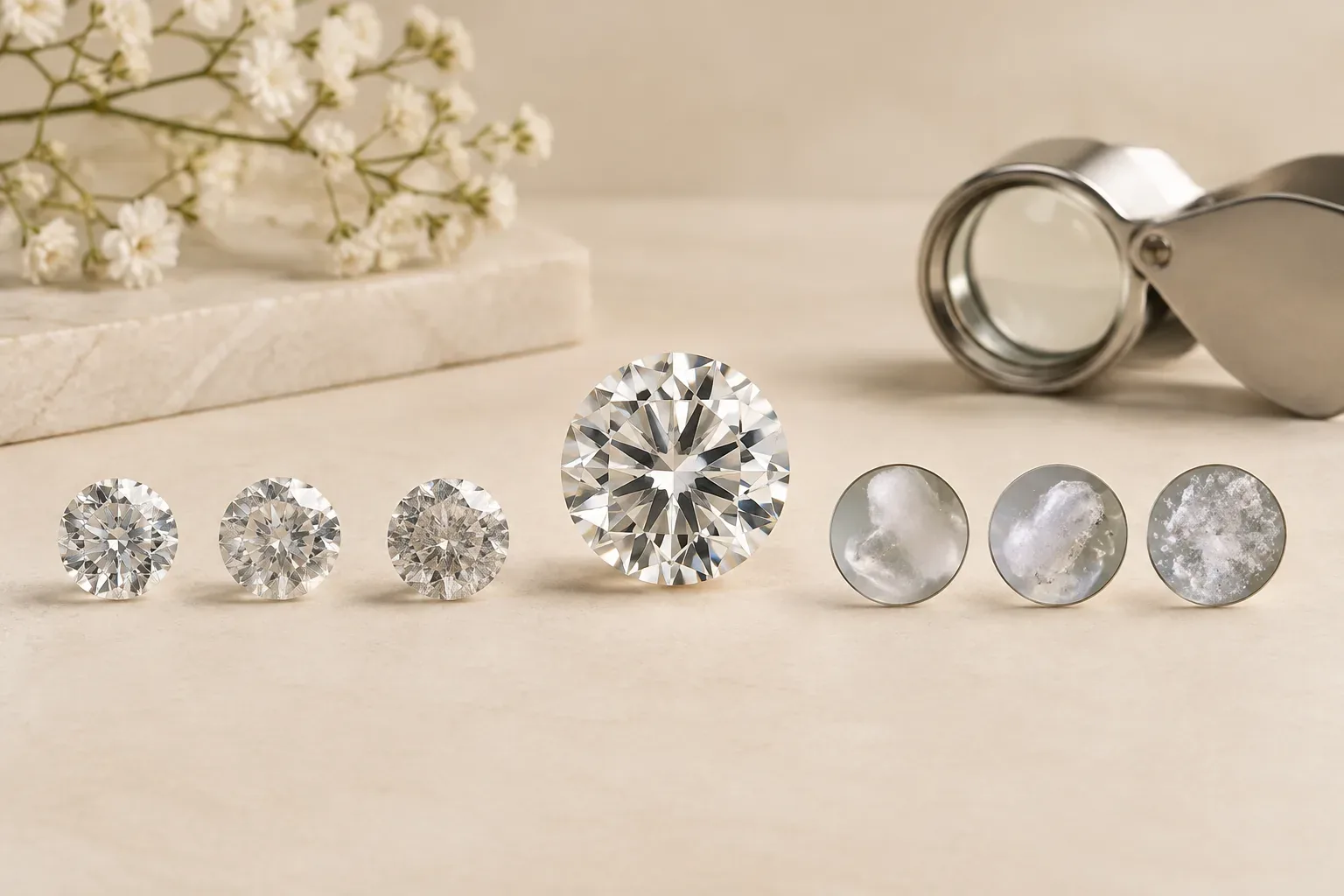
Meaning at a glance
Cloud inclusions are clusters of very small internal features that create haziness; they affect a diamond’s apparent clarity and light performance based on size, location, concentration and the stone’s cut, and they can lower price without necessarily compromising beauty. This guide gives definitions, decision criteria, expected trade-offs, safe care tips, and clear limits on what only a qualified jeweler or gemological laboratory can verify, following disclosure and treatment guidance from the Gemological Institute of America and the Federal Trade Commission.
What gemologists mean by a 'cloud' inclusion
In gemological practice, a 'cloud' refers to a group or cluster of very small inclusions whose combined effect is a localized haziness rather than a single visible crystal or feather. Professional gemologists describe and grade such features in clarity reports because their aggregate scattering of light affects transparency and apparent brilliance.
A trained grader or laboratory report will note cloud inclusions in a clarity description and, when relevant, show their position on an inclusion map. For consumers, the practical takeaway is that clouds often appear as soft, diffuse areas rather than sharp points, and the visual impact depends on factors a report can show: size, location and whether the cloud reaches the table or crown.
How cloud inclusions change a diamond’s appearance
Clouds can subtly or noticeably reduce a diamond’s apparent sparkle. If a cloud is small or near the girdle, it may be hard to detect face-up and have little effect on perceived beauty. If it is large, concentrated and near the table or center of the stone, it can create a milky or hazy patch that softens contrast and reduces scintillation.
The cut of the diamond strongly mediates these effects. A well-cut stone can direct light so that certain inclusions are less visible face-up, while a shallow or poor cut might make internal haziness more conspicuous. Carat weight and color also influence perception: larger stones make clouds easier to spot to the naked eye, and warmer or lower-color diamonds can make inclusions stand out differently than in near-colorless stones.
How cloud inclusions affect price and value
Clouds are a clarity factor; the more prominent they are, the lower the clarity grade and, typically, the lower the price compared with a comparable stone without them. The exact price impact depends on where the stone falls within clarity grade thresholds that buyers or labs use, the stone’s other 4Cs, and market demand for similar sizes and shapes.
Practical comparison strategies include viewing calibrated photographs or videos that show the inclusion face-up at standardized magnifications, comparing stones with similar carat and cut but different clarity grades, and asking for a written clarity description from a reputable laboratory or a qualified independent appraiser. The Federal Trade Commission requires accurate disclosure of a gemstone’s nature and treatments, so price comparisons should always be made alongside written information from the seller.
Treatments, detectability and documentation
Some clarity issues can be the result of treatments or enhancements. The Gemological Institute of America notes that treatments, disclosure and detectability affect consumer questions and decisions about gemstones, and that certain treatments require special care or can be detectable only with laboratory testing. Because treatment status changes value and care needs, always ask the seller whether the diamond has been treated and request documentary evidence.
A gemological laboratory report or grading document is the most reliable evidence a shopper can obtain before purchase. Sellers should disclose whether a diamond is natural, lab-grown, treated, or imitation, as emphasized by the Federal Trade Commission. For many consumers, the combination of clear images, a reputable lab report and transparent seller disclosure is sufficient for confident selection without private laboratory testing.
Documented historical meanings vs modern personal interpretations
The available specialist sources used for this article focus on physical characteristics, treatment and disclosure rather than historical symbolism attached specifically to cloud inclusions. Gemological literature typically documents optical and structural properties, not culturally specific symbolic meanings for internal features.
Modern symbolic interpretations—such as seeing a cloud as 'softness', 'uniqueness' or 'natural character'—are personal or marketing-driven and should not be presented as universal or historically documented. If symbolism matters to the wearer, treat cloud inclusions as a contemporary, individual meaning rather than a provenance-backed cultural tradition.
How cloud motifs and inclusions appear in jewellery design
Designers sometimes embrace inclusions visually, using settings and complementary elements to highlight a diamond’s character instead of hiding it. A halo or a textured metal surround can divert the eye from a central hazy patch, while bezel settings or colored side stones can mask girdle-near clouds. Conversely, solitaires and minimalist settings put the diamond face-up and will make cloud inclusions more noticeable.
Retail images and in-person viewing are important because inclusion visibility changes with setting style, light, and viewing distance. If you are choosing a piece that intentionally features a diamond with cloud inclusions, ask the jeweler for finished-piece photos or to see the exact mounted stone under normal showroom lighting.
Selection and gifting guidance: practical and respectful advice
Start by deciding what matters most: face-up beauty, maximum size for budget, or a distinctive natural look. If face-up brilliance is the priority, choose stones where any cloud is small, off-center, or not visible without magnification. If budget is tighter, accept a lower clarity grade but insist on clear, standardized imagery and a transparent written description.
For gifts, be mindful of the recipient’s taste. Some people prefer flawless-looking stones and will be disappointed by visible haziness; others value natural character and savings. When the recipient’s preference is unknown, choose a quality that balances appearance and value, get a return policy or exchange option in writing, and secure any available grading reports so the recipient can keep the documentation.
Care, maintenance and long-term considerations
Diamond care depends on whether the stone has been treated and on the nature of any internal features. The Gemological Institute of America advises that treatments and durability concerns create distinct care questions; for example, some clarity enhancements may affect how a stone responds to ultrasonic cleaning or heat. Ask the seller or lab report about any treatments and follow any special care instructions provided.
Routine gentle cleaning with approved solutions and periodic inspection by a qualified jeweler will help detect any changes to the setting or unexpected damage. If a clarity enhancement has been performed, follow the specific care guidance supplied by the laboratory or the treating party to avoid altering the effect.
What a shopper can and cannot verify without a lab
You can verify basic visual appearance through standardized photos, videos, and in-person inspection. You can compare face-up beauty between stones, check the seller’s written disclosures, and request a grading report from a recognized laboratory. The Federal Trade Commission reinforces the importance of clear distinctions and written disclosures for consumers when buying gemstones, diamonds and pearls.
You cannot reliably determine treatment status, precise clarity grading boundaries, or origin questions without a qualified gemological laboratory or a certificated independent appraiser. If these technical verifications matter to your purchase, insist on a recent lab report from a recognized laboratory and, when in doubt, consult an independent professional before finalizing the transaction.
Frequently asked questions
How can I tell if a cloud inclusion will be visible face-up?
Ask the seller for calibrated face-up photographs or a video of the exact stone in standard lighting and, if available, the stone’s inclusion map from a reputable laboratory. Small or off-center clouds are often hard to see without magnification, while large or centrally placed clouds are more likely to be visible to the naked eye.
Do cloud inclusions make a diamond weaker or more likely to chip?
Clouds are clusters of tiny features and usually do not by themselves cause structural weakness. However, other inclusion types, such as large feathers or cleavage-oriented features, can raise durability concerns. If durability matters, request a professional assessment from a qualified jeweler or gemological laboratory.
Can a cloud inclusion be removed or treated?
Some clarity enhancements exist for certain types of inclusions, and the Gemological Institute of America notes that treatments, detectability and disclosure are important consumer questions. Any treatment should be disclosed, may affect care, and is best verified by a lab report or specialist inspection.
How much cheaper is a diamond with cloud inclusions?
Price differences vary widely depending on clarity grade, carat, cut, color and market demand. Comparing stones with otherwise similar specifications and checking certified price guides or independent appraisals helps you quantify the trade-off.
Is a lab report necessary when buying a diamond with clouds?
A lab report is highly recommended because it documents clarity characteristics, any reported treatments, and other key factors. The Federal Trade Commission emphasizes clear written disclosures for gemstone sales, and a lab report is the most reliable pre-purchase documentation.
What should I ask the seller before buying?
Request high-quality face-up images or video, a current lab report if available, written disclosure of any treatments, the return policy, and whether the stone is natural or lab-grown. If any technical issue is unclear, ask to consult an independent appraiser or gemologist before purchase.
Sources and further reading
- Imaginaire Digital — Imaginaire Digital
- Gemological Institute of America — Gemological Institute of America
- Federal Trade Commission — Federal Trade Commission