Meaning at a glance
There is little museum-grade historical documentation that treats the dandelion as a distinct symbolic motif in jewelry; museum sources instead place floral motifs within broader changing social contexts of ornament. Modern dandelion jewelry draws on contemporary personal meanings—wishes, childhood, resilience—so choose pieces and materials with attention to craftsmanship and disclosure about materials and treatments.
What the historical record shows (and what it doesn't)
When researchers and curators survey the history of jewellery they often treat flowers as a category because botanical motifs appear repeatedly across periods and places, and because floral imagery changes in style and meaning as social contexts do. The Victoria and Albert Museum describes this broad sweep of floral ornament and how jewellery styles reflect shifts in fashion, technology, and social meaning. That scholarship establishes that florals were a flexible source of imagery rather than a single, consistent symbolic system.
What the museum sources cited here do not provide is a clear, repeatedly documented tradition that singles out the dandelion across distinct historical cultures as a loaded religious or civic symbol in jewellery. In other words, while flowers as a category are well attested in the museum record, specific evidence tying dandelions to named cultural or ritual meanings in historic jewels is limited in those same published museum materials.
Separating documented history from modern interpretations
Because the specialised museum and historical literature treats floral motifs broadly, any precise claims about the dandelion’s historical symbolism should be made cautiously. The documented historical claim supported by museum work is that jewellers have long used botanical forms and that their meanings shifted with fashion and context, as the Victoria and Albert Museum explains about jewellery history and changing social context. That is a different claim from saying that particular cultures or religions consistently endowed the dandelion with one fixed meaning in jewellery over centuries.
Modern popular meanings—wishes, childhood memory, hope, resilience, letting go, or new beginnings—are primarily contemporary interpretations that appear in present-day storytelling, greeting cards, and popular craft and jewellery markets. These modern associations are valid as personal or cultural expressions today, but they are not the same as documented historical facts drawn from museum catalogues. Treat modern symbolism as contemporary sentiment rather than as continuous historical tradition unless you can point to specific primary sources.
How the dandelion motif appears in jewelry
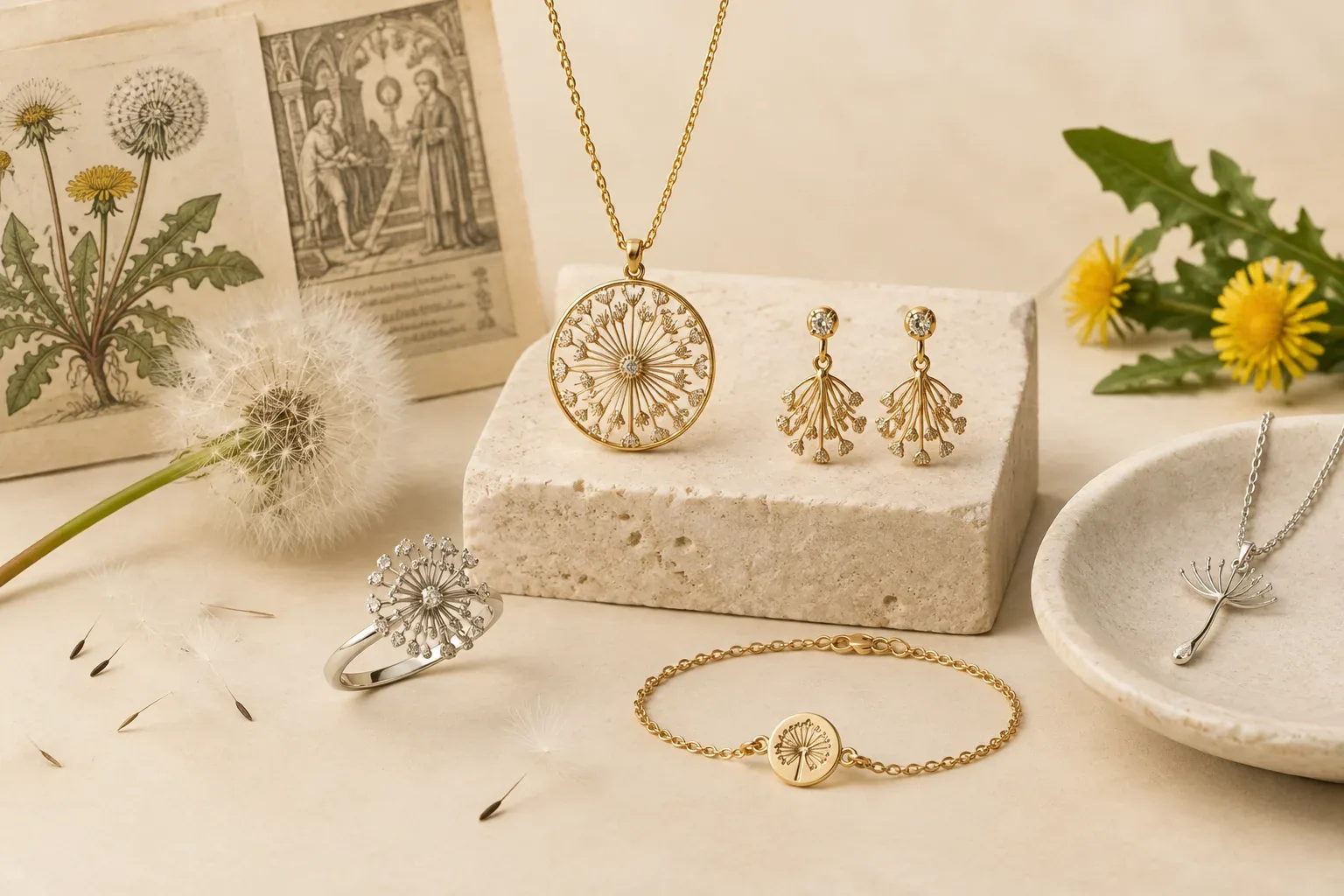
Designers today use the dandelion motif in several recognizable ways: a stylized single seedhead rendered in metal and set as a pendant, a scattering of tiny seed motifs forming an earring cluster, engraved or laser-cut silhouettes, and preserved dandelion seeds embedded in resin for an organic look. These approaches follow long-standing jewellery-making techniques: metal forming, enamelling, stone-setting, casting, engraving, and contemporary methods such as laser-cutting and resin casting.
Historically, jewellers have worked floral imagery in precious metals and gemstones, and the same range of materials is commonly applied to dandelion designs. The Victoria and Albert Museum’s materials on gemstones and jewellery history notes how different gems and techniques were chosen for visual effect and social meaning, so modern makers drawing on floral design may use gemstones, seed pearls, and coloured enamel to evoke delicacy or brightness. When gemstones are present, basic identification and disclosure practices recommended by regulators apply.
Material, treatment and disclosure: what to check
If a dandelion piece includes gemstones or claims to use particular precious metals, ask for clear information about the materials and any treatments. The Federal Trade Commission’s consumer guidance on buying gemstones, diamonds, and pearls explains that sellers should disclose treatments, enhancements, and whether gems are natural, lab-grown, or imitations. That guidance matters for price, care, and long-term expectations.
For metalwork, look for clear karat or fineness marks for gold and for sterling marks on silver, or for reliable descriptions when the piece is plated or made from base metals. For items described as vintage or antique, ask for provenance or condition notes so you understand repairs, replacements, or alterations. When sellers are transparent about materials and methods it makes the symbolic message more durable and the emotional or monetary value clearer.
Choosing and gifting dandelion jewelry respectfully
When you choose dandelion jewelry as a gift, focus first on the meaning the recipient is likely to attach. If the recipient values personal symbolic messages, explain what the motif means to you—whether that is a wish, resilience, childhood play, or letting go—rather than assuming the symbol has a single historical meaning. If the piece is meant to mark a life event, match the form to the occasion: a subtle seedhead pendant can be appropriate for everyday wear, while a more elaborate, gem-set brooch or locket may suit commemorative or formal gifting.
Consider materials, wearability, and lifestyle. Choose durable materials and settings for pieces intended for daily wear. Confirm metal and gemstone disclosures if the buyer or recipient has allergies or preferences. If you are buying from a small maker or artisan, ask about care recommendations and whether the design is uniquely handcrafted; that context often matters to recipients who appreciate makers’ stories. For guidance on matching meaning to gift choices and learning more about researching symbols, see our articles on how to choose meaningful jewelry and how to research jewelry symbols.
Care, longevity and ethical considerations
Care depends on materials: polished metals, enamel, resin, and delicate seed motifs each ask for different handling. Reliable sellers provide care instructions for plated finishes, gemstone settings, and soft organic materials. If ethical sourcing or sustainability matters to you or the recipient, ask the maker about material origin and whether any gemstones were treated or lab-grown, and apply the FTC’s disclosure expectations when evaluating claims.
Finally, respect the wearer’s interpretation. Because the dandelion motif is often invested with contemporary personal meanings, gifting or wearing dandelion jewellery works best when those meanings are discussed and mutually appreciated rather than assumed.
Closing note
In short, museum-backed histories support the broad importance of floral motifs in jewellery but do not provide a single, well-documented historical symbolic meaning specifically for the dandelion. Modern dandelion jewellery draws on general floral traditions and contemporary personal symbolism. Choose pieces for their craftsmanship and transparency about materials, and make the modern meaning you intend explicit when gifting to ensure the wearer receives the sentiment you hope to convey.
Frequently asked questions
Is the dandelion an established historical symbol in jewellery?
Museum-backed jewellery histories treat floral motifs broadly but do not widely document the dandelion as a distinct, consistently used historical symbol in jewellery. That means claims that the dandelion had one universal historical meaning in jewellery are not supported by the cited museum material.
What modern meanings are commonly attached to dandelion jewellery?
Modern uses of the dandelion motif commonly evoke wishes, childhood memory, hope, resilience, or letting go. These are contemporary cultural or personal interpretations rather than claims of continuous historical symbolism.
What materials are typical in dandelion-themed pieces?
Modern dandelion jewellery is made in metals such as gold and silver, in plated base metals, with enamelling, resin embedment, and sometimes with gemstones or seed pearls for sparkle. Materials vary widely between mass-produced and artisan pieces.
How can I verify gemstone or metal claims on a dandelion piece?
Ask the seller for written descriptions of materials, disclosures of any gemstone treatments or enhancements, and hallmarks for metal fineness. The Federal Trade Commission recommends that sellers disclose treatments and whether gems are natural, lab-grown, or imitations.
Is dandelion jewellery suitable as a gift for a formal occasion?
It can be, if the style, materials, and meaning match the occasion and the recipient’s taste. A refined gem-set or enamel piece may suit formal events, while a simple pendant is more suited to everyday wear. Clarify the intended meaning when gifting to avoid assumptions.
How should I care for delicate dandelion motifs?
Care depends on the materials: avoid harsh chemicals on enamel and resin, clean gemstones according to their hardness and treatments, and store delicate pieces to prevent bending or seed loss. Follow the maker’s care instructions where provided.
Sources and further reading
- Bedazzled: A History of Jewellery — Victoria and Albert Museum
- An A-Z of Gemstones — Victoria and Albert Museum
- Buying Gemstones, Diamonds, and Pearls — Federal Trade Commission