Meaning at a glance
Danburite is a transparent calcium boron silicate sometimes used as a colorless or pale faceted gem; treat its gemology, durability, identification, and required disclosure as separate from contemporary serenity symbolism.
What the historical and scientific record shows
Major gemological and museum references treat danburite primarily as a mineral and gem material rather than as an item with a long, documented cultural symbolism. The Gemological Institute of America's curated project materials, which include danburite among other gem materials, focus on identification, physical properties, and lapidary characteristics rather than cultural legends or ancient uses. That treatment places danburite squarely in the category of gem materials studied for their optical and physical behavior, cutting potential, and identification challenges.
The Smithsonian National Museum of Natural History frames gems and minerals in terms of geological origin, crystallography, rarity, and suitability for jewelry, emphasizing how mineral identity informs whether a material is practical for everyday wear or for occasional use. The Smithsonian's educational materials help explain why some minerals become jewels in certain periods and markets, and why others remain collectors' specimens. Taken together, these professional sources show that danburite’s documented history in museums and gemology is technical and geological rather than folkloric or widely attested across ancient cultures.
Documented facts versus modern personal interpretations
Documented facts about danburite that are supported by professional sources concern its mineral identity, optical clarity, and how gemologists and lapidaries handle it. The GIA discussion of danburite groups it with related gem materials for reference and emphasizes identification and cutting considerations. The Smithsonian highlights how mineral properties affect suitability for jewelry. Those are verifiable, technical claims and are the appropriate basis for buying, setting, and caring for danburite jewelry.
Modern personal and metaphysical interpretations that assign emotional qualities such as 'serenity,' 'clarity of mind,' or 'spiritual uplift' to danburite are contemporary attributions made by individuals, retailers, and some spiritual communities. These remain personal meanings rather than documented historical facts. They can be meaningful gifts or personal talismans if the wearer values them, but they should not be conflated with the scientific record.
How danburite appears in jewelry
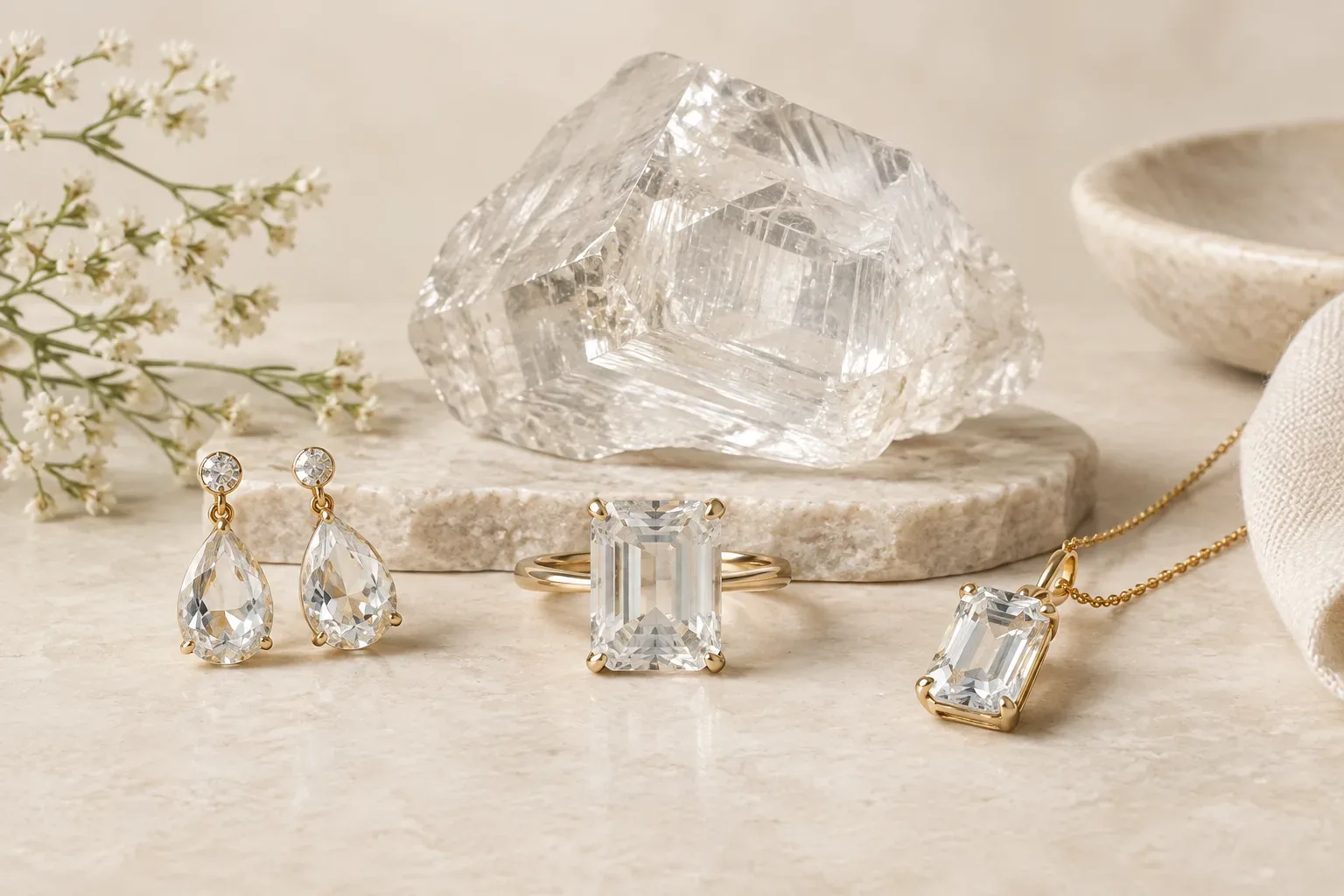
In jewelry, danburite most commonly appears as a colorless or very pale gemstone faceted to maximize brilliance and clarity. Because it can be transparent and clean to the eye, cutters often facet danburite for use as center stones in rings, pendants, and earrings where a bright, light-reflective appearance is desired.
Jewelry makers select danburite for pieces where an affordable, clear, gem-quality stone is wanted as an alternative to more expensive colorless gems. Its visual role in jewelry is therefore similar to other colorless or near-colorless gems: it functions as a focal, light-catching element rather than as an opaque or heavily colored accent.
Settings for danburite generally follow standard practice for faceted gems. Closed-back or open-back settings and protective mounts are chosen based on the piece’s intended use. Because museum and gemological guidance emphasizes evaluating a mineral’s suitability for everyday wear, consider that the setting should reflect how often the piece will be worn and the wearer’s activities.
Practical guidance for selecting danburite jewelry
Decide what you want the stone to do in the piece: be a daily wear center stone, an occasional-wear showpiece, or a personal talisman. That decision affects the choice of setting and the level of protection the stone needs. The Smithsonian’s material on gems and minerals stresses matching mineral properties to intended use when assessing suitability for jewelry.
When comparing stones, evaluate color, clarity, cut, and carat as you would with other faceted gems. Ask for a close-view photograph or in-person inspection under good light. For higher-value purchases, request written disclosure about whether the stone is natural, heated, treated, lab-grown, or an imitation. The Federal Trade Commission’s guidance on buying gemstones emphasizes clear disclosure and honest labeling for natural, lab-grown, treated, and imitation stones.
If provenance matters to you or the recipient, ask the seller about the source and whether any treatments were applied. For higher-value danburite, a gemological report from an established laboratory can confirm identity and report treatments. Keep in mind that professional gemological documentation focuses on identity and treatments rather than metaphysical claims.
Consider setting style and metal choice with durability in mind. If you plan daily wear, choose protective settings such as bezel or halo styles that reduce the chance of knocks and chips. For occasional-wear jewelry, more open, airy settings can highlight the stone’s brilliance but may expose the gem to greater risk.
Care, maintenance, and disclosure considerations
Follow conservative care practices for faceted gems: remove jewelry before heavy physical work, avoid hard knocks, and keep pieces separate to prevent abrasion. The Smithsonian’s guidance on gems and minerals encourages considering a mineral’s physical properties when deciding how to care for and wear it. If you have access to a jeweler’s care sheet for a specific stone, follow that advice.
Ask the seller to disclose any treatments, whether the stone is natural, lab-grown, or an imitation, and whether any enhancements affect a gem’s care or longevity. The Federal Trade Commission directs sellers to provide accurate information about gemstone origin and treatment; buyers should request this information and retain receipts and disclosures.
Clean danburite jewelry using gentle methods recommended for faceted gemstones, such as mild soapy water and a soft brush, unless a trusted gemological report or the seller advises otherwise. Ultrasonic or steam cleaners may be acceptable for many faceted stones but can be contraindicated for certain treatments or inclusions; when in doubt, consult a professional jeweler or gemologist.
For storage, keep danburite pieces separately wrapped or in compartments to avoid scratches from harder gems or metal contact. Periodic professional inspection of settings and prongs helps prevent loss and ensures stones are secure.
Gifting respectfully and meaningfully
If buying danburite as a gift, be clear about what the stone represents to you and what you expect it to represent to the recipient. If you intend to gift it for its perceived emotional or spiritual qualities, acknowledge that those meanings are modern personal attributions rather than historical facts, and present the stone as a personal symbol or sentiment.
Include practical information with the gift: a simple note regarding whether the stone is natural or treated, basic care instructions, and any receipts or gemological reports. For recipients who appreciate science or craft, mention the stone’s identity as a calcium boron silicate and the fact that professional gemological sources discuss the material as a gem candidate.
Consider the recipient’s lifestyle when choosing setting and metal. For someone active or who uses their hands frequently, choose more protective settings. For someone who values display and occasional wear, a more delicate mount may be appropriate.
Final notes
Danburite occupies a niche as a clear to pale faceted gem material whose documented value lies in its mineralogical and optical properties. Use professional gemological and museum sources to guide technical questions about identification, cutting, and suitability, and treat personal or spiritual meanings as individual preferences.
When buying, insist on transparent disclosure consistent with FTC guidance, match the setting to intended use, and follow cautious care practices recommended for faceted gemstones to preserve the piece for years to come.
Frequently asked questions
What does danburite symbolize?
Danburite’s symbolic meanings—such as clarity or serenity—are modern personal attributions rather than documented historical facts; professional sources describe it as a transparent calcium boron silicate used as a faceted gem, and any symbolic use should be presented as contemporary and subjective.
Is danburite durable enough for everyday wear?
Professional gemological and museum sources emphasize checking a mineral’s properties when assessing suitability for jewelry; select protective settings for frequent wear and consult a professional jeweler about a specific stone rather than assuming universal durability.
How can I tell if a danburite is natural, treated, or an imitation?
Ask the seller for clear disclosure and, for higher-value stones, seek a gemological report; the Federal Trade Commission advises buyers to receive honest labeling regarding whether a gem is natural, lab-grown, treated, or an imitation.
How should I clean and store danburite jewelry?
Follow conservative care methods used for faceted gems: clean with mild soapy water and a soft brush unless advised otherwise by a professional, avoid harsh chemicals and heavy impacts, and store pieces separately to prevent abrasion. When unsure, consult a jeweler.
Is danburite appropriate as a gift if I want to convey a spiritual message?
Yes, provided you present the spiritual message as a modern personal meaning rather than a documented historical claim; include practical information such as disclosures and care instructions to make the gift both meaningful and responsible.
Sources and further reading
- Gübelin Gem Project: Danburite–Humite — Gemological Institute of America
- Gems and Minerals: Beauties and Building Blocks — Smithsonian National Museum of Natural History
- Buying Gemstones, Diamonds, and Pearls — Federal Trade Commission