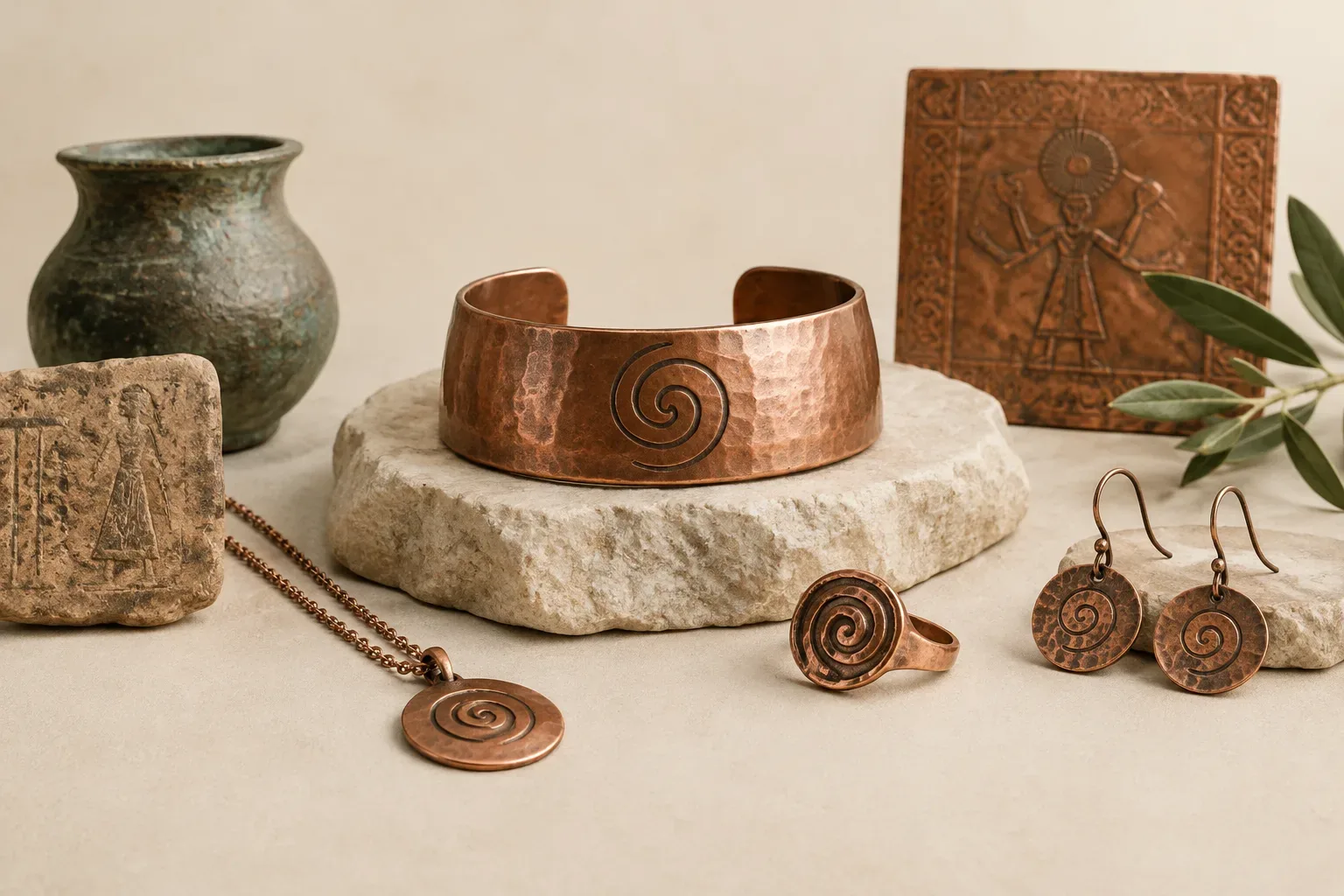
Meaning at a glance
Explain the documented history and changing contexts of the copper jewelry explained motif, separate cultural or religious evidence from later popular interpretations, and give practical guidance for choosing and wearing the motif in modern jewelry.
What we mean by copper jewelry: composition and common forms
In jewellery practice, "copper" can refer to items made from elemental copper or to pieces made from copper-based alloys such as bronze (copper and tin) and brass (copper and zinc). Museums and collections show all of these materials in historical pieces because they were durable, workable and often less costly than precious metals. Copper also appears as wirework, sheetwork, cast forms, and as a surface for decorative techniques such as chasing, repoussé, enamelling and patination, all techniques documented in museum collections and exhibitions on the history of jewellery.
Historical evidence and distinct cultural uses
Evidence assembled by the Victoria and Albert Museum demonstrates that copper and its alloys were widely used in different regions and periods for practical, decorative and status-related reasons. For example, Bronze Age societies across parts of Europe and the Near East used bronze (a copper alloy) for visible personal items because bronze combined hardness with the ability to be cast into detailed forms. In later historic periods, such as Roman and medieval Europe, copper alloys appear alongside gold and silver in everyday items and costume jewellery, often where cost or available technology shaped choice of metal. The V&A's research and displays on jewellery history place these materials in specific social and technological contexts rather than ascribing a single symbolic meaning across time and place.
Documented meanings versus modern personal interpretations
When interpreting the meaning of copper jewellery in historical contexts, rely on documentary and archaeological evidence rather than later stories. The Victoria and Albert Museum frames many historic objects by their social uses—status, commemoration, personal ornamentation and technological expression—rather than universal symbolic claims. Many modern claims about copper's spiritual, healing, or protective properties are recent interpretations or personal beliefs and are not consistently supported by historical sources. It is essential to separate what a culture actually recorded or made (for example, a bronze ritual object from a named archaeological culture) from later popular reinterpretations that attribute contemporary symbolism to an older object.
How motifs, gemstones and traditions appear in copper jewellery
Copper often serves as the structural metal or decorative backing for motifs and gemstones rather than as a symbol on its own. Historical and modern pieces place motifs—such as botanical shapes, geometric patterns, or figurative designs—onto copper through techniques documented in museum collections, including enamelling and metal chasing. Gemstones have been set into copper or copper-alloy mounts when those mounts met the designer's needs for colour, contrast, or cost. The Victoria and Albert Museum's resources on gemstones and jewellery history show how different stones were selected and mounted across periods; in some cases copper provided a warm-toned contrast that complemented certain gem colours, while in other contexts copper was a pragmatic choice where more precious settings were not used.
Hallmarks, marks, and what buyers should expect
The hallmarking systems that you may recognise for gold and silver have specific historical and legal origins and have not traditionally applied to copper in the same way. Museum literature on jewellery history explains that official hallmarks have been tied to specific precious metals and legal frameworks, so copper and many copper alloys frequently carry maker's marks, stamps indicating metal type, or no mark at all, rather than the guaranteed assay marks you find on gold and silver. When a copper piece does bear marks, they may identify the maker, the workshop, a designer's stamp, or a modern manufacturer's brand. If legal or assay guarantees are important to you, check the item's documentation and ask the seller directly about what any marks mean.
Disclosure, treatments, and seller responsibilities
The Federal Trade Commission advises sellers to be clear about the materials and treatments used in jewellery and gemstones. This guidance applies to buyers of copper jewellery as well: any plating, surface treatments, artificial patination, or the presence of gemstones that are dyed, treated, or assembled with adhesives should be disclosed by a reputable seller. For gemstones mounted in copper settings, disclosure about whether a stone is natural, treated, synthetic, or imitation is relevant to the item's value and care. Asking for written confirmation of metal and stone descriptions and for details of any surface finishes or coatings is a practical application of the FTC’s consumer guidance.
Practical selection and gifting guidance
Choose copper jewellery with respect for both the object's documented history and the recipient's preferences. If you are purchasing a piece as a historical or cultural object, prefer items with provenance, museum references, or clear maker information so that the object's origin and context are not lost or misrepresented. When gifting a copper piece for its aesthetic or personal meaning, make a clear distinction in your card or conversation between historically documented associations and your own contemporary interpretation or sentiment. Consider metal sensitivity: some people prefer to avoid uncoated base metals. If longevity or tarnish resistance is important, ask about any protective coatings or whether the piece is plated with another metal. Where symbolic meaning may intersect with cultural or religious traditions, research the specific culture or consult knowledgeable sources rather than assuming a universal significance.
Care, authenticity checks and conserving value
Conserve the appearance of copper jewellery by following care guidance appropriate to the finishes and any gemstones it contains. If a piece has a patina or artificial surface treatment, ask whether cleaning will remove that finish. For questions of authenticity and value, request written details from the seller about materials, treatments and provenance; reputable dealers or specialists should be willing to provide this information. For historical objects, museum catalogues and exhibition records can help establish date and context; for modern designer pieces, maker's marks and receipts help preserve the item's narrative.
Final thoughts
Copper jewellery explained requires three separations: separate copper’s physical forms (elemental copper and copper alloys), separate documented historical uses and cultural contexts from later popular symbolism, and separate the seller’s factual disclosures from a buyer’s personal meanings. Rely on museum scholarship for historical context, and on consumer guidance from regulators for expectations about disclosure when buying or gifting. That approach preserves both the object’s history and the meaning it may gain in a modern wearer’s life.
Frequently asked questions
Does copper jewellery carry traditional hallmarks?
Traditional assay hallmarks historically apply to defined precious metals; copper and many copper alloys often do not carry those same marks. Copper pieces may show maker's stamps, workshop marks, or no mark, so ask the seller for written information about any stamps and for provenance if that matters to you.
Should sellers disclose treatments or plating on copper jewellery?
Yes. The Federal Trade Commission recommends that sellers disclose materials and treatments, including plating, patination, or surface coatings, and whether any gemstones are treated, synthetic, or imitation, so buyers can make informed choices.
How can I tell if a copper piece is historically significant?
Look for documentation such as provenance, museum references, maker’s marks dated to a known period, or specialist reports. Museum catalogues and exhibition records can help establish historical context; reputable dealers should provide written details when a piece is described as antique or of cultural significance.
Will copper jewellery change colour or leave marks on skin?
Copper and some copper alloys can develop a surface patina over time; that patina can sometimes transfer a faint colour to clothing or skin. If you are sensitive to metal contact or want to preserve a polished surface, ask about protective coatings or choose pieces with a stable finish.
Is it appropriate to gift copper jewellery with cultural symbolism?
Be respectful and specific. If a design is tied to a particular culture or religious tradition, research its documented meaning and, when appropriate, consult members of that culture. When in doubt, describe whether the gift reflects your personal sentiment rather than asserting an ancient or universal symbolism.
Sources and further reading
- Bedazzled: A History of Jewellery — Victoria and Albert Museum
- An A-Z of Gemstones — Victoria and Albert Museum
- Buying Gemstones, Diamonds, and Pearls — Federal Trade Commission