Meaning at a glance
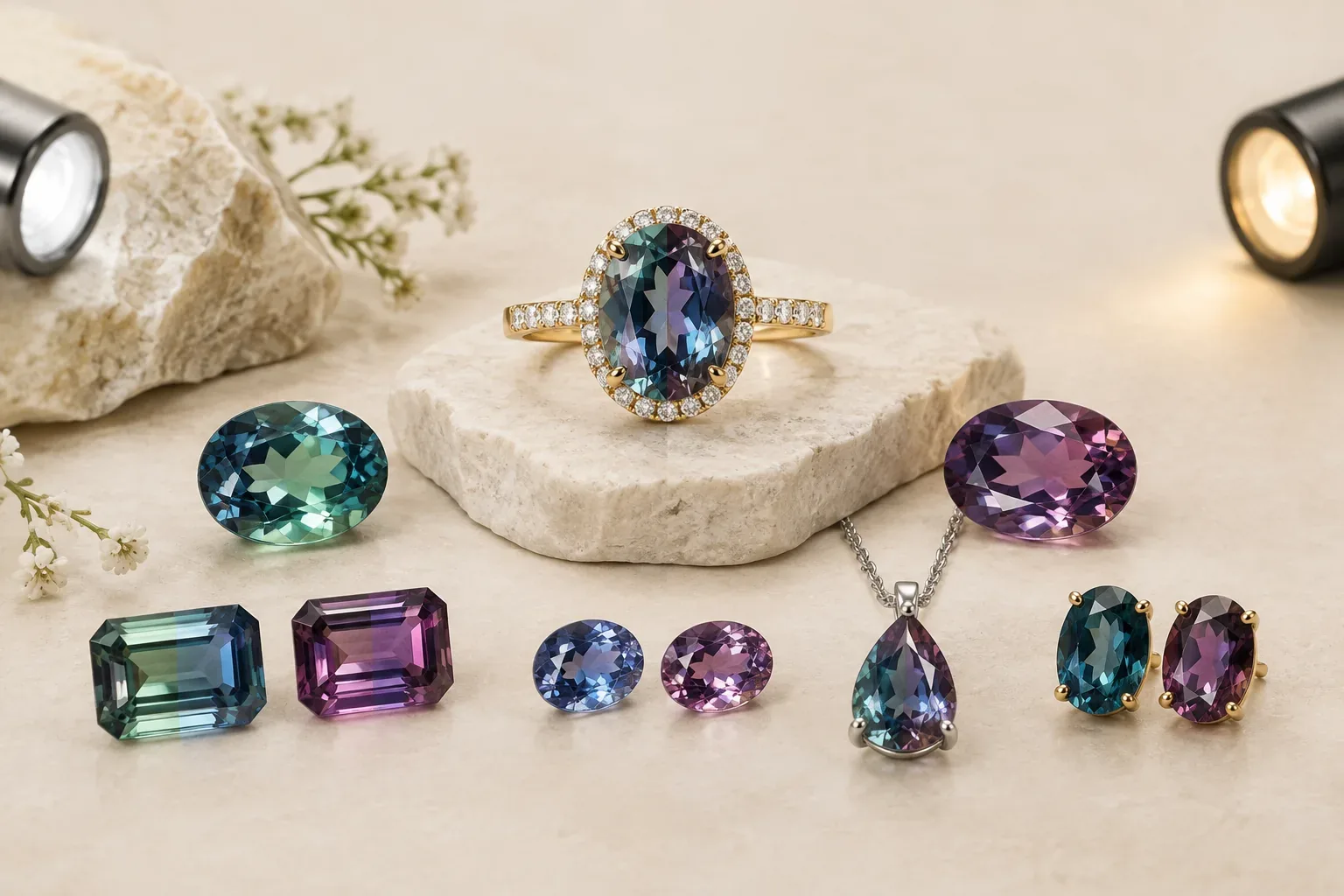
Genuine color change depends on a gem’s response to different light sources rather than simple viewing angle; classic alexandrite (a variety of chrysoberyl) is the most famous example, but other species can show the effect; buyers should learn grading terms for hue/tone/saturation and color uniformity, view stones in both daylight and incandescent light, be cautious about photography, and insist on treatment and origin disclosure or an independent lab report.
Direct answer: what color-change gemstones are and what this guide covers
Genuine color-change gemstones show a different apparent color when viewed under different light sources because their absorption interacts with the spectral quality of the light, not merely because of viewing angle or pleochroism. This guide explains the physical basis for that light-source-dependent change, names the most commonly encountered examples, defines the grading language you’ll see from reputable labs, explains why photographs often mislead, and gives practical buying and gifting guidance focused on disclosure and inspection.
How the color-change effect works (short, science-grounded explanation)
Color change in gems is a function of which wavelengths a material absorbs combined with the spectral balance of the illuminating light. Under a light source rich in short-wavelength (blue/green) energy, a gem with selective absorption can appear one color, while under a long-wavelength (yellow/red) source it can appear another. The Gemological Institute of America (GIA) distinguishes true color change from pleochroism, which is a different optical behavior caused by viewing a crystal along different crystallographic directions rather than by changing the light source.
Classic history and documented cultural associations
The best-documented historical association for a color-change gem is alexandrite. GIA’s alexandrite description links the variety to 19th-century discoveries in the Ural Mountains and to Russian jewelry collections where it was highly prized, which is why the stone is historically associated with Imperial Russia. GIA’s published materials are the primary professional source for that documented history and the gemological characterization of alexandrite.
Documented uses and meanings versus modern personal interpretation
Documented historical meanings for alexandrite derive from the social context in which it was collected and worn. GIA’s work documents alexandrite as a rare chrysoberyl variety valued for its striking optical behavior in the 19th century and incorporated into period jewelry. That is a statement of provenance and historical popularity, not a universal symbolic meaning.
Modern personal interpretations—such as assigning a color-change stone a specific emotional or spiritual property—are contemporary uses of jewelry and are not documented historical facts. These modern meanings can be meaningful to an individual or group, but they vary widely and are not universal. Treat historical documentation and personal symbolism as separate kinds of information when choosing or gifting a piece.
Common gem examples of color change
Alexandrite (a color-change variety of chrysoberyl) is the archetype and is described by GIA as showing the clearest light-source-dependent change in many classic examples. Other gem species can also show detectable color change under different lighting conditions, but the appearance, rarity, and value implications differ by species and by the strength and character of the change.
When sellers or reports describe an item as “color change,” inspect the accompanying documentation. Reputable gemological laboratories classify and describe the phenomenon; terms and emphasis differ by species and by the strength of the change, so a careful description and, where practical, a laboratory report are important for understanding what you are buying.
Grading language you’re likely to see and what it means
Laboratories and experienced dealers use standard color vocabulary—hue, tone, saturation—to describe a gemstone’s color under specified lighting. GIA’s guidance on colored gemstone value factors emphasizes hue-tone-saturation and also highlights color uniformity and color zoning as important factors that affect appearance and value.
For color-change stones specifically, you will often see descriptions that explain the primary color in daylight or fluorescent light and the color in incandescent or halogen light. A grading or descriptive report may also discuss the strength of the change (strong, moderate, slight), the degree of color uniformity, and whether pleochroism or color zoning affects appearance. Cut and orientation can influence how strongly the change is perceived, so look for commentary about how the stone was cut with its optical characteristics in mind.
Why photos and online images can mislead
Photographing gems is technically challenging because cameras and screens reproduce color differently than the human eye sees it in person. GIA’s guidance on gem photography explains that lighting type, color temperature, diffusion, and camera white balance all affect how a gem’s color is recorded. A single image can only show one lighting condition, and many online listings use photos taken under a single light source that may exaggerate or mute an apparent color change.
When you are considering a purchase online, ask the seller for verified images taken in both daylight-equivalent (cool) lighting and incandescent-equivalent (warm) lighting, or for a short video showing the stone under both conditions. Even then, insist on seeing an independent lab report or an in-person viewing whenever possible, because photography cannot fully substitute for inspection under controlled lights.
Practical selection and gifting guidance
If you are buying a color-change gem, start by asking for a written description from a reputable laboratory or a qualified gemologist. The Federal Trade Commission (FTC) advises consumers to seek clear information about treatments, origin, and whether a stone is a natural, laboratory-grown, or imitation material. Always ask for full disclosure of any treatments and for documentation of origin when available.
Before you commit, view the stone under at least two light sources: a daylight-equivalent (or natural daylight) source and a warm incandescent-equivalent source. Ask the seller to demonstrate the color change and to explain how cut and orientation affect the effect. If you are buying for a gift, consider how the stone will be worn: rings and pendants will encounter varied light; a setting that exposes the stone to ambient light will show the effect more readily than a fully bezel-set piece.
For valuable purchases, request an independent gemological report that explicitly describes the color-change behavior, the species, any treatments, and other relevant comments such as pleochroism or color zoning. For budget-conscious buyers, be especially attentive to seller reputation, return policy, and the FTC’s guidance about representations of treatments and imitations.
How color-change stones are used in jewelry design
Designers and consumers use color-change stones where visual surprise or versatility is desired. Jewelers commonly set alexandrite and other color-change gems in rings, pendants, and earrings so the stone is visible under everyday lighting variations. Designers sometimes choose open-back or prong settings to allow more light interaction, and they may select a cut that balances color-change visibility with brilliance.
Because cut and orientation can affect the strength of the perceived change, jewelers who specialize in color-change stones often work with gem cutters and designers to position the table and pavilion to maximize the effect for typical viewing angles. If you prefer a particular face-up color, discuss that with the seller; you may find that the stone’s face-up appearance in one lighting condition is more important to you than the other.
Red flags and final checklist for buyers and gifters
Be wary of sellers who provide only a single photograph or who do not disclose treatments. The FTC cautions shoppers to obtain clear information about treatments, lab-grown origins, and imitations before buying. Ask for verification from a reputable laboratory when price, rarity, or the claim of a strong color-change effect suggests higher value.
A practical checklist before buying: request viewing in both cool (daylight) and warm (incandescent) light; obtain a written description or lab report that quotes color descriptions under specified lighting; confirm full disclosure of treatments and origin; verify the seller’s return policy; and, for gifts, consider how the recipient will appreciate a stone with different appearances rather than a single fixed color.
Frequently asked questions
How can I tell if a stone really changes color?
Ask to see the stone under at least two light sources: a daylight-equivalent (cool) light and an incandescent-equivalent (warm) light. A genuine color-change description should note the appearance in each light. For higher-value purchases, obtain an independent gemological report that documents the color change and specifies species, treatments, and any other observations.
Is alexandrite the only color-change gem?
Alexandrite (a variety of chrysoberyl) is the most famous and historically documented color-change gem, as noted by GIA, but other gem species can show light-source-dependent color change. The strength and desirability of the effect vary by species and individual stone.
Can photographs show a gem’s true color change?
Photographs often fail to reproduce accurate appearance because lighting type, color temperature, and camera settings affect color. GIA advises that images can be misleading; request photos taken under both cool and warm light or view the stone in person whenever possible.
What should I ask about treatments and disclosure?
Follow FTC guidance: ask the seller whether the stone is natural, laboratory-grown, or an imitation, and request full disclosure of any treatments. For valuable stones, get a lab report from a reputable laboratory that explicitly states any detected treatments and other relevant observations.
How should I present a color-change gem as a gift?
Consider the recipient’s taste for changeable or surprising pieces; explain the phenomenon and, if practical, show the stone under two lights so they can appreciate both appearances. Provide any lab reports and care guidance, and choose a setting that lets the stone see varied light if they will enjoy the changing effect.
Sources and further reading
- Colored Gemstone Value Factors — Gemological Institute of America
- Factors in Colored Stones that Interact to Affect Value — Gemological Institute of America
- How to Photograph Gems and Jewelry — Gemological Institute of America
- Alexandrite Description — Gemological Institute of America
- GIA Diamond Research — Gemological Institute of America
- Buying Gemstones, Diamonds, and Pearls — Federal Trade Commission