Meaning at a glance
Clock jewelry meaning is rooted in documented changes in jewelry practice — from functional timepieces turned decorative in European material culture to later symbolic and personal uses — and should be distinguished between historically recorded meanings (as described by the Victoria and Albert Museum) and modern, individual interpretations; when choosing or gifting clock motifs, consider provenance, materials, whether the piece is functional, and disclosure about gemstones and treatments (per the Federal Trade Commission).
Historical evidence and cultural periods
The best-documented origins and changing uses of timepiece imagery in jewelry are preserved in museum collections and scholarship. The Victoria and Albert Museum (V&A) treats clocks, watches, and time-related ornament within the wider history of jewellery and changing social context, showing how practical timekeepers and decorative objects moved between utility and display in European material culture. The V&A describes how the introduction of portable timekeepers and evolving decorative techniques influenced what people wore and why they displayed such objects on the body.
Renaissance and Baroque Europe: In the broad sweep of European decorative arts, small mechanical clocks and early portable timepieces became objects of curiosity and luxury. The V&A's coverage of jewellery history places these developments among other shifts in technique and taste, where mechanical virtuosity could be expressed in ornamental cases and mounts designed to be shown as part of dress.
Georgian and Victorian Britain: Later centuries saw watches and time-keeping accessories become integrated into everyday dress and sentimental jewellery. The V&A documents how forms such as fob watches, watch pendants, and decorated cases were used both as personal devices and as surface for decoration. In the nineteenth century, when jewellery more frequently carried personal and sentimental meanings, timepiece forms could appear alongside lockets and hairwork as objects associated with memory or display.
20th century and modern design movements: The V&A's historical narrative also follows twentieth-century changes when wristwatches, Art Deco design, and industrial production shifted the balance between function and ornament. In many collectible and contemporary pieces the clock motif can be a literal miniature dial, a stylized face, or an abstract suggestion of time expressed through shape and materials.
Documented historical meanings versus modern personal interpretations
Documented historical meanings are the uses and readings that appear in primary sources, museum catalogues, and curatorial interpretation. The V&A frames timepiece objects and clock motifs in jewellery primarily in terms of social status, craftsmanship, novelty, and changing function—that is, whether a piece was prized for its mechanism, for ornament, or for its role in dress and commemoration. These are the historically attested contexts that can be cited with museum reference.
Modern personal interpretations are open-ended and diverse. Contemporary wearers may choose clock motifs to express punctuality, to acknowledge the passage of time, to mark a milestone, as a memento mori theme, or simply for visual appeal. These modern meanings often build on historical associations but are not fixed by them; they depend on individual intention, designer narrative, and cultural conversation rather than a single documented origin.
It is important not to conflate historically documented uses with a universal symbolic meaning. The same visual motif could have different meanings to different people in different eras, and what curators record as the social context of an ornament is not an exhaustive list of every symbolic use across communities.
How the clock motif, gemstones, and traditions appear in jewelry
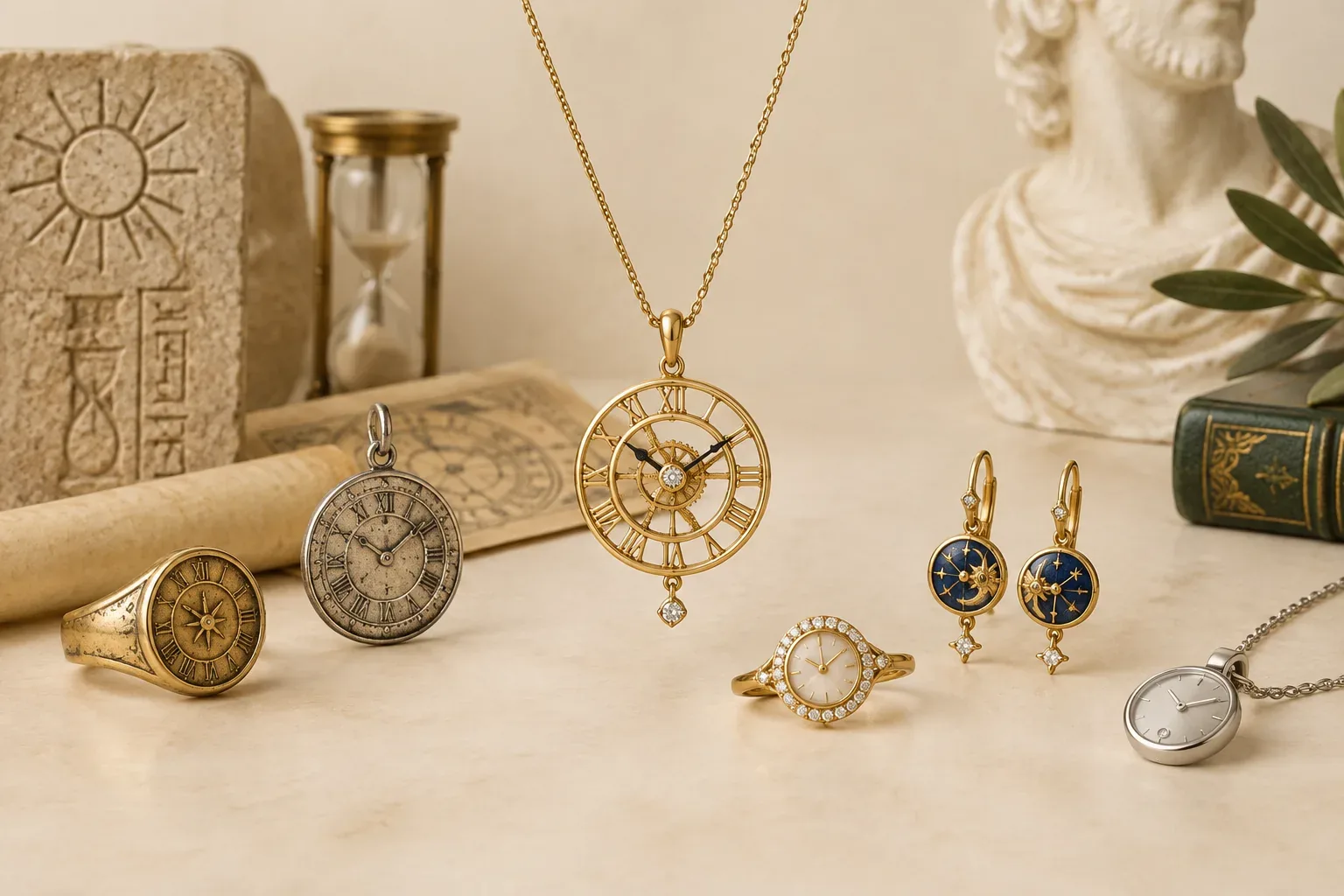
The clock motif appears in jewelry in several material and formal ways. Historically and today you will find full working watch pendants and wristwatches that have been adapted as decorative pieces, miniature decorative dials set into brooches or rings, and purely symbolic or stylized faces used as design motifs. Enamel work, engraved cases, openwork bezels, and the inclusion of a visible movement or skeleton dial are recurring technical approaches used to make time visible in a small format.
Gemstones and decorative materials have been used to emphasize, hide, or frame the timepiece element. The Victoria and Albert Museum's A–Z of Gemstones explains the historical and practical contexts in which particular gems were chosen for jewellery, from hardness and durability to color and cultural preference. Diamonds and hard stones have been used to protect and set off dials, while softer materials or inlays could be employed for pictorial or sentimental work. Enamel and painted miniatures also appear frequently as surface decoration around dials.
Tradition and technique matter: settings intended to protect a functioning mechanism differ from decorative motifs meant only to suggest a clock face. Historically, craftsmen adapted case-making, hinge work, and gem-setting to accommodate gears and glass crystals; today designers may simulate those textures in cast forms or laser-engraved metal without any moving parts.
When gemstones are present, modern buyers should be aware of cut, treatment, and imitation issues. The Federal Trade Commission provides practical guidance about disclosure of treatments and imitations for gemstones and pearls, emphasizing that sellers should clearly inform buyers when stones have been enhanced or simulated.
Practical and respectful selection or gifting guidance
Decide whether you want a functional timepiece or a symbolic motif. A working pendant watch may require servicing and a design that accommodates a mechanism; a purely decorative piece will prioritize surface treatment, durability, and ease of wear. Consider the recipient's lifestyle: a piece intended for daily wear should use hard, durable materials and reliable clasps and should be sized for comfort.
Be mindful of provenance and material disclosure. If the piece contains gemstones, ask about the type of gem, whether it has been treated, and whether any stones are simulated or synthetic. The Federal Trade Commission recommends clear disclosure of treatments and imitations for gemstones, diamonds, and pearls; insist on written details if those factors are important to you.
Match symbolism to intention and culture with sensitivity. If you intend the motif to convey a specific message—remembrance, celebration of a milestone, a prompt to live in the present—state that intention in a card or conversation so the recipient understands your meaning. Conversely, avoid assuming a symbolic interpretation is universal; where you are aware that certain motifs carry cultural or religious meanings in a particular community, seek guidance from someone knowledgeable in that tradition before choosing the design.
Practical care and repair: if you choose a mechanical watch-style piece, factor in servicing costs and ask whether spare parts are available. If the jewelry uses surface decoration such as enamel or fragile inlays, instruct the recipient about care to reduce the risk of damage. For heirloom intentions, consider engraving or accompanying documentation that records why the piece was given and any known provenance.
Pair your purchase or gift with reliable research. If you want to learn more about a specific maker or period reference, consult museum catalogues and specialist dealers, and consider the Victoria and Albert Museum’s resources on jewellery history for broader context. For guidance on buying gemstones and understanding treatment disclosures, consult the Federal Trade Commission's consumer advice.
Closing note
Clock jewelry meaning sits at the intersection of technology, fashion, and personal signification. Use museum-established history to understand how motifs evolved, and use careful, culturally aware conversation to ensure a modern wearer understands your gift. If you want to explore related symbols or practical buying guidance, see the linked resources and how-to guides for further reading.
Frequently asked questions
What does clock jewelry symbolize?
Clock jewelry symbolism varies. Museum evidence frames timepiece motifs as expressions of status, novelty, or craftsmanship in historical contexts, while contemporary wearers may use them to mark milestones, remember a loved one, or symbolize an attitude toward time. There is no single universal meaning.
Is clock-themed jewelry appropriate as a gift?
Yes, if chosen with thought. Clarify your intent when gifting so the recipient understands whether the piece is a functional watch, a sentimental reminder, or a purely decorative object. Be mindful of cultural sensitivities and ask if you are unsure about a specific tradition.
Should I buy a working watch or a decorative clock motif?
Choose a working watch if you want utility and plan for maintenance; choose a decorative motif if you prioritize aesthetics, lower upkeep, or a symbolic statement. Check construction and materials for durability in either case.
How can I be sure gemstone claims are accurate?
Ask the seller for written disclosure about the type of gemstone, whether it has been treated, and whether any stones are synthetic or simulants. The Federal Trade Commission advises clear disclosure of treatments and imitations for gemstones, diamonds, and pearls.
Are there care considerations for clock jewelry?
Yes. Mechanical pieces require regular servicing and protection from moisture and shocks. Enamel, inlay, and fragile stones benefit from careful handling and appropriate storage. Ask a jeweller or conservator about specific care for antique or mechanically complex items.
Where can I learn more about historical examples of clock jewelry?
Museum catalogues and exhibitions provide the strongest historical evidence. The Victoria and Albert Museum’s resources on jewellery history are a useful starting point for understanding how time-related motifs appeared in different periods.
Sources and further reading
- Bedazzled: A History of Jewellery — Victoria and Albert Museum
- An A-Z of Gemstones — Victoria and Albert Museum
- Buying Gemstones, Diamonds, and Pearls — Federal Trade Commission