Meaning at a glance
Castle jewelry meaning encompasses documented historical uses tied to status, residence, and remembrance recorded in museum collections, later popular reinterpretations, and practical guidance for selecting and gifting modern pieces.
What the historical evidence says — cultures and periods
Surviving jewelry and museum scholarship indicate that architectural motifs, including towers, crenellations, and simplified castle silhouettes, appear in European material culture from the medieval period through the post-medieval centuries into the 19th century and later. The Victoria and Albert Museum's surveys of jewelry history document how jewelry designs have reflected social rank, political allegiance, and personal memory across these periods, and how motifs were adopted and adapted over time.
In these documented contexts the castle form often functioned as part of a broader visual language rather than a single fixed symbol. For example, in heraldic and portrait-related objects created in European settings, architectural imagery could signal a family's seat, territorial claim, or noble identity. Museum catalogs and historical studies emphasize that designers and patrons used recognizable architectural elements to convey connections to place or lineage, not a universal spiritual meaning.
Separating documented historical meanings from modern interpretations
Documented meanings come from surviving objects, provenance records, and museum interpretation. The V&A and similar institutions describe how motifs reflected social context: status, affiliation, or memory. Those are historical readings grounded in object-based evidence and archives rather than in contemporary sentiment.
Modern personal interpretations are varied and legitimate but distinct from those historical readings. Today people choose castle jewelry to express romantic ideas of fairy-tale fantasy, the notion of protection or refuge, a love of history or travel, or purely aesthetic preference. These contemporary meanings are personal and cultural evolutions rather than direct continuations of a single historic intention, and they are not universal across cultures or individuals.
How the castle motif appears in jewelry
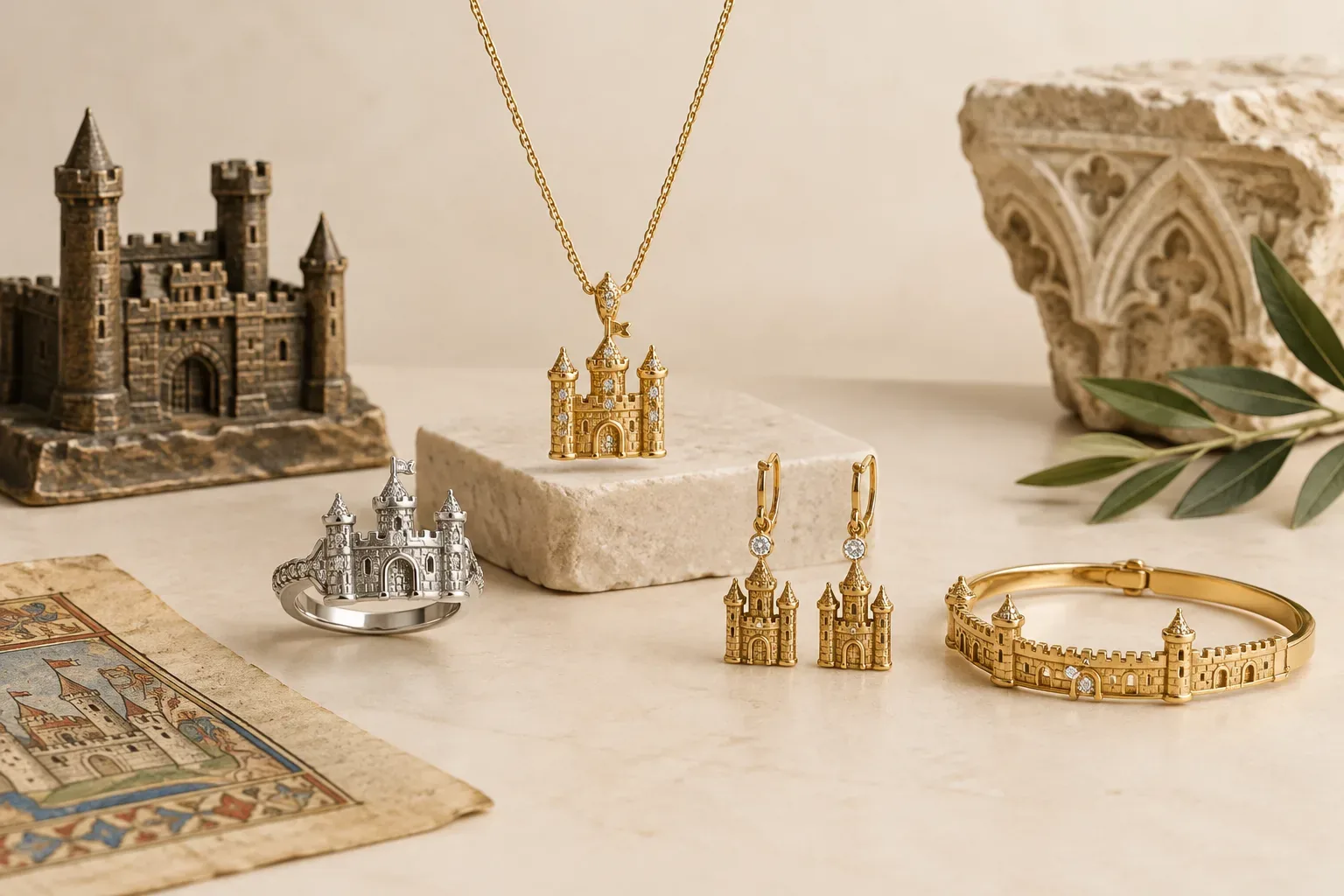
Designers translate castle imagery into jewelry in several ways: simplified silhouettes and outlines that suggest towers or battlements, miniature architectural scenes set under glass or in lockets, and heraldic-style badges that incorporate turrets or fortified gates. The motif also appears as engraved or cast elements on rings, brooches, pendants, and cufflinks.
Gemstones and materials are used to support the motif visually and symbolically. Clear stones or glass may be set to represent windows or water around a castle, while darker gems can suggest masonry. The Victoria and Albert Museum's A–Z of Gemstones provides historical context about which gems were fashionable in different periods and how lapidary techniques influence a stone's color, durability, and setting options. Contemporary pieces often mix metals, patinas, and enamel to convey texture and age.
Design language and variations to recognize
Not every depiction that resembles a castle carries the same connotation. Some pieces draw directly on heraldic vocabulary with stylized towers and shields, which in documented historical contexts often related to family identity or military service. Other pieces are explicitly romantic or illustrative, produced in the 19th century and later when nostalgia for medieval architecture became fashionable in decorative arts. Museum accounts show this revivalist interest shaped many popular designs in the Victorian and later periods.
Contemporary designers may reinterpret the castle as minimalist geometry, a fairy-tale icon, or as part of a travel-themed series. Recognizing whether a piece is historically derived, revivalist, or contemporary helps set expectations about provenance and meaning.
Choosing and gifting castle jewelry: practical and respectful guidance
Decide whether you want a piece for its historic associations or for contemporary symbolism. If provenance and historical authenticity matter to you or the recipient, look for documented provenance or museum-quality descriptions and ask sellers about the object's history and prior ownership. The Victoria and Albert Museum's work on jewelry history can help you identify period styles and revivalist trends when assessing older pieces.
If the gift is meant to express a modern sentiment—romance, protection, shared travel memories, or fandom for fantasy—select a design and material that reflect that intent. Consider the recipient's metal and gemstone preferences, any allergy concerns, and the piece's wearability. Rings and bracelets have different practical considerations than pendants or brooches, so choose a form the recipient will use.
When buying gem-set castle jewelry, ask about treatments, enhancements, and imitation materials. The U.S. Federal Trade Commission provides consumer guidance on disclosure for gemstones, diamonds, and pearls; reputable sellers should disclose whether a stone is treated, lab-grown, or an imitation. Clear information about materials ensures the recipient understands the object's value and care needs.
Be culturally and personally respectful. Do not assume a castle motif will carry the same meaning for someone from a different background. A thoughtful note that explains why you chose the motif—whether for family heritage, a shared trip to a castle, or an admired aesthetic—adds context and avoids misinterpretation.
Care, materials, and authentication notes
Materials, treatments, and workmanship affect both the look and longevity of castle-themed pieces. Use the V&A's guidance on gemstones to understand how certain stones behave and the typical settings they require. For modern or vintage purchases insist on clear information about metal purity, stone treatments, and any replacement parts.
Ask sellers for condition reports and, when appropriate, independent appraisal or laboratory reports. The Federal Trade Commission's consumer guidance emphasizes disclosure of treatments and imitations; sellers should be transparent about whether gems are natural, treated, lab-grown, or simulants. Proper disclosure protects both buyer and recipient and preserves the meaning you intend to convey.
Putting meaning into practice — wearing and pairing castle jewelry
Wear castle motifs in ways that support your intended meaning. For everyday wear choose durable metals and secure settings; for a sentimental or ceremonial gift consider a piece that can be kept in a locket or worn at special occasions. Combining castle imagery with a birthstone, a family crest, or a travel memento can create a layered, personal narrative.
If you are uncertain about the recipient's preferences, choose a reversible or understated design that invites explanation. Pairing with neutral metals and simple gemstones keeps the motif legible without overwhelming the wearer’s existing style.
Final thoughts
Museum scholarship, notably work collected and explained by the Victoria and Albert Museum, shows that the castle motif in jewelry has been used in specific historical and cultural contexts to indicate status, place, or memory rather than a single universal meaning. Modern wearers freely adapt the motif for personal and aesthetic reasons, and both approaches are valid.
When buying or gifting castle jewelry, distinguish whether you value historical authenticity or contemporary symbolism, seek clear information about materials and provenance, and add a note of explanation to make the intended meaning clear and respectful.
Frequently asked questions
Does a castle symbol always mean heritage or nobility?
No. Historical evidence recorded in museum collections shows the motif could indicate a family's seat or territorial links in some European contexts, but it did not universally denote nobility. In modern use many people choose the motif for personal or romantic reasons rather than lineage.
What gemstones work well with castle-themed jewelry?
There is no single rule. Historically popular stones depended on period fashion; the Victoria and Albert Museum's A–Z of Gemstones explains which gems were used in different eras. For contemporary pieces, choose stones whose color and durability suit the design and the wearer's preferences.
How can I tell if a historic castle piece is authentic?
Look for provenance, museum-quality descriptions, and condition reports. Ask sellers about prior ownership and request independent appraisal when appropriate. Sellers should also disclose treatments or replacements as recommended by consumer guidance from the Federal Trade Commission.
Is castle jewelry appropriate as a romantic gift?
Yes, many people wear castle motifs as expressions of romance, protection, or fantasy. To avoid misunderstanding, include a note explaining your intent—whether it's about shared travel memories, a family home, or a fairy-tale sentiment.
Are there cultural sensitivities around castle imagery?
Meanings vary by culture and individual background. The motif may carry specific historical associations for some people, so be mindful and ask about any cultural or familial connotations before gifting.
What should I ask a seller before buying gem-set castle jewelry?
Ask about metal purity, gemstone identity, treatments, whether stones are natural or lab-grown, any restoration work, and return or authentication policies. The FTC advises full disclosure about treatments and imitations.
Sources and further reading
- Bedazzled: A History of Jewellery — Victoria and Albert Museum
- An A-Z of Gemstones — Victoria and Albert Museum
- Buying Gemstones, Diamonds, and Pearls — Federal Trade Commission