Meaning at a glance
Butterfly jewelry meaning combines a long history of decorative use with changing social contexts; museums document the motif’s repeated appearance and evolving uses, while many modern interpretations emphasize transformation and personal narrative—choose pieces with attention to material disclosures, cultural context, and the wearer’s taste.
What the historical evidence shows (and what is museum-documented)
Museum curators and exhibitions present jewelry as an object whose form and meaning shift with time and place. The Victoria and Albert Museum frames jewelry history around changing social contexts, showing how the same motifs can mean different things in different periods or functions. This institutional approach is the basis for claims about documented history of motifs rather than generalized cultural assertions.
Concerning butterflies specifically, the clearest museum-documented examples in the V&A’s public material are modern and decorative. The V&A’s article on the Papillon ring by designer Glenn Spiro records a named, dateable example of a contemporary butterfly ring in a museum context, which demonstrates the motif’s use in late 20th and early 21st century jewellery design and collecting practice rather than proving a single ancient origin. The V&A’s broader programming, such as the 'Bedazzled' history of jewellery events, presents jewelry across periods to show how motifs are adopted and reinterpreted rather than offering a single, continuous butterfly symbolism across all cultures.
Separating documented historical meanings from modern interpretations
When museums document a motif, they distinguish the object’s date, maker, technique and social context. For butterfly imagery, museum documentation often records the piece’s maker and date and may interpret likely uses—ornamental, sentimental, or fashionable—based on evidence such as provenance, inscriptions, or contemporary sources. That kind of documentation is distinct from later or popular interpretations that attach universal symbolic meanings.
Modern popular meanings—such as the butterfly as a straightforward symbol of personal transformation, rebirth, or the soul—are widespread in contemporary culture but are not necessarily the documented reason a historic piece was created. In the absence of primary historical sources explicitly stating intent, it is safer to treat many modern symbolic readings as personal or cultural overlays rather than as universal historical facts. The V&A’s curatorial approach encourages readers to see motifs as flexible signs that acquire new meanings over time.
How the butterfly motif, gemstones, and traditions appear in jewelry
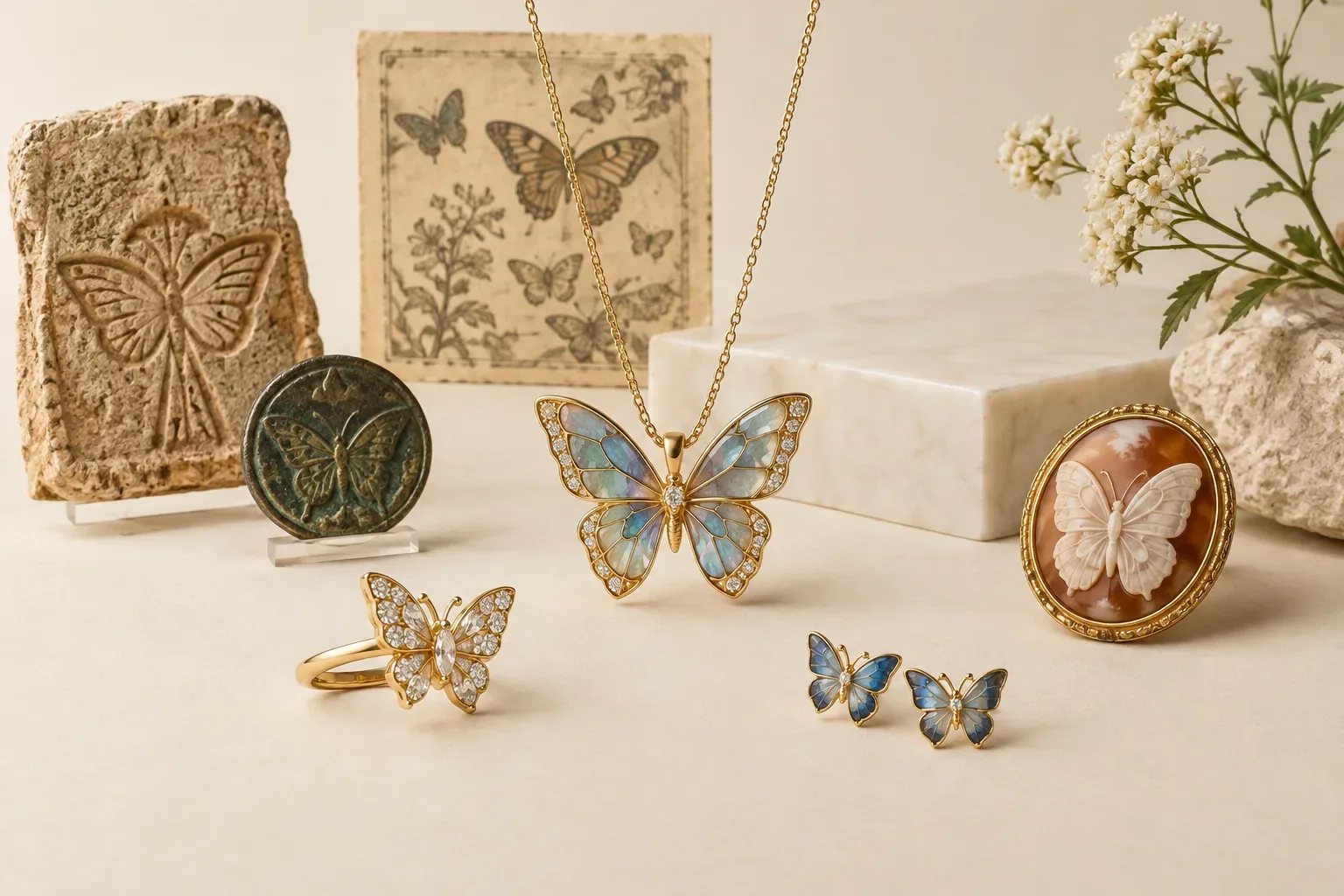
Jewellers interpret the butterfly motif in many forms: as delicate brooches whose wings can be rendered in metalwork, as rings and pendants with openwork or enamel to suggest wing pattern, as gemstone-set pieces using colored stones to mimic wing color, and as minimalist silhouettes in contemporary metal chains. The V&A’s Papillon ring is a museum-documented example of a designer’s contemporary use of the motif, showing how modern techniques and design languages rework the butterfly shape for current tastes.
Materials and techniques used to express the motif range from intricate enamel painting and gem-setting to laser-cut silhouettes and cast sculptural forms. Gemstones commonly used to suggest the color and sparkle of wings include sapphires, emeralds, rubies, and diamonds in historic and modern pieces, while lower-cost or more conceptual pieces may use simulated stones, glass, or colored enamel. For any gemstone claim, the Federal Trade Commission’s consumer guidance on buying gemstones, diamonds, and pearls makes clear that sellers must disclose treatments, enhancements, and simulants, so buyers should always ask for those disclosures when material authenticity matters to them.
Choosing and gifting butterfly jewelry—practical, respectful guidance
Start with the recipient’s taste and the occasion. Some people prefer a literal, naturalistic butterfly with color and detail; others prefer a stylized or minimalist suggestion of a butterfly. Consider whether the piece should read as fashion jewelry, a designer piece, a sentimental gift, or a keepsake. For a jewelry object intended as a sentimental marker—such as commemorating a life change—talk with the recipient, if appropriate, about whether they associate the motif with the intended meaning.
Check materials and disclosures. If the choice of gemstone or precious metal matters to you or the recipient, request written information about metal content and gemstone treatments. The Federal Trade Commission advises buyers to ask sellers whether gems are treated, lab-grown, or simulants. Where provenance, maker, or age factor into value, ask for documentation and, for older pieces, a condition report.
Be culturally respectful. While butterflies are widely used as decorative motifs in many places, do not assume a single symbolic meaning across cultures. Avoid gifting a motif as a supposedly universal religious or cultural symbol without checking that the recipient embraces that reading. When a piece references a specific cultural craft or technique—such as a named historical style—buy from makers who properly credit and compensate those traditions.
Consider wearability and care. Butterflies with delicate enamel or stone settings require more careful wear than simple silhouettes. Ask the seller about recommended cleaning and storage, and include care advice with the gift when appropriate. Small practical choices, like clasp type and chain length for a pendant, can make a gift more wearable and meaningful.
If the piece is intended as a memorial or a very personal symbol, consider personalization options such as engraving, or choose a form that allows the recipient to internalize the meaning rather than imposing an interpretation. A short note explaining why you chose the piece can make a gift feel thoughtful without asserting a single, universal symbolism.
Practical shopping tips and authentication
When buying butterfly jewelry, verify any claims about gemstones or precious metals. The Federal Trade Commission’s guidance on buying gemstones, diamonds, and pearls explains that sellers must disclose treatments, synthetic origins, or simulants. For antique or designer pieces, ask for provenance, maker’s marks, or certificates where available. For modern designer pieces, museum documentation—like the V&A’s article on the Papillon ring—can provide useful context about design trends, but each object should still be evaluated on its own merits.
If you value sustainability or ethical sourcing, ask about supply chains and whether stones or metals are certified. For pieces referencing artisanal traditions, prefer makers who acknowledge and fairly compensate those craftspeople. Simple questions to a seller about materials, signature marks, and return policies can reduce uncertainty and help you select a piece that will be worn and valued.
Putting meaning into a butterfly piece
Because the butterfly motif carries many contemporary associations, the most meaningful way to use it is to make the symbolism explicit to the wearer. A handwritten note, a pairing with a personal inscription, or choosing a technical detail that reflects the recipient’s story will help the piece carry the intended meaning. Museums such as the Victoria and Albert Museum remind us that objects acquire new meanings as they travel through lives and collections; the same is true for jewelry worn across years.
Frequently asked questions
Is the butterfly a universal symbol for transformation?
No. While many contemporary readers associate butterflies with transformation, rebirth, or the soul, these interpretations are modern and culturally variable. Museums such as the Victoria and Albert Museum emphasize that motifs acquire changing meanings in different periods and contexts, so it is best to treat any single symbolic claim as a culturally specific or personal interpretation rather than a universal truth.
How can I tell if a gemstone in a butterfly piece is real or treated?
Ask the seller for written disclosures. The Federal Trade Commission advises consumers to request information about whether gems are natural, lab-grown, treated, or simulants. Reputable sellers should provide clear details about treatments and origin, and for higher-value purchases, consider an independent appraisal.
Are museum butterfly pieces evidence of a single historical meaning?
No. Museum-documented pieces, including the V&A’s Papillon ring by Glenn Spiro, show that the butterfly motif appears across periods, but museums interpret each object according to its date, maker, materials, and documented use. That means a museum example demonstrates usage and design history rather than proving a single, continuous symbolic meaning.
What should I consider when gifting butterfly jewelry?
Consider the recipient’s style and whether they would welcome the motif’s contemporary meanings. Check materials and disclosures, consider personalization or a note to explain the gift’s intent, and be culturally respectful by not assuming the motif carries the same significance for everyone.
Can I wear a delicate enamel or gemstone butterfly piece every day?
Delicate pieces require care. Enamel and small gemstone settings are more vulnerable to knocks and chemicals, so follow the seller’s care instructions and avoid wear during activities that risk damage. For everyday wear, choose sturdier silhouettes or set stones that are securely mounted.
Sources and further reading
- Bedazzled: A History of Jewellery — Victoria and Albert Museum
- Papillon ring by Glenn Spiro — Victoria and Albert Museum
- Buying Gemstones, Diamonds, and Pearls — Federal Trade Commission