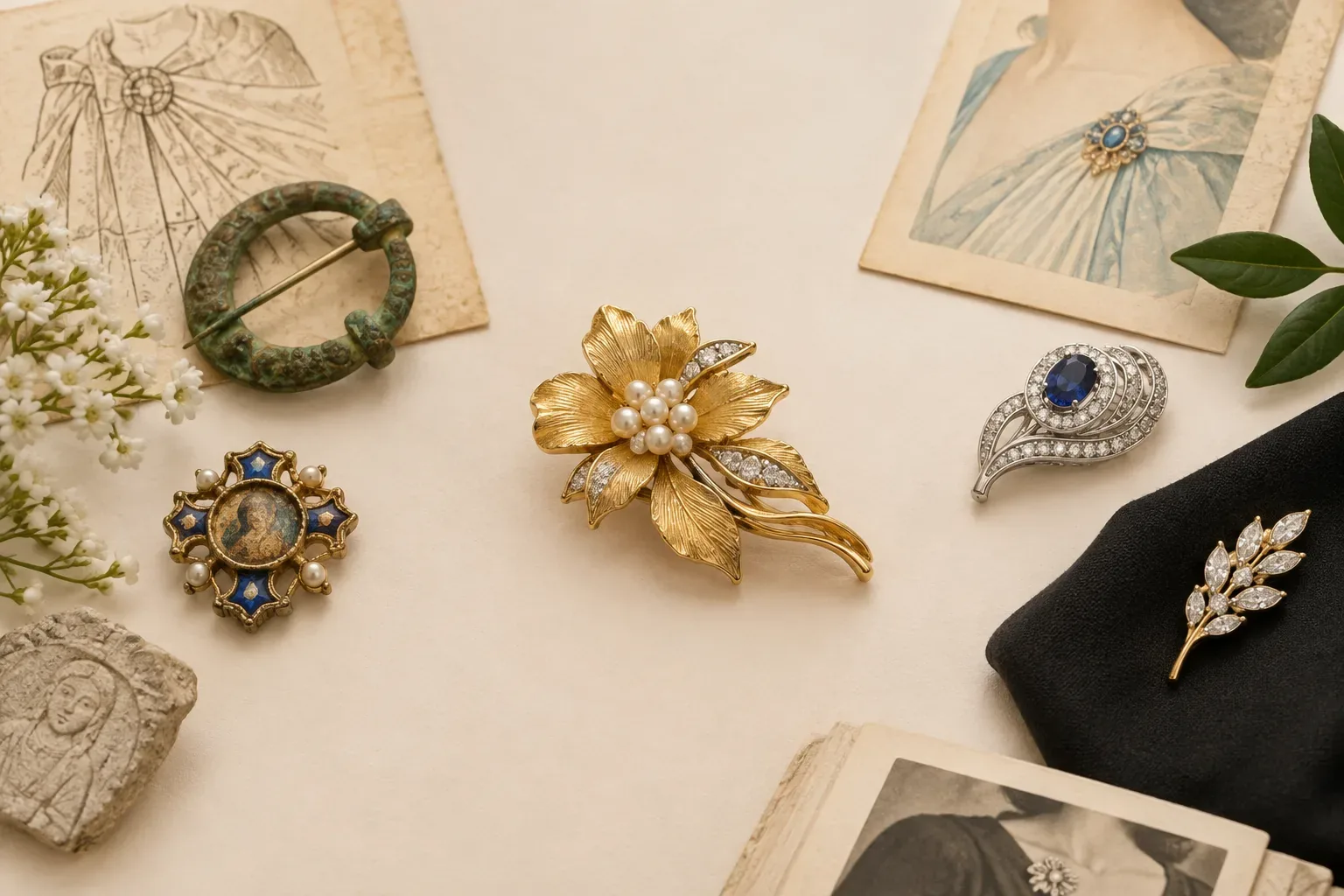
Meaning at a glance
Explain the documented history and changing contexts of the brooch online shopping guide motif, separate cultural or religious evidence from later popular interpretations, and give practical guidance for choosing and wearing the motif in modern jewelry.
Quick answer
A usable brooch online shopping guide focuses on three things: verify documented provenance and condition using clear photos and seller disclosures, distinguish historically documented meanings from later popular or personal interpretations, and use consumer-protection checks (returns, authenticity promises, and treatment disclosures) before you buy. This article explains the historical evidence the Victoria and Albert Museum records, clarifies modern interpretations, and gives practical steps to choose and gift a brooch respectfully and safely.
What the historical record shows (and which cultures it documents)
Museum research shows that brooch-like pins are ancient functional and decorative objects. The Victoria and Albert Museum describes how forms that fasten clothing appear in a wide range of cultures and periods and that their social meaning changed with use and fashion. For example, metal fastenings and ornamental pins served both practical and symbolic roles in ancient, medieval, and later European contexts, with specific styles linked to regional dress and social practice, as recorded by the V&A.
Because brooch forms evolved over centuries, it is important to cite the specific culture or period when discussing historical meaning. The V&A's materials and exhibitions place particular emphasis on the changing social context of jewellery across periods—for instance, brooches used primarily as clothing fasteners in one era may be repurposed as status objects or commemorative tokens in another. When researching a particular piece, look for museum documentation or seller provenance that names the culture, period, and function claimed for that object.
Documented historical meanings versus modern personal or popular interpretations
Documented meanings are those directly supported by contemporary records, inventories, or museum interpretation. For instance, the V&A and related curatorial literature document that certain brooches have been used as practical closures, as indicators of regional dress, and in more recent centuries as sentimental or mourning jewelry. These are historical observations grounded in material culture and archival evidence.
Modern personal or popular interpretations—what a buyer today may feel about a motif—are valid as individual meaning but should not be conflated with historical fact. A floral motif that a modern wearer associates with a family story is a contemporary personal meaning; unless there is documentary evidence that the motif carried that same symbolism historically in the same culture, it should be presented as a personal or modern interpretation, not an established historical meaning.
How motifs, gemstones, and traditions appear in brooches
Motifs: Brooches have carried figurative and abstract motifs—plants, animals, geometric patterns, and portraits—depending on technical capability and fashion. Museum descriptions show that motifs can signal region, function, or fashion: a botanical motif may reflect Victorian tastes, while earlier pieces may feature stylized animal or geometric decoration. Treat any claimed symbolic meaning for a motif with reference to the specific culture and documentation that supports it.
Gemstones and materials: Gemstones appear in brooches as centerpieces or accents and are documented in museum resources. The Victoria and Albert Museum's gemstone guide explains historical use and identification cues for commonly used stones, and notes how different gems were prized in different periods. When a seller claims that a brooch contains a particular gemstone, ask for specific information about identification, treatments, and any accompanying certification.
Traditions and construction: Traditional techniques—stone setting, enamel, repoussé, and metalworking—shape how a brooch looks and wears. The V&A's historical materials emphasize how advances in technique and changing fashions altered brooch scale, detail, and function over time. For online buying, photos and condition reports should show how construction and wear affect value and safety for wearing.
How to assess photos and product information online
Photographs are your primary tool when shopping online. High-quality images should include multiple angles, close-ups of any hallmarks or maker's marks, shots that show scale (a ruler or a coin can help), and photos of the reverse and fastening. Ask the seller for additional images if any of these are missing or blurred.
Product descriptions should state materials, gemstone identifications, dimensions, and condition clearly. If a brooch is described as antique, the seller should explain provenance and any restoration or repairs. For gemstones and treatments, consult authoritative consumer guidance: the Federal Trade Commission requires truthful disclosures about material treatments and imitations. If the listing omits treatment or origin information for gemstones, request clarification before you buy.
Policies to check before you buy
Return and refund policy: Confirm the return window, who pays return shipping, and whether returns are accepted for items described as final sale or estate pieces. Condition disputes are more common with secondhand and antique jewelry, so a clear return policy reduces risk.
Authentication and guarantees: Look for explicit authenticity guarantees, condition reports, and certificates for gemstones when offered. For significant purchases, ask whether the seller will provide a third-party report or whether they accept returns if independent testing contradicts the listing.
Shipping and insurance: Check how the item will be shipped and whether insurance or tracking is included. Antiques and high-value brooches should be shipped with adequate tracking and insured to the item's declared value.
Red flags to watch for
Stock photos reused across multiple listings, missing hallmark close-ups, and vague material descriptions are common red flags. Extremely low prices for items described as antique or set with high-quality gemstones should invite extra skepticism.
Lack of seller contact information, no returns for condition disputes, or resistance to provide additional photos or provenance documentation are also warning signs. In the case of gemstones, the Federal Trade Commission advises that sellers disclose treatments and imitations; absence of such disclosures is a consumer-protection concern.
Selection and gifting guidance (practical and respectful)
Match the brooch to the wearer’s style and lifestyle. Consider metal allergies and daily activities: delicate pins may be unsuitable for someone who uses hands actively. When selecting a motif, research whether the symbol has a strong cultural, religious, or historical association; if it does, decide whether it is appropriate to present as a gift and whether the recipient will appreciate that context.
Antique or culturally specific brooches require sensitivity. If a motif is tied to a particular culture or religious tradition, prefer to buy from reputable sellers who can document provenance and who demonstrate respectful handling of cultural heritage. For a gift with intended symbolic meaning, explain whether that meaning is a documented historical reading or a personal interpretation so the recipient understands the context.
Ask for a condition report and prefer sellers who disclose repairs, missing stones, or unstable fastenings. For irreplaceable or high-value items consider paying for a professional appraisal or third-party certification as part of your purchase process.
After purchase: care, alteration, and documentation
Keep all seller correspondence, receipts, and photos of the item at the time of purchase. If you plan to alter or repair an antique brooch, consult a conservator or jeweller experienced with antique pieces so that repairs are reversible or documented.
For gemstones and treated materials, note any certificates and keep them with the piece. Proper storage, occasional professional cleaning, and safe handling will extend the life of a brooch and preserve any historical patina that contributes to its character and value.
Frequently asked questions
How can I tell if a brooch photo online is trustworthy?
Trustworthy photos show multiple angles, close-ups of hallmarks or maker’s marks, a scale reference, the reverse and fastening, and clear images of any damage. If those images are missing, ask the seller for additional photos before buying.
What documentation should I ask for with an antique brooch?
Ask for provenance information, a condition report, clear images of repairs or restorations, and any certificates for gemstones or metal. Documentation that names a reliable source or past ownership history strengthens a piece’s attribution.
Are sellers required to disclose gemstone treatments?
Yes, the Federal Trade Commission expects truthful disclosure about material treatments and imitations. If a seller does not disclose whether a gemstone has been treated or is a synthetic or imitation, request clarification in writing before purchasing.
What are common red flags in brooch listings?
Red flags include reused stock photos, vague material descriptions, missing hallmarks in photos, no return policy for condition disputes, and prices that seem implausibly low for the claimed materials or age.
How do I choose a brooch as a respectful cultural gift?
Research the motif and its cultural associations. Prefer reputable sellers with clear provenance for culturally specific items, and when in doubt, choose a design without explicit religious or sacred symbolism unless you know the recipient will appreciate it.
Should I get a third-party appraisal?
For high-value purchases or pieces with important provenance claims, a third-party appraisal or gemstone report adds an independent layer of verification and can be worth the cost.
Sources and further reading
- Bedazzled: A History of Jewellery — Victoria and Albert Museum
- An A-Z of Gemstones — Victoria and Albert Museum
- Buying Gemstones, Diamonds, and Pearls — Federal Trade Commission