Meaning at a glance
This article explains the documented history and changing contexts of common ancient Egyptian jewelry symbols, distinguishes museum-backed historical meanings from later or personal interpretations, describes how motifs and gemstones appear in jewelry, and gives practical, respectful guidance for selecting, wearing, and gifting these motifs in modern pieces.
Which symbols and motifs are we talking about?
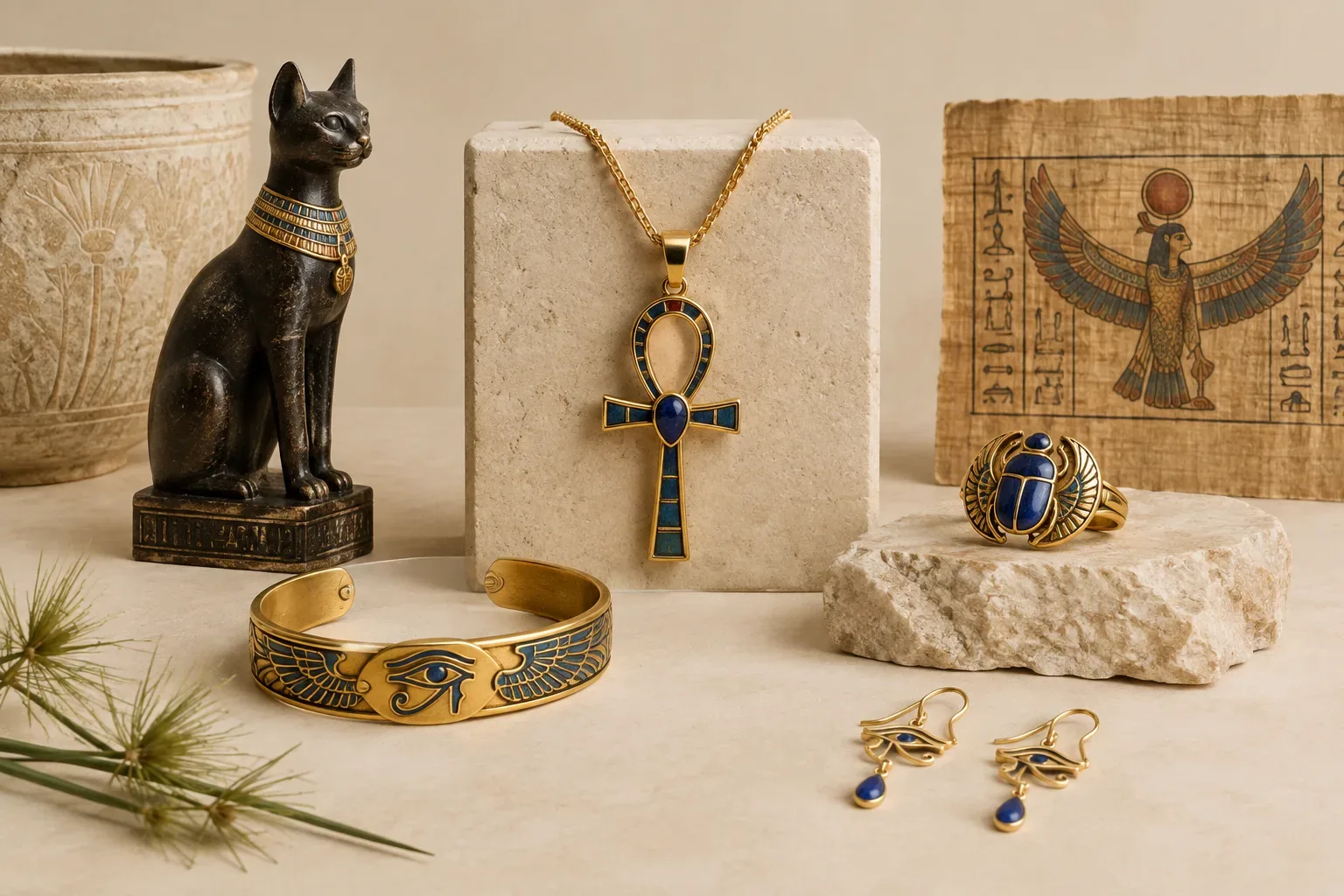
When people search for ancient egyptian jewelry symbols, they most often mean recurrent motifs found in Egyptian archaeology and museum collections: the scarab (dung beetle), the ankh (looped cross), the Eye of Horus (wedjat), the lotus flower, and the uraeus (rearing cobra). These motifs appear alongside depictions of gods such as Horus and the falcon, and in combination with beads, amulets, and inlays. The Victoria and Albert Museum’s overview of jewellery history describes how recognizable forms and motifs recur across Egyptian objects now held in museum collections and discussed in exhibition material.
Historical evidence and periods: what do museums document?
The principal evidence for ancient Egyptian jewelry symbols comes from archaeology, museum collections, and the study of tomb assemblages and temple finds. The Victoria and Albert Museum and similar institutions show that these motifs appear in material dated across long stretches of ancient Egyptian history, with particular concentrations in certain periods. For example, scarab amulets and seals are common in Middle Kingdom and New Kingdom grave contexts, while gold work and refined inlays are especially numerous in elite New Kingdom burials and later Ptolemaic and Roman-period contexts.
Museums catalogue objects by period (for instance, Old Kingdom, Middle Kingdom, New Kingdom, Late Period, Ptolemaic, Roman Egypt), and that chronology matters: the social and ritual uses of a symbol could change between centuries. Exhibition narratives from the Victoria and Albert Museum emphasize that jewellery form, material, and context are all necessary to interpret an object's original function and significance rather than assuming a single, unchanging meaning across time.
Documented historical meanings versus modern interpretations
Museum-backed research helps identify documented uses or likely functions of motifs in their ancient contexts. For example, several motifs appear frequently in funerary assemblages or as seals on objects intended to protect the dead, suggesting roles in protection, rebirth, or identity. The Victoria and Albert Museum’s resources on jewellery history show that objects were often multifunctional: decorative, symbolic, and practical.
However, clear historical meanings are not the same as modern personal or commercial interpretations. Where museum evidence links a motif to protection or rebirth in a funerary context, that documentation does not mean every modern wearer will or should adopt the same intention. Popular Victorian and 20th-century revivals—often described in museum histories—introduced additional layers of meaning and fashion that are distinct from the ancient contexts. In short: documented ancient roles are evidence-based claims about how objects were used in specific cultural and temporal settings; contemporary symbolic uses are personal, cultural, or stylistic choices that may intentionally diverge from or reimagine those ancient roles.
Gemstones, materials, and what the museums say
Ancient Egyptian jewellery frequently pairs motifs with particular materials: gold, carnelian, lapis lazuli, turquoise, and faience are well-attested in museum collections. The Victoria and Albert Museum’s 'An A–Z of Gemstones' explains historical uses and the cultural importance of these materials in decorative arts. Lapis lazuli and turquoise, for example, were prized for their color and often associated with lapis’s import from long-distance trade and turquoise’s ornamental use in inlays.
Material choices in antiquity had practical and symbolic dimensions: gold’s permanence and color, stone colors that echoed particular associations, and faience’s glossy blue-green glaze could all contribute to an object's perceived power or prestige. Modern makers often reference these historical associations in design, but the meanings they ascribe—such as a modern belief that a particular stone confers luck—come from contemporary or alternative spiritual frameworks rather than direct ancient sources.
How these motifs and materials appear in jewellery (historic and modern forms)
In ancient contexts, motifs were rendered as amulets, bead inlays, pectorals, rings, and necklace pendants. Scarabs were frequently carved in stone or faience as seal amulets, ankhs were cast or modeled in gold and bronze, and the Eye of Horus was formed as inlaid amulets or hieroglyphic motifs on plaques. Museums document these forms in hoards, tombs, and temple offerings, and exhibition narratives often highlight the combination of material and form when interpreting an object's original use.
In contemporary jewellery, these motifs are adapted as pendants, rings, cufflinks, engraved or laser-cut metalwork, and fashion jewelry mass-produced in a variety of materials. Designers may copy the shape of an ancient pectoral, simplify hieroglyphic detail into a modern pendant, or set turquoise and lapis in ways that reference ancient color palettes. When reproducing ancient forms, makers differ widely in their faithfulness to archaeological technique and in the transparency of materials and treatments.
Practical and respectful selection or gifting guidance
If you are choosing or gifting jewelry featuring ancient Egyptian symbols, consider three practical and respectful priorities: historical awareness, material transparency, and the recipient’s relationship to the imagery. First, learn what museums and reputable sources document about a motif’s historical contexts so you understand whether a symbol appears in funerary, protective, or civic uses and in which periods. The Victoria and Albert Museum’s publications and catalogues are a useful starting point for this background.
Second, insist on transparent information about materials and treatments. The U.S. Federal Trade Commission provides guidance on disclosures that dealers should make about gemstone treatments, imitations, and the nature of materials used. Ask sellers whether stones are treated, whether metal is gold-filled, plated, or solid, and request written confirmation if authenticity matters to you.
Third, think about cultural sensitivity. Symbols that have ritual associations in ancient Egyptian religion are being repurposed in modern contexts by many different communities; avoid claiming universal or 'authentic ancient' meanings that cannot be supported by evidence. If gifting to someone with Egyptian heritage or a direct cultural link, consider asking whether such imagery would be welcome. When in doubt, choose items that respect provenance, give preference to makers who are transparent about their sources, and communicate why you chose the piece.
Buying, care, and ethical concerns
Provenance and maker transparency matter. Museums emphasise context: an object’s archaeological or documentary provenance affects how we understand it. For modern purchases, request clear information on where materials came from and how a piece was made. The Federal Trade Commission’s guidance on buying gemstones recommends that consumers ask about origin, treatments, and whether stones are natural or lab-grown and urges sellers to disclose imitations and treatments.
Care for materials according to their type—gold needs different maintenance from faience or inlaid stones—and verify cleaning instructions with the seller. Finally, be wary of mass-market items that present themselves as 'authentic ancient' without provenance; museum scholarship treats provenance and context as essential to historical claims, and buyers should too.
Final thoughts
Ancient Egyptian jewelry symbols are rich visual languages recorded in material culture; museums such as the Victoria and Albert Museum document how motifs and materials functioned in particular historical contexts. When using these symbols today, separate what is supported by archaeological and curatorial evidence from later fashions and personal meanings. Choose pieces with attention to provenance and material disclosure, and gift with sensitivity to the recipient’s relationship to the imagery.
Frequently asked questions
What did the scarab symbol mean in ancient Egypt?
Museum research documents the scarab as a common amulet form linked with protection, identity, and rebirth in particular contexts such as seals and burial assemblages; its specific functions can vary by period and find context, so consult museum catalogues for details.
Does the ankh always mean 'life'?
The ankh is widely associated in Egyptian art with life-related imagery, but museums stress interpreting such symbols in context: the ankh appears in temple and funerary scenes and on amulets, and the nuances of meaning depend on period and use rather than a single universal definition.
Are the gemstones used in ancient Egyptian jewellery the same as those sold today?
Many of the same materials—gold, carnelian, lapis lazuli, turquoise, and faience—feature in both ancient objects and modern pieces. The Victoria and Albert Museum’s gemstones guide explains historical and modern uses; for purchases, ask sellers about treatments and whether a stone is natural or synthetic, following Federal Trade Commission guidance.
Can I wear ancient Egyptian symbols without being disrespectful?
Yes, you can wear these symbols respectfully if you are informed about their histories, avoid claiming modern or ancient universality, choose makers who are transparent about provenance, and consider the preferences of recipients with direct cultural ties to Egypt.
How can I tell if jewellery claiming to be 'ancient Egyptian' is authentic?
Authenticity requires provenance and specialist assessment. Museum scholarship treats archaeological context as essential; for purchases, request documentation of origin and consider expert appraisal rather than relying on marketing claims.
What should I ask sellers about gemstones and treatments?
Ask whether stones are natural, treated, or synthetic, whether metal is solid or plated, and request written disclosure of any treatments or imitations. The Federal Trade Commission recommends documented disclosure of gemstone origin and treatment.
Sources and further reading
- Bedazzled: A History of Jewellery — Victoria and Albert Museum
- An A-Z of Gemstones — Victoria and Albert Museum
- Buying Gemstones, Diamonds, and Pearls — Federal Trade Commission