Meaning at a glance
Explain the documented history and changing contexts of the alexandrite treatments and imitations motif, separate cultural or religious evidence from later popular interpretations, and give practical guidance for choosing and wearing the motif in modern jewelry.
Short answer
Alexandrite treatments and imitations matter because they change appearance, durability, and value; buyers should expect honest disclosure and a written report when possible, and they should ask whether a stone is natural, treated, synthetic, or an imitation before purchasing or gifting. This article explains historically documented uses of gemstones, distinguishes those records from modern personal meanings, describes how alexandrite appears in jewelry, and offers practical, respectful questions to ask sellers and gift recipients.
What the historical record actually shows
Museums and scholarly collections show that gemstones have long been valued for color, rarity, and cultural associations, and that those uses changed over time with fashion, technology, and trade. The Victoria and Albert Museum documents how jewelry has shifted in social meaning across periods, from status and religious uses to sentimental and personal symbolism, and how new materials and techniques altered what was desirable (Victoria and Albert Museum).
That broader history is the relevant documented record for alexandrite: the ways people have prized color-change or rare-colored stones fit into the wider pattern the museum describes. The V&A’s resources on gemstones explain identification and historical context rather than universal symbolic claims; they show that what people valued in a gem—color, rarity, or technical novelty—depends on time, place, and social class (Victoria and Albert Museum).
Documented historical meanings versus modern personal interpretations
Documented meanings are the practices and associations that historical records, museum collections, and contemporary accounts actually describe. For gemstones generally, those records show that jewelry signaled status, marked rites of passage, and followed changing fashions (Victoria and Albert Museum). These are the kinds of claims you can support with historical evidence.
Modern personal interpretations—such as assigning a specific mystical power or a universally shared emotional meaning to alexandrite—are not the same as documented historical fact. People today often attach personal symbolism to stones because of color-change effects, rarity, or popular articles, but those meanings vary by culture, community, and individual preference. Treat modern spiritual or personal meanings as contemporary choices rather than documented, universal truths.
How alexandrite typically appears in jewelry
In practice, stones sold as alexandrite are mounted in the same ways other faceted colored stones are used: as center stones in rings, in pendants, studs and drop earrings, and as accent gems in more complex settings. Museum coverage of jewelry history shows that gem placement, setting style, and metalwork are often shaped by period taste and by the technical properties of the stone being set (Victoria and Albert Museum).
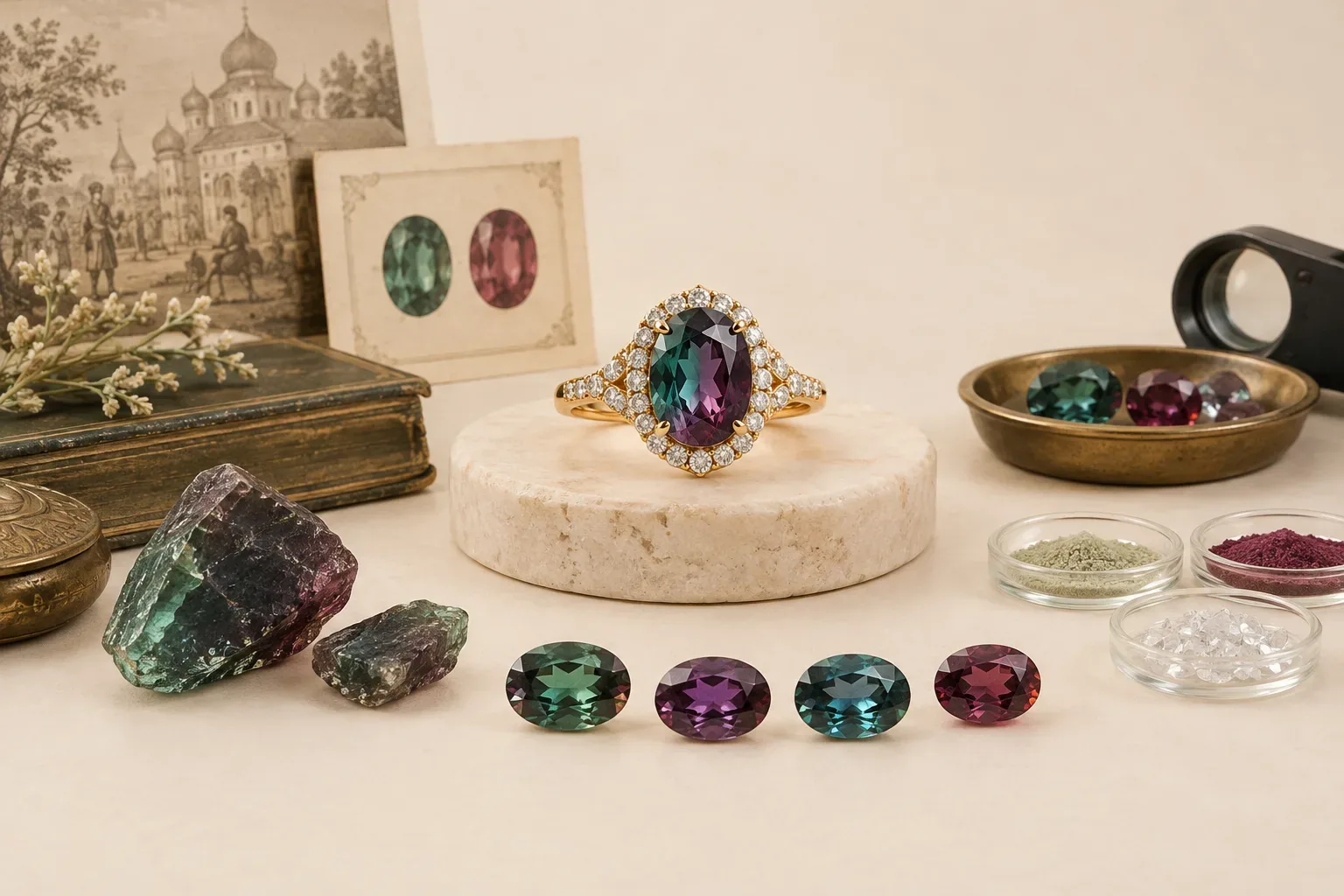
Because color and color change are the most admired features for alexandrite-style gems, jewelers and designers commonly use settings that show the stone’s face-up color and allow the wearer to view its effect in different lights. Antique and vintage pieces that include rare or unusual gemstones are represented in museum collections as examples of how taste and technology intersected in a given era (Victoria and Albert Museum).
Treatments, synthetics, and imitations — what to know
Several categories of material appear in the market for alexandrite-style stones. Treated natural stones are natural gemstones that have been changed to improve color, clarity, or durability. Synthetic stones are laboratory-grown gems with the same chemical composition and structure as their natural counterparts. Imitations are materials that only visually resemble alexandrite but do not share its composition. All three are common across colored gemstone markets.
From a consumer-protection perspective, the Federal Trade Commission makes clear that disclosure is essential: sellers should tell buyers if a stone has been treated, is synthetic, or is an imitation, and any treatment should be described accurately (Federal Trade Commission). That is the practical standard buyers should rely on rather than assumptions about a shop or label.
Questions to ask sellers and what answers to expect
Before you buy or accept a piece as a gift, ask whether the stone is natural, treated, synthetic, or an imitation. Ask for the nature and permanency of any treatment the seller reports. Ask whether a reputable gemological laboratory report accompanies the stone and, if so, which lab issued it. According to the consumer guidance summarized by the Federal Trade Commission, sellers should disclose these facts and provide written information when requested (Federal Trade Commission).
If a seller says a stone is treated or synthetic, ask what that means for everyday wear and care. Some treatments require special handling or temperature limits; some synthetics may be less expensive and more durable than a rare natural stone. If you prioritize rarity or resale value, a natural, untreated stone with a lab report will usually be the clearest option. If you prioritize color or affordability, a disclosed treated or synthetic stone can be a fine, sensible choice—so long as disclosure is clear and documented.
Selection and gifting guidance with cultural respect
Choose with context in mind. If you are selecting alexandrite-style jewelry as a gift, consider the recipient’s taste, their interest in natural versus synthetic materials, and the meaning they place on rarity. Because historical uses of gemstones varied by society and period (Victoria and Albert Museum), do not assume a single symbolic meaning will be received the same way by different people.
Be candid and respectful when gifting. If the piece is treated, synthetic, or an imitation, label it as such in your note or conversation and explain why you chose it—perhaps for its color, durability, or design. If the recipient values provenance or investment potential, present documentation of treatment or authenticity. Transparency honors both the buyer’s rights under consumer guidance (Federal Trade Commission) and the recipient’s ability to make an informed choice.
Final takeaways
Alexandrite treatments and imitations are part of the normal contemporary market for colored stones. Historical records show that gemstones’ meanings and uses change with time and place (Victoria and Albert Museum), so modern symbolic claims should be treated as personal or cultural choices rather than universal facts.
Practically, rely on disclosure and documentation. Use simple, direct questions about natural versus treated versus synthetic versus imitation materials, and request written reports when available. Sellers are expected to disclose material treatments and imitations to consumers (Federal Trade Commission). That approach protects both value and emotional intent when you buy or give alexandrite-style jewelry.
Frequently asked questions
How can I tell if an alexandrite is natural or synthetic?
Ask the seller for a written description of the stone and any laboratory report. Reputable sellers will disclose whether a stone is natural, treated, synthetic, or an imitation. The Federal Trade Commission advises buyers to request clear disclosure and documentation (Federal Trade Commission).
Do treated alexandrite-style stones perform less well in jewelry?
It depends on the treatment. Some treatments improve color or durability without affecting daily wear; others may require special care. Ask the seller to explain the treatment’s nature and any care recommendations, and request that information in writing.
Are synthetic alexandrites a good alternative to natural stones?
Synthetic stones can offer consistent color and lower cost while having the same chemical composition as natural stones. If you value natural rarity, choose a documented natural stone; if you prioritize color or price, a disclosed synthetic may be a suitable, honest alternative.
What should I expect on a gemological report?
A reputable report will identify whether a stone is natural, treated, synthetic, or an imitation and describe any treatments detected. If you are buying a high-value piece, request a report from a well-known laboratory and have the seller note the lab’s name on the paperwork.
Is an imitation alexandrite always a bad purchase?
No. An imitation can be an affordable option if the buyer understands it is not a natural stone and the seller openly discloses that fact. The important point is transparent labeling so expectations about value and care are accurate.
What should I say when gifting a treated or synthetic piece?
Be transparent in a respectful way. Explain why you chose the piece—its color, design, or durability—and mention any treatments or synthetic origin if they matter to the recipient. Honesty preserves trust and allows the recipient to value the gift appropriately.
Sources and further reading
- Bedazzled: A History of Jewellery — Victoria and Albert Museum
- An A-Z of Gemstones — Victoria and Albert Museum
- Buying Gemstones, Diamonds, and Pearls — Federal Trade Commission