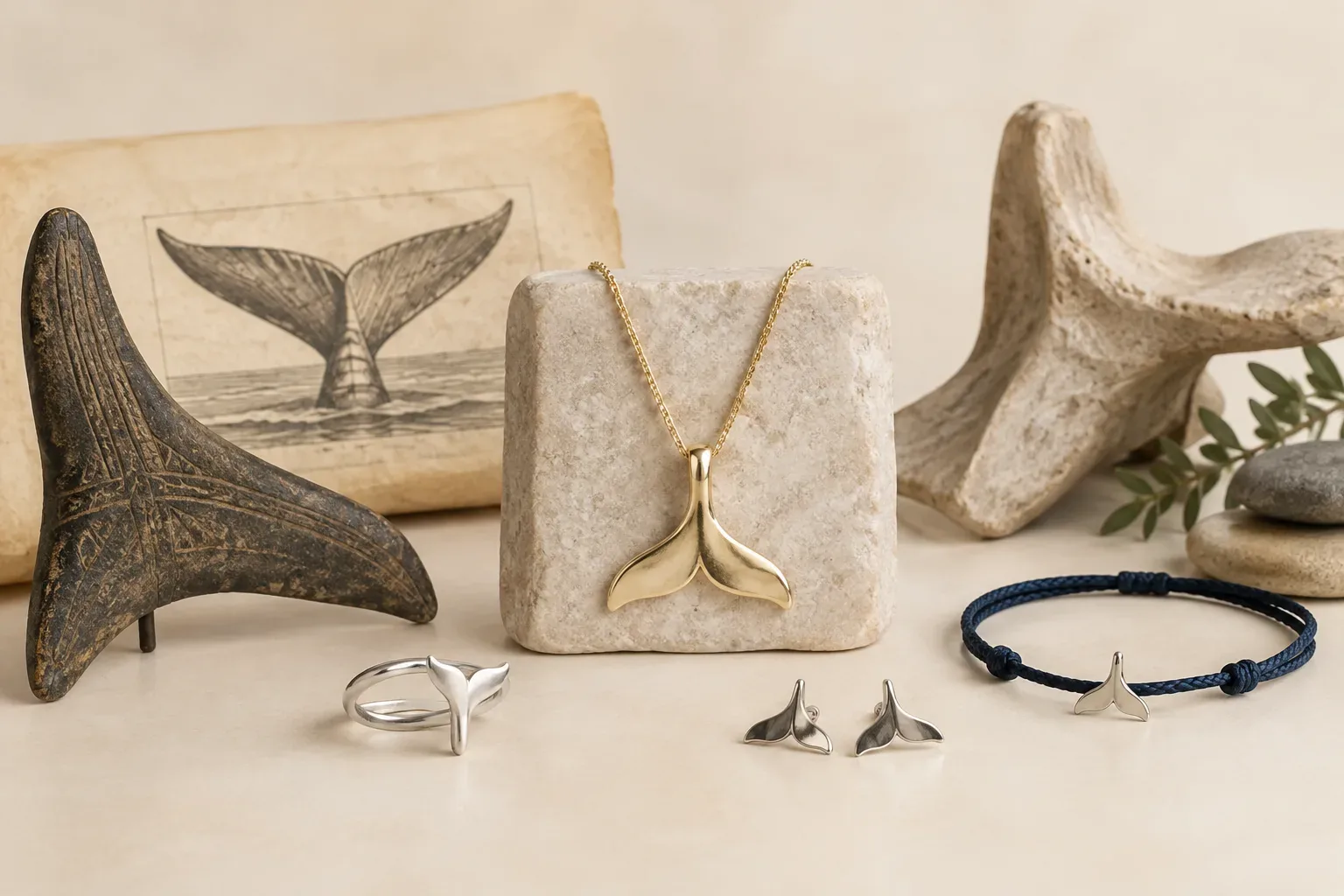
Meaning at a glance
Documented historical evidence for the whale tail motif in jewelry is limited; museums note that jewelry motifs shift with social contexts, and many of the meanings attributed to whale tails today are modern personal or commercial interpretations inspired by whales’ natural qualities and coastal cultures. Choose and gift whale tail jewelry by checking material disclosures, respecting conservation sensitivities, and matching the design to the recipient’s relationship with the sea.
Historical evidence and sources
Surveys of jewelry history in museum collections and exhibitions show how motifs have been adopted, adapted, and reinterpreted across periods and regions rather than remaining fixed in meaning. The Victoria and Albert Museum describes how changing social contexts shape jewelry styles and symbolism, and that museums often document motifs as part of shifting fashion and personal meaning rather than as unchanging cultural constants. That general pattern helps explain why direct, widely attested historical use of a specific whale tail motif in jewelry is limited in the published museum record.
Because the academic and curatorial literature collected by museums emphasizes varied and changing uses of motifs, it is safest to say that the whale tail as a distinct jewelry motif has stronger documentation in recent decades — in modern souvenir, surf, and coastal design traditions — than as an archetypal symbol with deep, universally documented ancient roots. Where particular communities historically used marine imagery, those practices are best treated case by case and supported by specific ethnographic or archaeological evidence; the museum overview cautions against assuming a single, continuous meaning across time and place.
Separating documented history from modern interpretations
Documented history: The clearer, evidence-based statements are twofold. First, museum research shows that jewelry motifs gain and lose popularity and that curators document these shifts rather than treating motifs as timeless emblems. Second, zoological and conservation resources identify whales as major marine animals with particular biological traits; those facts form the factual backbone for later symbolic use and are recorded by scientific authorities such as NOAA Fisheries.
Modern interpretations: Contemporary meanings attached to the whale tail — for example, ideas of protection for sailors, luck, freedom, environmental stewardship, or personal ties to the ocean — largely derive from recent cultural trends. These associations arise from popular culture, coastal tourism, surfer and bohemian aesthetics, and personal storytelling. They are meaningful to people today but should not be presented as universal or historically continuous. Always qualify symbolic claims and attribute them as contemporary or culturally specific when known.
How the motif and related materials appear in jewelry
The whale tail motif appears in modern jewelry across a range of forms. Designers commonly render the tail as a stylized pendant, charm, small sculptural element on a ring, or as a repeating motif in a bracelet or earring. Museums that document jewelry techniques note that motifs are expressed in whatever materials and techniques are available and fashionable in their era, so contemporary whale tails show up in metals, enamels, mother-of-pearl, engraved surfaces, and set stones depending on the maker’s intent.
Gemstones and organic materials sometimes accompany the motif. Pearls and mother-of-pearl are logical companions given their marine origin, though consumers should pay attention to materials disclosures: government consumer guidance explains how gemstones, diamonds, and pearls can be treated, imitated, or enhanced, and stresses the importance of accurate disclosure by sellers. For symbolic or ethical reasons many modern makers avoid using actual whale derivatives and instead use non-animal alternatives or synthetic materials to evoke the ocean without implicating protected wildlife.
Design choices also reflect scale and wearability. A small whale-tail charm may be used on a bracelet or anklet as a subtle emblem, while a larger pendant becomes the focal point on a chain. The motif may be figurative and anatomically detailed, or highly abstracted into a simple crescent or split-tail silhouette. Exhibition and collection studies show that such visual simplification or stylization is a common way jewelry makers make motifs widely wearable and durable.
Choosing and gifting whale tail jewelry: practical and respectful guidance
Match meaning to the recipient. Before buying, consider what the whale tail would signify to the wearer. Is it a memento of a shared trip to the coast, a nod to a love of marine life, a fashion statement associated with surf culture, or a symbol of resilience or freedom the recipient values? For gifts intended to carry a message — for example, a token of safe travels — explain your intention in a card so the meaning is explicit rather than assumed.
Ask about materials and disclosures. Follow consumer guidance and ask sellers to identify metals, gemstone treatments, and material origins. The Federal Trade Commission advises that buyers verify claims about gemstones, diamonds, and pearls because treatments, enhancements, and imitations are common. If a piece includes pearls or precious stones, request written disclosure of any treatments and of the country or method of origin when available.
Respect conservation and cultural sensitivity. Whales are prominent marine species with scientific and conservation importance noted by NOAA Fisheries, and many people attach conservation value to marine imagery. If the wearer is conservation-minded, choose pieces made from non-whale materials and from makers who prioritize sustainable practices. Avoid items that claim to contain whale parts unless you can verify legality and ethical sourcing; when in doubt, select materials such as recycled metals, lab-grown gems, or responsibly harvested mother-of-pearl alternatives.
Consider craftsmanship and longevity. A well-made piece will be wearable for years; evaluate metal purity, soldering quality, clasp durability, and stone settings. Discuss care instructions with the seller so you can include them with the gift. If the recipient has metal sensitivities, select hypoallergenic metals or ensure a suitable plating or lining is present.
Be mindful of context and occasion. Whale tail jewelry can be casual or elevated depending on materials and design. A sterling silver charm is suitable for everyday wear, while a gold pendant set with gemstones can be appropriate for significant milestones. Think about how the recipient dresses and what they will feel comfortable wearing in their daily life.
When to question historical or cultural claims
If a seller or marketing copy asserts that a particular whale tail design is an ancient symbol from a named culture, ask for the supporting evidence. Museum literature emphasizes that motifs often reflect recent fashions and personal meanings, and that solid cultural claims should be backed by ethnographic or archaeological sources. Insist on provenance for older or ethnographic pieces and be wary of romanticized narratives that lack documentation.
Similarly, if a piece purports to include rare or protected animal materials, request clear legal and sourcing documentation. Modern ethical and legal frameworks around wildlife materials are complex; if the provenance is unclear, opt for verified alternatives. Sellers who are transparent about materials and provide certificates or verifiable provenance are generally safer choices for both ethical and quality reasons.
Frequently asked questions
Is the whale tail a traditional symbol in any specific culture?
There is not broad, uncontested documentary evidence that the whale tail has a single traditional meaning across a particular culture; museum studies emphasize that motifs often acquire new meanings over time, and claims about ancient cultural origins should be supported by specific ethnographic or archaeological sources.
What do people commonly mean when they say a whale tail symbolizes something?
In contemporary use the whale tail commonly stands for a personal connection to the sea, a sense of freedom or journey, or an affinity with marine life; these are modern interpretations rather than universal historical meanings and vary by wearer and community.
Are real whale parts used in whale tail jewelry?
Most contemporary makers do not use real whale parts; many consumers and designers prefer alternatives for ethical and legal reasons. If a piece claims to contain whale-derived materials, request seller documentation and consider choosing non-whale alternatives if you have conservation concerns.
How can I verify the gemstones or pearls in a whale tail piece?
Ask the seller for written disclosure of gemstone treatments, enhancements, and whether pearls are natural, cultured, or imitation. The Federal Trade Commission advises buyers to obtain clear information because treatments and imitations are common.
Is whale tail jewelry appropriate to gift for a special occasion like an anniversary or graduation?
Yes, when the motif suits the recipient’s tastes and the meaning you intend. Match the piece’s formality, materials, and message to the occasion, and consider including a note explaining the thought behind the gift so the symbolic intent is clear.
How should I care for whale tail jewelry?
Care depends on materials. Ask the maker for specific instructions. For metal pieces, store them dry and polish according to metal type; for pieces with pearls or organic materials, avoid harsh chemicals and prolonged moisture. Good sellers will provide care guidance.
Sources and further reading
- Bedazzled: A History of Jewellery — Victoria and Albert Museum
- 11 Cool Facts About Whales, Dolphins, and Porpoises — NOAA Fisheries
- Buying Gemstones, Diamonds, and Pearls — Federal Trade Commission