Meaning at a glance
Explain the documented history and changing contexts of the octopus motif, separate cultural or religious evidence from later popular interpretations, and give practical guidance for choosing and wearing the motif in modern jewelry.
Quick answer
Octopus jewelry meaning is not a single, ancient, universally agreed symbol. Museum scholarship shows that animal and sea motifs have long appeared in jewellery and that meanings shift with time and place; specific, well-documented historical uses of the octopus motif are comparatively limited in museum catalogues and tend to be better documented in modern and revival pieces. Today, wearers commonly ascribe personal meanings—such as adaptability, mystery, creativity, or protection—to octopus designs, but those are modern interpretations rather than universal historical facts.
What the museum record and jewellery history show
Overview sources from major museums emphasize that jewellery motifs follow changing social, economic, and aesthetic contexts. The Victoria and Albert Museum presents a long view of jewellery history showing how designers repeatedly draw on nature and the sea for motifs and that the social functions of jewellery—from status to remembrance—change over time (Victoria and Albert Museum). This museum-level scholarship is useful for understanding why animal forms appear and reappear in jewellery styles across periods, but it does not convert every motif into a single, continuous symbolic meaning.
Documented historical evidence for the octopus motif
While many natural and marine forms are well represented and catalogued in museum collections, the record for octopus-specific motifs is more limited. Museum surveys and exhibitions that cover jewellery history place more emphasis on broader categories—such as animals, mythical sea creatures, and plant forms—than on a continuous tradition of octopus imagery. Where octopus designs are visible in collections and commercial archives, they are often associated with late 19th- and 20th-century oceanic fashion, seaside tourism jewellery, and contemporary artisanal revivals rather than an unbroken ancient symbolic lineage (Victoria and Albert Museum).
Because comprehensive cataloguing varies between collections, the presence or absence of octopus motifs in a museum does not by itself prove wide historical use or a particular meaning. The safest historical claim, supported by museum-level literature, is that natural and marine motifs have recurred in jewellery and that octopus designs are most clearly traceable in more recent, modern contexts rather than as a single, ancient symbol with a single meaning.
Separating documented historical meanings from modern interpretations
Documented meanings in the historical record are generally tied to the broader categories described by museums: motifs used for status, commemoration, sentimental symbolism, or fashion trend. Where an octopus appears historically in jewellery, museum records tend to situate it within those broader functions rather than assign a single, specific symbolic role (Victoria and Albert Museum).
Modern interpretations—what many people think of when they ask about 'octopus jewelry meaning'—are typically personal or drawn from recent popular culture, literature, and design communities. Contemporary wearers and makers may describe the octopus as a symbol of intelligence, flexibility, mystery, regeneration, or protection, but these associations are current cultural readings and should not be presented as universal historical truths. If you want biological context about cephalopods or marine life separate from symbolism, consult dedicated science resources such as NOAA Fisheries for reliable biological information rather than jewellery histories (NOAA Fisheries).
How the octopus motif appears in jewellery: styles, materials, and gemstones
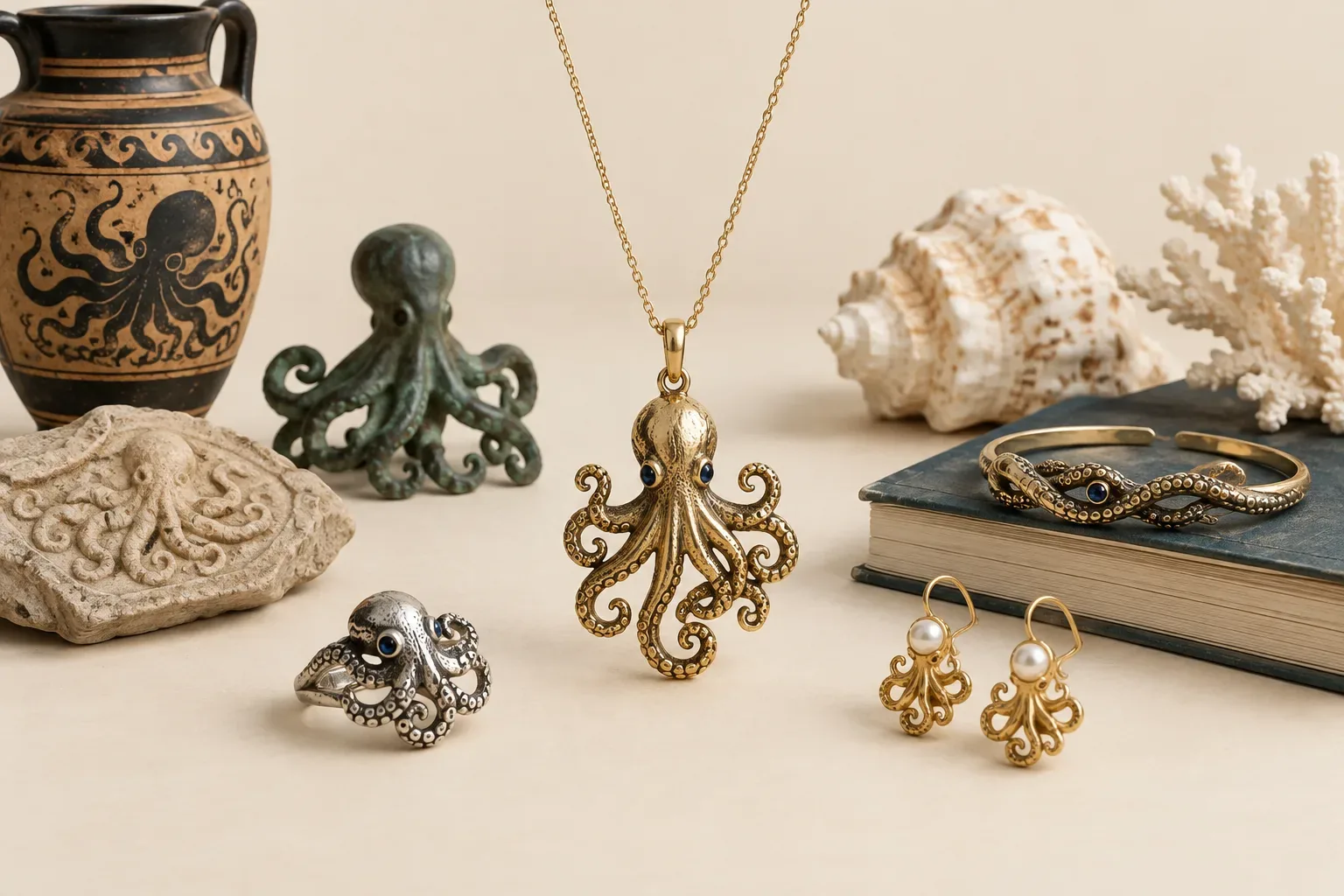
In modern jewellery the octopus motif appears across formats: pendants, rings, brooches, earrings, and charms. Designers may portray the animal realistically with detailed tentacles and suckers, stylize it into an abstract form, or combine it with other ocean imagery such as shells, coral-like scrollwork, or waves. Larger statement pieces use three-dimensional sculptural metalwork, while smaller charms reduce the form to a silhouette or line-drawing aesthetic.
Common materials and techniques include precious metals such as sterling silver and gold, mixed-metal treatments, enamel to introduce color and shine, and gem accents used for eyes or body decoration. Pearls and iridescent stones such as opal are often paired with ocean motifs for a marine feel. Contemporary designers also set colored gems like peridot or tourmaline in octopus pieces; when a gemstone is part of the design, ask about treatments and origin because many gems are heat-treated, lab-created, or filled—disclosures the Federal Trade Commission recommends consumers request when buying gemstones (Federal Trade Commission).
Artisanal and handmade octopus jewellery often emphasizes texture—curling tentacles, openwork, and movable elements—while mass-market pieces can rely on cast charms and plated finishes. Choices of scale and finish matter for wearability: a finely detailed silver pendant reads differently from a gold-plated charm on a bracelet.
Practical guidance for choosing, wearing, and gifting octopus jewellery
Start by separating intent from aesthetics. Decide whether you want the piece for its visual appeal, as a personal emblem for the wearer, or as a culturally specific symbol. If the recipient values symbolic meaning, ask or research what the octopus denotes to them personally rather than assuming a universal meaning. If you prefer a neutral choice, select a smaller, wearable design that emphasizes form and craftsmanship rather than an explicit symbolic statement.
Consider materials and wearability. If the recipient has metal sensitivities, choose nickel-free metals or confirm hypoallergenic claims. For gemstone-set pieces, follow FTC guidance by requesting written disclosures about treatments, whether stones are natural, lab-created, or simulants, and any grading or certification (Federal Trade Commission). Avoid misrepresentations by buying from reputable sellers and keeping receipts and any accompanying documentation.
Be mindful of cultural and contextual sensitivities. If you suspect a motif has religious or culturally specific significance for a particular community, research carefully before gifting and consult reliable sources or the recipient. Use our practical guides on researching symbols to learn respectful approaches and questions to ask (see 'How to Research the Meaning of a Jewelry Symbol').
Match scale and lifestyle to the wearer. A daily-wear necklace should be durable and low-profile, while a statement brooch or ring can be reserved for occasions. For gifts, consider reversible or subtle designs so the recipient can choose how publicly to wear the piece. If you want to pair symbolism with birthstones or personal color preferences, select gemstones thoughtfully and confirm authenticity as noted above.
Finally, care for the piece. Instructions from makers vary; in general, protect plated finishes from chemicals and moisture, clean solid precious metals gently, and store gemstone pieces separately to avoid abrasion. Keep any seller-provided care instructions and documentation for future reference.
Concluding notes
Octopus jewellery meaning today sits mainly in the realm of modern interpretation and personal symbolism rather than a single, well-documented historical tradition. Museum overviews of jewellery history help explain why marine and animal motifs recur and how meanings shift with fashion and function (Victoria and Albert Museum). If you are buying or gifting an octopus piece, prioritize craftsmanship, material disclosures, and respect for the recipient's cultural context and personal associations. For scientific questions about the animal itself, consult marine science resources such as NOAA Fisheries rather than jewellery sources (NOAA Fisheries), and for gemstone authenticity and disclosures consult official consumer guidance from the Federal Trade Commission (Federal Trade Commission).
Frequently asked questions
Does octopus jewelry have one fixed historical meaning?
No. Museum scholarship shows jewellery motifs change by period and place, and octopus designs do not have a single, universally documented historical meaning; modern meanings are often personal or cultural rather than ancient facts.
Are octopus symbols tied to any particular culture or religion historically?
Museum overviews indicate animal and marine motifs have appeared in many cultures, but specific religious or cultural associations for the octopus motif are not broadly documented in museum catalogues as a single tradition; context matters and claims should be checked against reliable historical sources.
What should I ask when buying an octopus piece with gemstones?
Ask the seller for written disclosures about whether stones are natural, treated, lab-created, or simulants and for any grading or certification. The Federal Trade Commission recommends getting these details in writing for clarity and future resale.
Is octopus jewellery appropriate as a gift?
It can be, if you consider the recipient’s taste and how they interpret symbols. Choose a style and scale that match their daily life and be sensitive to any cultural or religious meanings the recipient may care about.
How should I care for octopus jewellery?
Care depends on materials: protect plated finishes from moisture and chemicals, clean solid metals gently, and store gemstone pieces separately. Follow any maker-supplied care instructions and keep purchase documentation.
Where can I find reliable biological facts about octopuses separate from symbolism?
For trustworthy scientific information about marine animals, consult marine science resources such as NOAA Fisheries rather than jewellery or cultural history sources.
Sources and further reading
- Bedazzled: A History of Jewellery — Victoria and Albert Museum
- 11 Cool Facts About Whales, Dolphins, and Porpoises — NOAA Fisheries
- Buying Gemstones, Diamonds, and Pearls — Federal Trade Commission