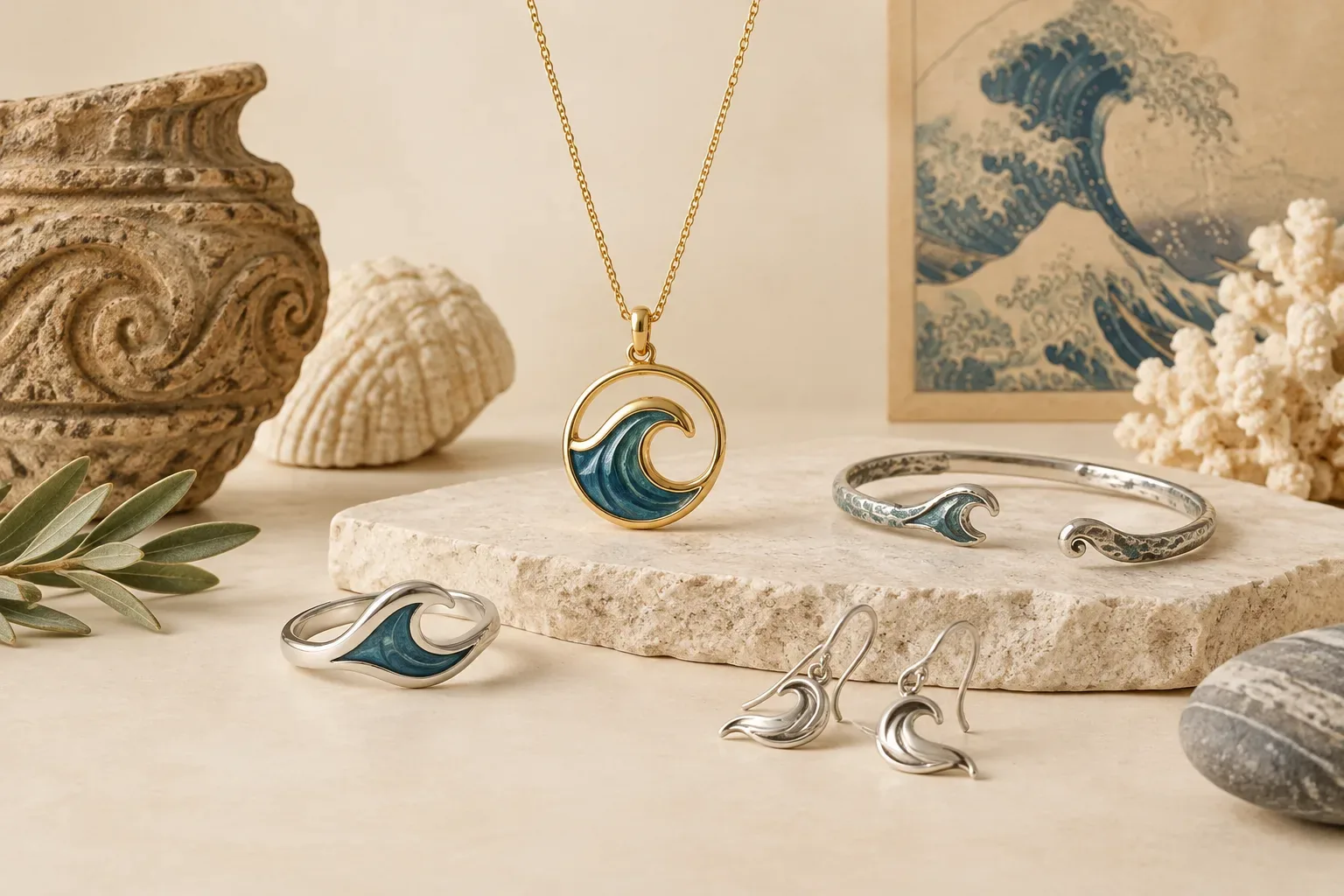
Meaning at a glance
The ocean wave motif in jewelry has a long history as a decorative natural form used across periods; documented museum histories stress changing contexts rather than a single universal meaning, and modern wearers layer personal symbolism onto that history. This article separates documented historical contexts from later interpretations and offers practical selection and gifting advice.
Quick answer
Explain the documented history and changing contexts of the ocean wave motif, separate cultural or religious evidence from later popular interpretations, and give practical guidance for choosing and wearing the motif in modern jewelry.
What the historical record shows
Surveying the history of jewellery makes clear that motifs drawn from nature — including wave-like forms and marine materials — recur across time and place, and their meanings shift with cultural use and social context rather than staying constant. Museum overviews of jewellery history identify natural forms and stylized motifs as a persistent source of decorative inspiration in ancient, medieval, and later European periods and in modern decorative arts, emphasizing changing taste, technique, and social meaning rather than one fixed symbolism (Victoria and Albert Museum).
That museum perspective is important because it reframes the ocean wave motif primarily as a visual language that appears in different technical and social contexts. For example, a wave-like scroll carved into metal in one century may be an ornamental border, while a marine-themed pendant in another period may signal a wearer’s livelihood, travel, or affiliation. Where scholars can point to religious or civic uses tied to specific rituals or offices, those uses are documented for particular objects and communities rather than universally applicable to every wave design (Victoria and Albert Museum).
Identifying documented cultural or period uses
The reliable record we have — as summarized in museum and decorative arts surveys — is about contexts, not universal meanings. Museums document wave-like and marine motifs appearing across multiple periods: items recorded from ancient through medieval times and into the 18th and 19th centuries show how jewelers adapted natural forms to local tastes and technologies (Victoria and Albert Museum).
When a specific cultural or religious meaning exists, it is tied to that culture’s practices and must be confirmed in the provenance and scholarship for the particular object. General museum histories caution against assuming that a decorative ocean motif found on a Victorian brooch has the same spiritual or communal significance as a similarly shaped motif from another era or place (Victoria and Albert Museum).
Documented history versus modern personal interpretations
Documented history, as museums and scholarship present it, emphasizes where and when motifs were used and how they related to materials, technology, and social role. That documentation usually stops short of declaring a single symbolic meaning for a motif across cultures. Instead, the historical record supports statements about materials, techniques, and contexts (Victoria and Albert Museum).
Modern personal interpretations — the idea that an ocean wave piece universally represents, for example, resilience or freedom — are contemporary meanings layered onto the motif by wearers, designers, and marketing. These modern associations are valid as personal or cultural trends, but they are distinct from the documentary evidence about historical use. In short: museum documentation tells us that wave motifs were used widely and variably; modern symbolic claims are often recent and personal rather than documented across history (Victoria and Albert Museum).
How the ocean wave motif appears in jewelry
Designers and makers use the ocean wave motif in several clear ways: as a stylized metal form that outlines or suggests movement, as an engraved or chased repeating pattern, as a pierced or openwork silhouette, and as an inlay or setting that uses marine-related materials. Materials commonly associated with sea-inspired pieces include shell and mother-of-pearl inlays, pearls, and metalwork that mimics cresting curves. Museum collections and catalogs emphasize that such material choices are both aesthetic and technical decisions shaped by available skills and trade networks (Victoria and Albert Museum).
When gemstones and organic sea materials are involved, buyer guidance and disclosure are especially important. For example, pearls are a marine-sourced gem that have specific grading and treatment considerations; consumer guidance from the Federal Trade Commission explains that sellers must disclose treatments, simulated gems, and the nature of materials so buyers can make informed choices (Federal Trade Commission). Separately, biological facts about marine animals or environments are a matter of science and should not be conflated with symbolic claims; authoritative sources on marine life provide biological context but do not assign cultural symbolism (NOAA Fisheries).
Practical guidance for selecting wave-motif jewelry
Decide whether you want historical authenticity, stylistic inspiration, or a modern personal symbol. If your priority is documentary pedigree — a piece with museum-provenance or clear period attribution — consult specialist references and, when possible, examine provenance and hallmarks. Museum surveys can help you understand how motifs were used in specific periods and social contexts (Victoria and Albert Museum).
If you prefer a modern or personal meaning, choose designs and inscriptions that reflect the message you want to convey and be clear with recipients when you give the piece. For gemstone purchases and disclosures, ask sellers about treatments, origin, and whether pearls or other materials are natural, cultured, or imitation; the Federal Trade Commission recommends clear disclosure of treatments and simulants so buyers can compare value and care requirements (Federal Trade Commission).
Gifting and cultural respect
When gifting an ocean wave piece, consider the recipient’s connection to maritime cultures, family history, or spiritual practices. Because documented cultural meanings are specific to particular communities and objects, avoid assuming that an ornament borrowed from a living tradition carries the same meaning for the recipient unless you have verified that context. Doing basic research into an emblem’s provenance is respectful and reduces the risk of cultural misstep; our related guide on researching symbols can help you evaluate context and intent (see How to Research the Meaning of a Jewelry Symbol).
If a motif is clearly tied to a contemporary cultural or sacred practice, ask about its significance before gifting, and prefer designs made or licensed by creators within that culture. When buying pearls or marine-sourced materials as a gift, request written details of material type and care so the recipient understands value and upkeep (Federal Trade Commission).
Care, authenticity, and disclosure
Marine-related materials often require particular care. Mother-of-pearl and some shell inlays are relatively soft and may be damaged by chemicals, while pearls are porous and sensitive to perfume and heat. Ask sellers for care instructions and document any special handling required. The Federal Trade Commission recommends asking about treatments and imitations and retaining purchase documentation for insurance and future resale (Federal Trade Commission).
If you are buying vintage or historically styled pieces, bear in mind that condition, repair history, and mounting methods affect both appearance and value. Museums and dealers often document restorative work; if you need a verified period piece, require provenance and a condition report before purchase (Victoria and Albert Museum).
Putting meaning into practice
Wear or gift wave-motif jewelry with an awareness that its documented history emphasizes variety and context. If you seek a personal message — for example, to commemorate a seaside childhood, a love of surfing, or a metaphor of resilience — select design elements that make that intention clear: opt for engraving, choose particular materials, or select modern designers who articulate the meaning you want.
If you are drawn to historic or museum-informed pieces, seek reputable reference or dealer information and accept that the historic motif may have had pragmatic, decorative, or local meanings that differ from contemporary interpretations. Balancing historical understanding with personal attachment produces the most respectful and meaningful approach to ocean wave jewelry.
Frequently asked questions
Does the ocean wave motif have a single, documented symbolic meaning?
No. Museum histories stress that wave motifs appear in many contexts and periods, and documented uses vary by culture and object; there is no single universal historical meaning applied to all wave designs (Victoria and Albert Museum). Modern symbolic readings are typically personal or contemporary trends rather than a single documented historical meaning.
Are pearls always the best choice for ocean-themed jewelry?
Pearls are a historically and aesthetically appropriate choice for many sea-inspired pieces, but they require special care. The Federal Trade Commission advises buyers to ask about whether pearls are natural, cultured, or imitation and to request disclosure of any treatments or enhancements (Federal Trade Commission).
How can I tell if a wave motif piece is historically authentic?
To assess authenticity, request provenance, hallmarks, and a condition report from the seller or dealer. Museum catalogs and specialist references help place stylistic features in period context; if you need a verified period piece, require documentation before purchase (Victoria and Albert Museum).
Is it culturally insensitive to wear wave motifs from another culture?
It depends on the motif. If a design is clearly tied to a living cultural or sacred practice, learn the context and, where appropriate, seek permission or buy from creators within that culture. Basic research into the emblem’s provenance reduces the risk of unintentionally appropriating meaningful symbols (see How to Research the Meaning of a Jewelry Symbol).
Can biology tell me what a marine motif should mean?
No. Scientific sources such as NOAA Fisheries provide biological facts about marine life, but biological information does not prescribe cultural or symbolic meaning. Symbolic interpretations are cultural constructs and should be researched separately from natural history (NOAA Fisheries).
What should I ask a seller when buying ocean-inspired jewelry?
Ask for written disclosure of materials and any treatments, origin information for gemstones or pearls, the maker or designer’s background, and care instructions. The Federal Trade Commission recommends transparency about treatments and simulants so you can compare value and care requirements (Federal Trade Commission).
Sources and further reading
- Bedazzled: A History of Jewellery — Victoria and Albert Museum
- 11 Cool Facts About Whales, Dolphins, and Porpoises — NOAA Fisheries
- Buying Gemstones, Diamonds, and Pearls — Federal Trade Commission