Meaning at a glance
This article explains the documented history and changing contexts of mountain motifs in jewelry, distinguishes historical cultural evidence from later popular or personal interpretations, and offers practical guidance for selecting and wearing mountain-themed pieces today.
Quick answer
The mountain jewelry meaning depends on context: historically, landscape and natural motifs in jewellery served changing social, decorative, and symbolic roles across periods; modern wearers layer personal, cultural, or commercial meanings onto those motifs. This article explains the documented history and changing contexts of the mountain motif, separates cultural or religious evidence from later popular interpretations, and gives practical guidance for choosing and wearing the motif in modern jewelry.
What the historical record shows
Surveys of jewellery history held and presented by the Victoria and Albert Museum (V&A) show that depictions of landscape and nature in personal ornament are longstanding and have shifted in meaning over time. The V&A’s overview of jewellery history frames ornament as a social and cultural practice that changes across ancient, classical, medieval, early modern and modern European contexts, and notes that motifs drawn from the natural world often reflect contemporary tastes, technology and social function rather than a single fixed symbolism.
In ancient and classical contexts, jewellery was often a marker of status, identity, or religious affiliation; the V&A’s historical survey places such objects within systems of social display. During the medieval period in Europe, functional and devotional objects—such as reliquary pendants and pilgrim badges—could carry landscape or site-specific references tied to religious practice. In the Renaissance and later Georgian and Victorian eras the V&A documents a rise in naturalistic ornament: floral sprays, foliage and other nature motifs became fashionable as techniques in metalwork and gem cutting evolved and as tastes shifted toward sentimental and picturesque subjects.
The V&A’s presentations of gemstones also emphasize how particular stones acquire associations through use and provenance. The museum’s A–Z of gemstones explains historical contexts for stones and how gem choices and cutting styles have changed with technology and trade. This background helps explain why some materials come to be associated with certain landscapes or ideas—for example, transparent quartz or rock crystal has long been used for its clarity and 'mountain-like' crystalline appearance—while other associations arise later through romantic or commercial narratives.
Which cultures or periods are documented, and what is evidence-based
When discussing documented meanings it is important to separate cultures and periods precisely. The V&A’s broad history treats ancient Egyptian, Greco-Roman, medieval European, Renaissance, Georgian and Victorian European jewellery as distinct chapters in how communities used ornament. In those documented contexts the primary evidence for meaning comes from provenance, inscriptions, associated objects, and contemporaneous texts or inventories rather than a single symbolic dictionary.
For example, the function of jewellery in ancient and classical societies is documented through burial finds, temple offerings and inscriptions; in medieval Europe the religious function and pilgrimage-related objects are attested in church records and surviving pieces; and in the Victorian period natural motifs are well-documented in pattern books, trade catalogs and the objects themselves. The V&A’s materials make clear that meanings attributed to motifs in one period do not automatically carry over to another without supporting evidence.
Modern interpretations versus historical meanings
Modern uses of mountain imagery often draw on romantic, psychological or lifestyle ideas—resilience, solitude, adventure, a connection to nature—yet these contemporary meanings are largely modern constructions or personal attributions rather than continuations of a single, documented historical symbol. The V&A’s historical framing underscores that many nature motifs were originally decorative, fashionable or status-driven, and only later reinterpreted by designers, marketers and wearers.
It is also common today to blend cultural or spiritual references with personal symbolism. While some communities may have documented traditions connecting specific landscapes to spiritual practices, the general association of a mountain motif with universal spiritual meaning is not supported as a universal historical fact in the museum’s material. Treat modern spiritual or motivational readings as contemporary layers of meaning unless you can point to direct historical or ethnographic evidence for a particular community.
How the mountain motif and related gemstones appear in jewellery
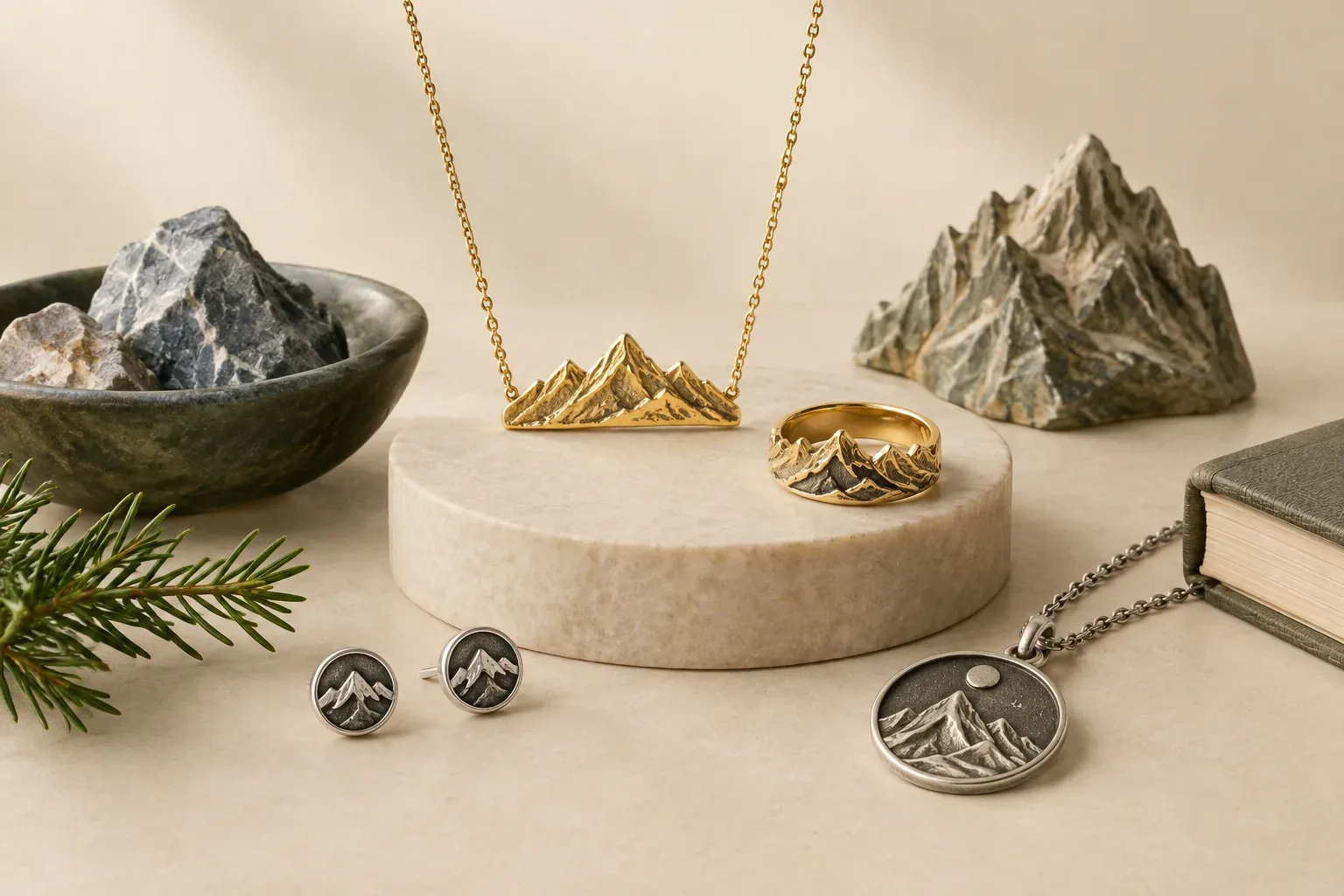
Designers suggest a mountain to the eye in several ways. A silhouette or line-engraved peak is a direct, figurative approach often used in pendants, rings and cufflinks. Abstracted forms—stacked chevrons, triangular settings, or layered metalwork—evoke ridges and peaks. Jewelry makers also use texture and finish, such as hammered metal, matte surfaces, or facets that mimic the roughness of rocky outcrops.
Gemstones and materials are another route to 'mountain' feeling. Designers sometimes use raw or minimally cut crystals, quartz points, or white/grey stones to suggest alpine rock and snow. The V&A’s A–Z of gemstones explains how different stones have been used historically for color, optical effect and cultural preference; in contemporary mountain-themed pieces, gem choice is often aesthetic or evocative rather than derived from a documented symbolic system. Settings that leave a crystal partially exposed or mimick strata with layered metals can reinforce the mountain imagery.
Traditions associated with mountainous regions can also inform jewellery, though the documented evidence for ritual or cultural use must be checked for each culture. Where a community has a specific heritage of alpine metalwork or stone-working, those technical or stylistic characteristics may appear in jewellery attributed to that region. When buying or interpreting such work, look for provenance and maker information rather than assuming a particular spiritual meaning.
Selecting or gifting mountain-themed jewelry—practical and respectful guidance
Begin by deciding what you want the piece to convey. If the intention is personal—commemorating a hike, a shared trip, or an idea like perseverance—choose a literal or stylised motif that matches that memory. If you intend to reference a cultural or spiritual tradition, research the provenance carefully and prefer makers from that community or clear tribute pieces that acknowledge their source.
Check materials and disclosure. The U.S. Federal Trade Commission (FTC) guidance on buying gemstones, diamonds, and pearls stresses the importance of clear disclosure about treatments, synthetic stones, and imitations. When a piece uses a crystal point, rough stone, or a gem that is marketed as 'mountain-sourced', ask for documentation about treatments, origin, and whether the stone is natural, treated, or lab-grown.
Consider craftsmanship and durability. Mountain-themed pieces that include pointed crystals or delicate settings are striking but may be less suitable for everyday wear. If the recipient is active or wants an heirloom-quality piece, choose sturdy mounts and hard gemstones, and discuss repair options or warranties with the seller.
Be culturally respectful. Don’t assume a motif carries the same spiritual weight across cultures. If a design is explicitly tied to a living cultural or religious tradition, source it from makers within that tradition or from ethical sellers who provide context about the design’s origins and meaning.
Personalize thoughtfully. Engraving a summit name, date, or brief phrase can make the piece meaningful without appropriating cultural symbols. For a gift, include a note explaining why you chose the motif so the recipient understands your intention.
Care, authentication and buying tips
Ask sellers for clear information about metals, gemstones and any treatments. The FTC resources highlight that sellers should disclose whether a gem is treated, synthetic, or an imitation and provide guidance on common terms. Request certificates or lab reports for high-value stones, and for smaller purchases, ask specific questions about hardness and recommended care.
Handle delicate mountain-style features with care. Exposed crystal tips or open-backed settings may catch on clothing; clean according to the materials used and consult a jeweller for routine maintenance. If a piece has sentimental significance, consider insuring it or keeping documentation of purchase and any appraisals.
Final thoughts
Mountain jewellery meaning is plural: it arises from documented historical uses of natural motifs, from technical choices in materials and gem cutting, and from contemporary personal and commercial reinterpretations. Use historical surveys such as the V&A’s resources to understand how motifs evolved, and follow consumer-protection advice such as the FTC’s guidance when buying gemstones. With provenance, clear disclosure, and respectful intent, mountain-themed jewellery can be a meaningful and beautiful choice.
Frequently asked questions
What does mountain jewelry symbolize?
Mountain-themed jewelry can symbolize many things depending on context: historically, nature motifs in jewellery served decorative, social or status-related functions; today people often ascribe personal meanings such as endurance, adventure, or remembrance. The exact symbolism should be determined from the piece’s provenance and the wearer’s intentions rather than assumed to be universal.
Are mountain motifs tied to a specific culture or religion?
Not universally. Different cultures and periods have used natural and landscape motifs for specific religious, regional, or social reasons, but the presence of a mountain motif in a contemporary piece does not automatically indicate a particular cultural or religious meaning. Look for documented provenance or maker information if the cultural origin matters.
How can I verify the authenticity of stones in a mountain-style piece?
Ask the seller for written disclosure about treatments, origin, and whether stones are natural, treated, or lab-grown. For high-value gems, request an independent lab report. The FTC recommends clear disclosure of treatments and synthetic or imitation materials.
Is raw crystal jewellery appropriate for everyday wear?
Raw crystals and exposed points are visually striking but are often more fragile and can catch on clothing. Choose secure settings and harder gemstones for everyday wear, and discuss care and repair options with a jeweller.
How do I gift mountain jewellery respectfully?
Decide whether your intent is personal memory, fashion, or cultural reference. If the design draws on a living cultural tradition, source it from makers of that tradition or from sellers who provide context. Include a note explaining your intention, and ensure material disclosures and provenance are clear.
Sources and further reading
- Bedazzled: A History of Jewellery — Victoria and Albert Museum
- An A-Z of Gemstones — Victoria and Albert Museum
- Buying Gemstones, Diamonds, and Pearls — Federal Trade Commission