Meaning at a glance
Arrow jewelry meaning has shifted across time and place: museum collections show the motif used in a range of historical contexts with different documented meanings, while modern wearers attach personal and popular interpretations; understanding that distinction helps you choose, style, and gift arrow pieces thoughtfully and respectfully.
What historical evidence shows — cultures and periods
Museum collections and curatorial writing at the Victoria and Albert Museum document how a single motif — like an arrow or weapon element — can appear in very different jewellery types across periods and places. Curators present examples ranging from ancient Mediterranean metalwork and classical-period ornament through medieval and Renaissance decorative uses, into the sentimental and picturesque jewellery popular in 18th and 19th century Europe, and finally into twentieth- and twenty-first-century fashion pieces. The Victoria and Albert Museum frames these objects within changing social functions and meanings rather than treating any symbol as fixed.
That curatorial perspective means we can identify the arrow as a recurring decorative device: sometimes as a stylised element in a larger pattern, sometimes as a literal depiction of a weapon, and sometimes as a small charm or pendant. Where curators can verify the context — for example, a brooch or pendant from a documented period or provenance — the museum records the object's original social or cultural function. Those documented functions differ: an ornamental arrow element in a classical bracelet carries different evidence and context than a Victorian brooch evoking romance or hunting motifs. The Victoria and Albert Museum's exhibitions and cataloguing emphasise these changing functions and contexts rather than a single universal meaning.
Separating documented historical meanings from modern interpretations
Documented historical meanings are those supported by object provenance, manufacturer or owner records, contemporary texts, or museum cataloguing. For example, when a museum catalogue notes that a 19th-century brooch was sold as a love token or that an armlet with weapon imagery belonged to a military context, those are historical claims grounded in evidence. The Victoria and Albert Museum's work in jewellery history models this approach by connecting objects to their social uses and documented contexts.
Modern personal and popular interpretations are the meanings people give to arrow motifs today. These include ideas of direction, ambition, protection, or Cupid's arrow as shorthand for romantic attraction. Such contemporary readings are valid as personal symbolism but should not be presented as the original or only historical meaning of an object unless there is clear evidence linking that meaning to the piece's origin.
How the arrow motif, gemstone, and tradition appear in jewellery
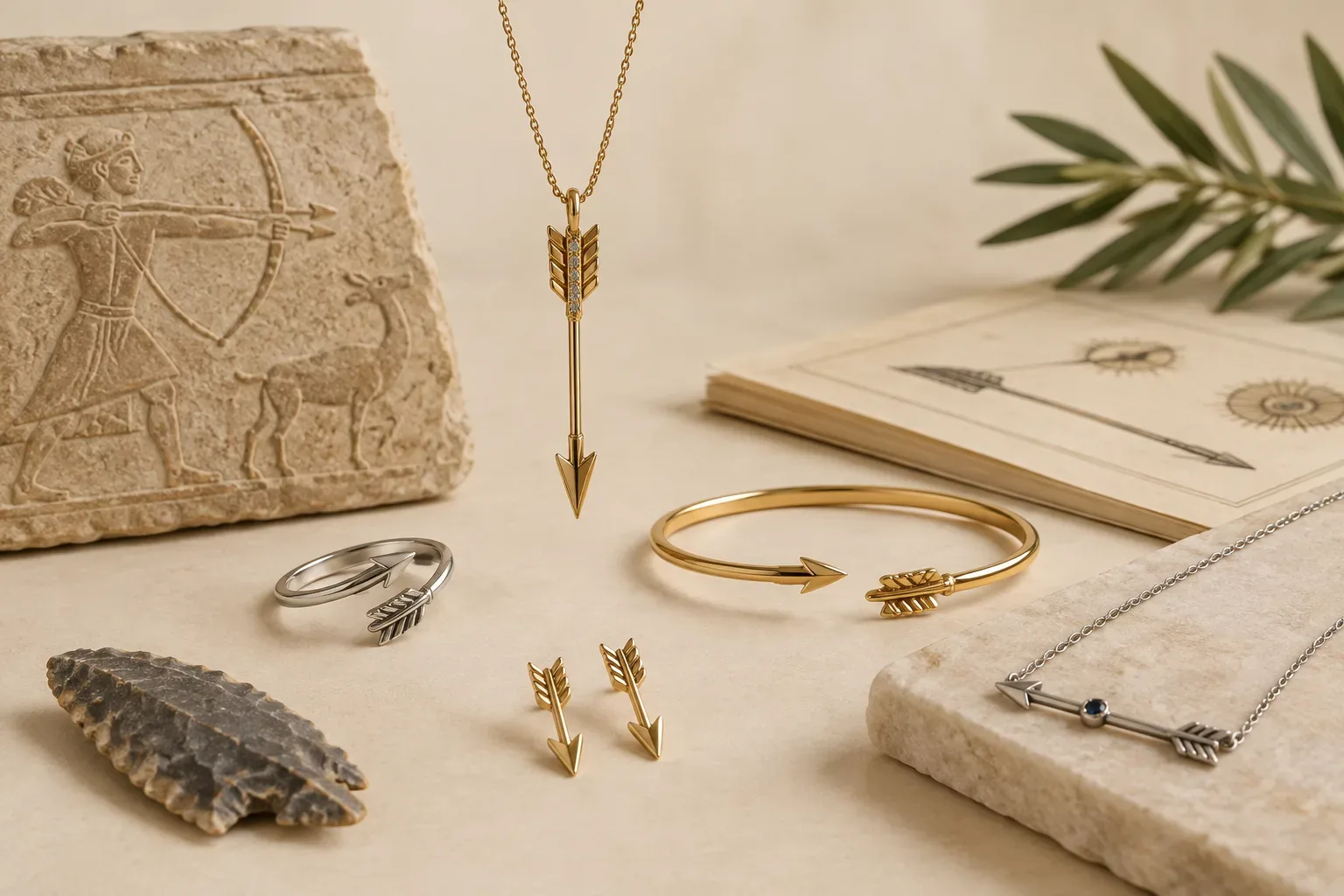
In jewellery the arrow motif shows up in several consistent forms: as full arrow-shaped pendants or charms, as stylised arrowheads used in brooches or rings, as paired or crossed arrows used decoratively, and as diminutive arrow details forming part of clasps, clasps, or metalwork patterns. The motif may be literal — a carved or forged arrow — or abstracted into a chevron, point, or tapered shape.
Gemstones and material choices influence how an arrow reads visually and symbolically. The Victoria and Albert Museum's A–Z of Gemstones explains how different stones have been used historically for decorative effect and status, and how particular materials can signal social meanings in their own right. In modern arrow jewellery, a small gemstone might be set as an arrow's 'point' to create a focal flash of color, or an actual worked stone such as an arrowhead-shaped jasper or agate may be mounted as a pendant.
Documented material practices and modern disclosure
Historical pieces reflect the materials and methods of their time: gold and silver metalwork, enamel, and inlaid stones were common in many historical periods, while later mass-produced costume jewellery used plated metals, glass, and synthetic stones. The Victoria and Albert Museum's work highlights how techniques and social meanings change as materials and production methods change.
For modern buyers, the Federal Trade Commission provides practical guidance on disclosure of treatments, imitations, and material quality. When selecting an arrow piece, ask sellers whether gemstones are natural, treated, lab-grown, or simulants, and request written information or certification if the price implies a valuable stone. Clear disclosure helps align expectations about durability and value and respects both the maker's and buyer's rights.
Choosing and gifting arrow jewellery respectfully
Be explicit about which meaning you intend when gifting an arrow motif. If your intent is personal — to wish someone direction on a new path, or to mark a shared journey — say so in a card or conversation so the symbolic layer is mutual rather than assumed. If you know a recipient prizes a historical reading, choose a piece with documented provenance or a museum-reproduction style and supply contextual information.
Respect cultural origins. Some arrow imagery is part of distinct Indigenous or tribal visual languages; if a design is clearly derived from a living cultural tradition, consider whether the maker is from that tradition and whether purchase supports the originating community. If you are unsure about a piece's cultural origin, ask the seller for background or choose a design framed explicitly as contemporary and inspired rather than presented as an authentic cultural artefact.
Practical checks before purchase include confirming metal purity marks, gemstone disclosure per FTC guidance, durable construction if the piece will be worn daily, correct sizing for rings or necklaces, and care instructions. For heirloom or antique arrow pieces, request or read any available provenance and condition reports.
Styling and everyday wear
Arrow jewellery is versatile: a small arrow pendant works as an everyday talisman, a bolder arrowhead can be a statement brooch or pendant, and crossed arrows are often used in friendship or partnership pieces. Think about scale and metal tone when styling: delicate arrow necklaces layer well with other thin chains, while a solid metal arrow cuff or ring reads as a single, bolder symbol.
Care depends on materials. Gold and platinum require routine cleaning to remove skin oils, silver may need occasional polishing to address tarnish, and gemstones can demand specific care depending on hardness and porosity. When in doubt, follow the maker's care notes and seek professional repair for worn prongs or broken clasps.
Conclusion
Arrow jewellery meaning is not a single fixed story. Museum scholarship, notably work and collections at the Victoria and Albert Museum, shows that arrow motifs have been used in diverse ways across periods and cultures, and that documented meanings come from the object's context and provenance. Modern wearers add personal and popular layers of meaning that are equally valid for individual expression but should be distinguished from historical claims. When you choose or gift an arrow piece, combine clear information about materials and provenance, respectful attention to cultural origins, and simple personal framing so the symbol communicates what you intend.
Frequently asked questions
What does arrow jewelry mean?
Historically, the meaning of arrow motifs varies by culture and object context; museum documentation shows arrows used as decorative devices, status symbols, or in motifs linked to particular practices. Today many people interpret arrow jewellery personally as a symbol of direction, protection, ambition, or romantic attraction, but those are modern layers of meaning rather than universal historical facts.
Is it appropriate to buy or wear arrow designs from Indigenous or cultural traditions?
Exercise care and respect. If a design is explicitly derived from a living cultural tradition, seek makers from that tradition or documentation that the design is sold ethically. If provenance is unclear, ask the seller for background or choose a piece presented as contemporary inspiration rather than claiming cultural authenticity.
How can I verify the materials in an arrow pendant or arrowhead necklace?
Ask the seller for written disclosure about metal purity and gemstone origin or treatment. For gemstones and pearls, follow the Federal Trade Commission guidance and request certificates or treatment disclosures when the item carries significant value.
How do I care for arrow jewellery with gemstones?
Care depends on the stone and metal. Hard stones like sapphire or diamond tolerate everyday wear better than porous or soft stones. Follow maker care instructions, avoid harsh chemicals, and have settings inspected if you wear the piece daily.
Can arrow jewellery be used as a meaningful gift?
Yes, provided you make your intention explicit. Saying why you chose the motif — for example, to mark a new direction or to celebrate a shared journey — helps align the giver's meaning with the recipient's understanding.
Sources and further reading
- Bedazzled: A History of Jewellery — Victoria and Albert Museum
- An A-Z of Gemstones — Victoria and Albert Museum
- Buying Gemstones, Diamonds, and Pearls — Federal Trade Commission