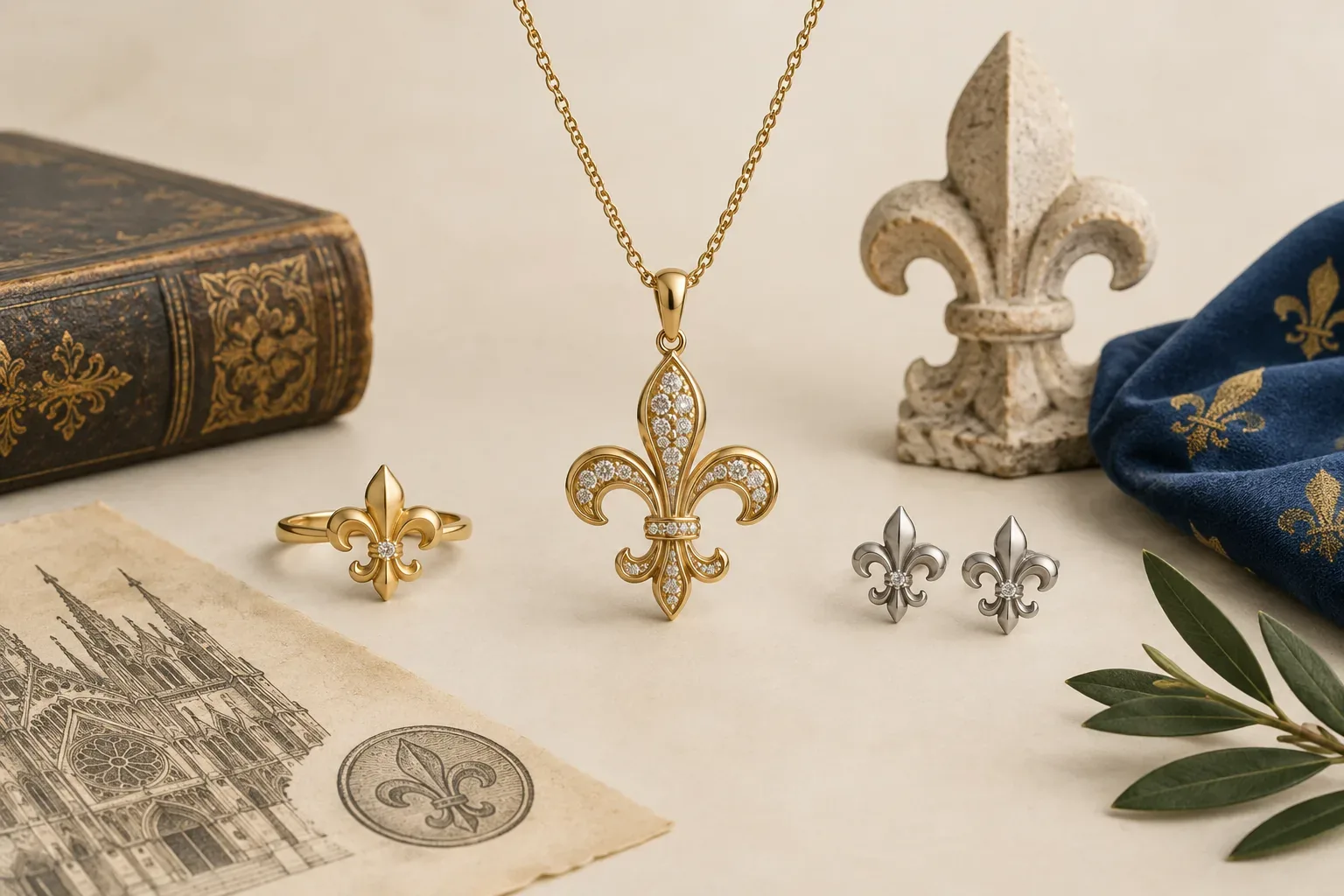
Meaning at a glance
The fleur‑de‑lis jewelry meaning combines documented historical uses—from ancient decorative motifs and medieval French heraldry to later revival fashions—with a range of modern personal or civic interpretations; this article separates primary historical evidence (attributed to the Victoria and Albert Museum) from contemporary symbolic uses and offers practical guidance for selecting, authenticating, and gifting fleur‑de‑lis jewelry.
Direct answer (thesis)
In short: the documented fleur‑de‑lis jewelry meaning is best understood as a long‑lived decorative motif whose specific senses changed by time and place—appearing in ancient ornament, adopted in medieval French heraldry and religious art, revived in later fashion movements, and today worn for aesthetic, familial, civic, or personal symbolic reasons; the historical record and museum scholarship make clear which associations are historically evidenced and which are modern interpretations, and those distinctions should guide selection and gifting.
Historical evidence, by culture and period
Ancient and early medieval precedents: stylized plant and lily motifs appear in a wide range of ornamental traditions long before any single cultural claim to the fleur‑de‑lis. Decorative flower motifs can be seen across Mediterranean and Near Eastern metalwork and stone carvings. The Victoria and Albert Museum places such recurring floral devices in the broader history of jewellery, showing how ornamental shapes are adapted and reinterpreted across periods and regions rather than originating in an isolated moment.
High medieval France and heraldry: the clearest documented shift toward a specifically identified fleur‑de‑lis symbol occurs in medieval European heraldry and royal iconography. In France it became associated with royal arms and emblems; museums and curatorial scholarship trace how the motif was used on seals, coins, textiles, and metalwork in service of dynastic identity. The V&A's historical surveys of jewellery note this association as a prominent example of how motifs acquire official and ceremonial meanings through sustained royal usage.
Religious art and Christian interpretation: in some medieval and later Christian contexts the stylized lily was read as a symbol of purity or of the Virgin Mary. That religious reading was one of several layered meanings attached to floral emblems. It became part of the visual vocabulary in ecclesiastical jewelry, votive objects, and illuminated manuscripts. Careful museum documentation treats these religious associations as one historically attested strand among others rather than as a universal or exclusive interpretation.
Renaissance to modern revivals: the motif returned in later decorative arts and jewellery fashions, including 19th‑century historicist revivals that borrowed medieval and classical forms. The Victoria and Albert Museum’s exhibitions and essays on jewellery history document these revivals and show how designers used the fleur‑de‑lis as a fashionable historicizing motif, often divorced from its older political or religious contexts.
Documented historical meanings versus modern interpretations
Documented meanings: museum scholarship, including the Victoria and Albert Museum’s surveys of jewellery history, supports a cautious, evidence‑based view: the fleur‑de‑lis functioned as an ornamental plant motif in many cultures; in medieval Europe it became strongly associated with French royal heraldry; and it appears in Christian art as one of several attributes linked to Mary and certain saints. Those are documented uses supported by material culture and curatorial research.
Modern personal and civic interpretations: outside the historical record, people today may adopt the fleur‑de‑lis as a symbol of local identity, family heritage, scouting organizations, fashion, or private spiritual meaning. These contemporary readings are valid personal uses but are not universally backed by historical evidence. When wearing or gifting fleur‑de‑lis jewellery, it is helpful to distinguish whether the piece is meant to recall a specific historic association (for example, French royal imagery), a civic emblem (such as a municipal logo), or a personal sentiment.
How the motif appears in jewelry
Design and form: jewellers render the fleur‑de‑lis in many scales and styles, from small stamped charms and signet ring engravings to three‑dimensional brooches and pendants. Historically informed pieces may use filigree, enamel, or engraving to echo medieval techniques, while modern interpretations range from minimalist silhouettes to bold Art Nouveau or Art Deco adaptations. The V&A’s collections and its exhibition material on jewellery history describe these formal continuities and changes across periods.
Materials and gemstones: fleur‑de‑lis designs appear in gold, silver, bronze, and base‑metal costume jewellery. Gemstones may be set as accent stones—seed pearls and rock crystals in earlier devotional jewellery, colored gems during Victorian revivals, or diamonds in contemporary fine jewellery. The Victoria and Albert Museum’s articles on gemstones provide useful background on how particular stones were favoured at different times and how techniques like cabochon cutting or faceting alter a piece’s look.
Techniques and traditions: historic pieces often show period techniques—enamel work, granulation, repoussé, and hand engraving—while many modern makers use casting, laser cutting, and plating. Reproductions and revival pieces often intentionally mimic older craft methods to evoke a sense of age or authenticity; museum descriptions of technique help buyers recognize these intended effects.
Selecting and gifting fleur‑de‑lis jewelry respectfully
Clarify meaning and intent before buying: decide whether you want a piece that evokes documented history (for example, a reproduction of a medieval style), a civic emblem, or a purely aesthetic item. If the recipient has a connection to a particular meaning—French heritage, membership in an organization that uses the symbol, or a religious devotion—choose a piece that aligns with that context and avoid assuming the motif’s significance for someone else.
Check provenance and materials: for gemstone settings and precious‑metal pieces, ask sellers about gemstone treatments, disclosure, and metal hallmarks. The Federal Trade Commission provides consumer guidance on buying gemstones, diamonds, and pearls; follow their recommendations to ensure accurate descriptions of treatments, imitations, and metal content. For higher‑value purchases, request documentation such as receipts, certification, or an independent appraisal.
Respect cultural and institutional uses: some organizations and municipalities use a specific fleur‑de‑lis design as an official emblem. If you are buying a piece that closely reproduces a civic or institutional mark, consider whether that use is appropriate for the occasion and the recipient. Gifting such a piece to someone without a connection to that emblem can create confusion or unintended messages.
Match style, scale, and wearability: select a size and metal that suits the recipient’s daily habits and wardrobe. A large, ornate brooch carries different social signals than a small pendant or pair of stud earrings. For someone who prefers low‑maintenance jewellery, choose durable metals and secure settings.
Authenticity, care, and legal considerations
Determine whether a piece is antique, vintage, or a modern reproduction by looking for maker’s marks, hallmarks, and consistent wear patterns. Museum cataloguing practices described by institutions such as the Victoria and Albert Museum help buyers learn what to inspect and how to read marks and construction techniques.
For gemstones and treated stones, rely on seller disclosure and, if needed, independent gemological verification. The Federal Trade Commission’s guidance explains common treatments and the seller’s obligation to disclose them; this is particularly important if a fleur‑de‑lis piece is set with historically popular gems such as garnet, sapphire, or pearls.
Care and maintenance depend on materials: pearls and some soft stones need gentler handling, while high‑karat gold is softer than lower karat alloys and may wear differently. When buying antique or fragile pieces, ask a conservator or reputable jeweller about cleaning and storage to avoid damage.
Closing guidance and summary
The fleur‑de‑lis jewellery meaning is not a single, unchanging message; museum scholarship, particularly the Victoria and Albert Museum’s histories of jewellery and gemstones, demonstrates that the motif’s functions shifted from decorative precedent to dynastic and religious emblem and then to fashion revival and civic use. Modern wearers adopt the motif for many reasons—heritage, faith, civic pride, scouting, or pure aesthetics—but those contemporary meanings should be distinguished from what is documented in the historical record.
When choosing or gifting fleur‑de‑lis jewellery, be intentional about the meaning you wish to convey, verify materials and provenance where value or authenticity matters, and treat civic or institutional designs with respect. For buyers of gemstone‑set pieces, follow the Federal Trade Commission’s consumer guidance on disclosure and treatments to make an informed purchase.
Frequently asked questions
Does the fleur‑de‑lis always mean French royalty?
No. While the fleur‑de‑lis became strongly associated with French royal heraldry in the medieval period—a relationship documented in museum studies—it also appears earlier and elsewhere as a decorative plant motif and later as a religious or fashionable emblem. The royal association is historically important but not the motif’s only meaning.
Is the fleur‑de‑lis a religious symbol?
In some Christian contexts the stylized lily was used as a symbol of purity or as an attribute of the Virgin Mary. Museum scholarship treats this as one documented historical usage rather than a universal religious meaning; many modern uses are secular or personal.
Can I wear fleur‑de‑lis jewelry if I’m not French or Catholic?
Yes. Many people wear the motif for aesthetic reasons, family or civic identity, or personal symbolism. Be mindful of context: some groups or municipalities use specific designs as official emblems, and wearing those designs may carry particular civic or institutional connotations.
How can I tell if a fleur‑de‑lis piece is antique or a reproduction?
Look for maker’s marks, hallmarks, consistent wear, and construction techniques. Museum catalogs and the V&A’s materials on jewellery history describe period techniques that can help distinguish antiques from modern reproductions. When in doubt, consult a reputable appraiser or specialist.
What should I ask about gemstones in fleur‑de‑lis jewelry?
Ask the seller whether stones have been treated, whether they are natural or synthetic, and whether any certification is available. The Federal Trade Commission recommends that buyers seek full disclosure about treatments, imitations, and the seller’s return and appraisal policies.
Sources and further reading
- Bedazzled: A History of Jewellery — Victoria and Albert Museum
- An A-Z of Gemstones — Victoria and Albert Museum
- Buying Gemstones, Diamonds, and Pearls — Federal Trade Commission