Meaning at a glance
This article explains the documented history and changing contexts of the horseshoe motif, separates cultural or religious evidence from later popular interpretations, and gives practical guidance for choosing and wearing the motif in modern jewelry.
How the horseshoe motif entered jewelry: documented history
The horseshoe began as a functional iron object used to protect the hoof. Its adoption into jewelry is part of the broader history of ordinary objects being transformed into decorative or symbolic motifs, a process discussed by the Victoria and Albert Museum in its overview of jewellery history and social context. The V&A traces how materials and motifs that were once functional or associated with a particular trade or social practice became decorative motifs or sentimental emblems as tastes and technologies changed.
In European contexts the horseshoe motif appears in popular and decorative languages from the 18th and 19th centuries onward, where jewelers and the public reused familiar shapes as charms, brooch motifs, and pendants. The V&A's historical surveys show that jewellery often adopts motifs associated with personal identity, occupation, or felicity, and the horseshoe fits into that pattern: a visible symbol with an obvious connection to horses, travel, and rural life that could be stylized for fashion or worn as a token.
Museum collections and catalogues discussed by the V&A indicate that the horseshoe motif has been used in different types of pieces, including brooches, pendants, and rings, and that materials and decorative techniques changed with fashion. Using a museum lens to view these changes helps separate the object’s practical origin from its later life as ornament.
Documented cultural meanings versus modern personal interpretations
Historical documentation collected and interpreted by institutions such as the V&A shows that motifs like the horseshoe acquired meaning in varied ways: sometimes as markers of trade or rural identity, sometimes as sentimental tokens exchanged in a social context. These are documented cultural uses rather than universal or fixed symbolic definitions.
Later popular beliefs—such as the horseshoe as a universal luck-bringing amulet, or rigid rules about the orientation of the motif meaning 'holding luck' versus 'letting it spill out'—belong largely to folklore and modern personal interpretation. These contemporary ideas are widespread in popular culture but are not universal and can differ by region, community, and individual. Where a historical source records a specific practice or meaning, I attribute that context to the V&A's work; where an idea is part of general popular belief today, the status of that idea is modern and personal rather than a single documented cultural truth.
In short, the documented historical record shows the horseshoe becoming a decorative and often sentimental motif; modern claims about its mystical powers or exact symbolic prescriptions are contemporary interpretations layered onto that history, not always traceable to a single origin.
How the motif, gemstones, and techniques appear in horseshoe jewelry
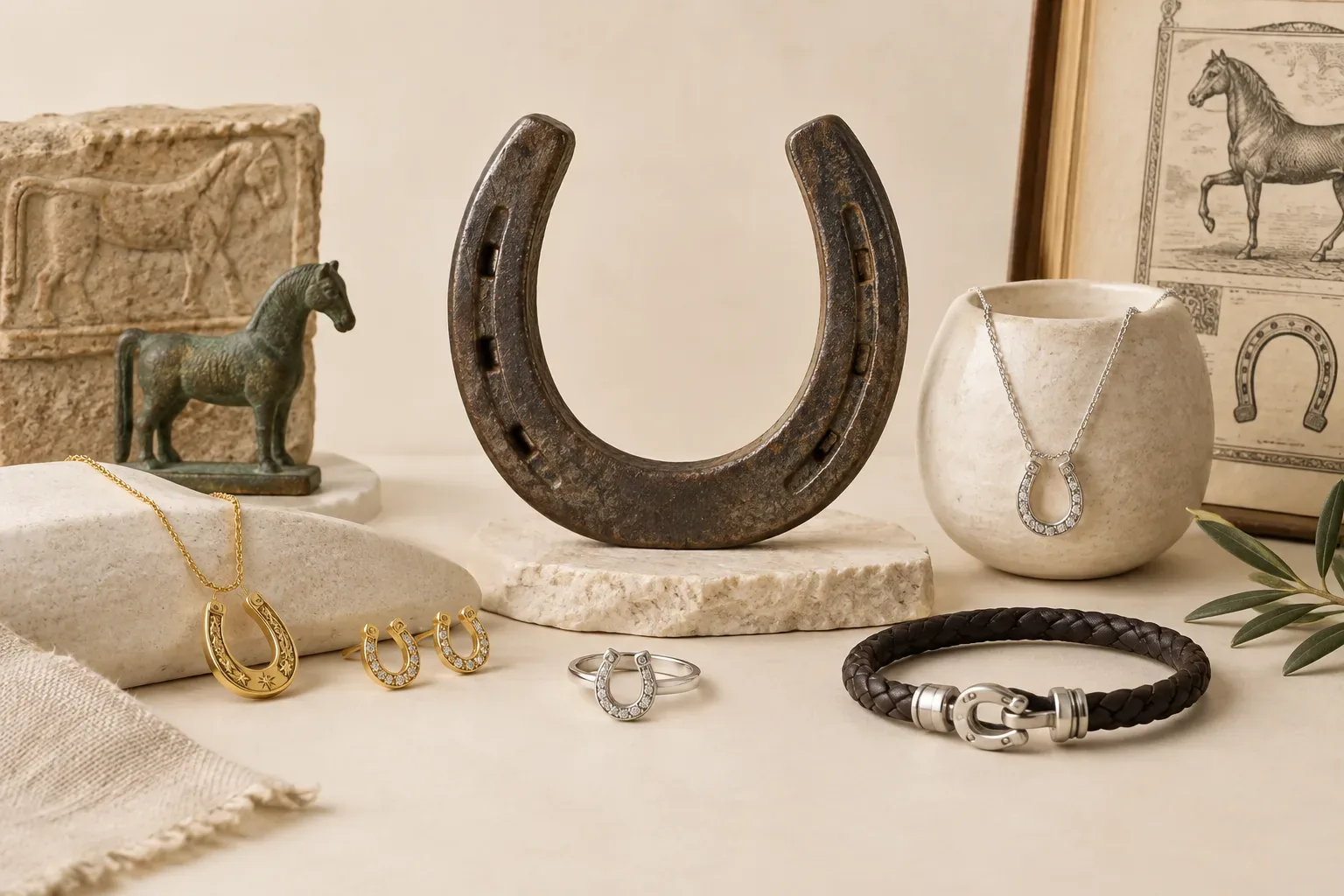
As a motif, the horseshoe is adaptable. Jewelers have rendered it in full three-dimensional form, in flat stylized silhouettes, as openwork, or as a frame for gemstones. It is commonly found on pendants, brooches, rings, and charms designed for bracelets or necklaces. The motif’s graphic simplicity makes it suitable for engraving, enamelling, and gem-setting, depending on the period and taste.
Gemstones and materials used in horseshoe jewelry reflect wider jewellery practice rather than an exclusive list linked to the motif. The Victoria and Albert Museum’s A–Z guide to gemstones explains how different stones have been used historically for colour, durability, and social signaling, and how gem choices evolved with taste and technology. In practice, makers may set diamonds for sparkle and perceived luxury, seed pearls or turquoise for period-appropriate colour, or cabochon stones for a more rustic or folk-inspired look. Enamel and mixed metals have also been used to add color and contrast.
When considering modern purchases, the provenance and treatment of gemstones and other materials matter. The U.S. Federal Trade Commission provides practical guidance on buying gemstones, diamonds, and pearls, emphasizing that sellers should disclose treatments, imitations, and material substitutions. That guidance is relevant to horseshoe jewelry just as to any piece of gem-set jewelry: ask about treatments, request written information, and, when appropriate, ask for independent certificates for higher‑value stones.
Stylistic and regional variations to note
The visual language of horseshoe jewelry varies by region and by era. In some Victorian and later European examples the motif is highly stylized and worked into complex sentimental compositions with other emblems. In more recent fashion contexts the horseshoe can be sleek and minimal, often rendered in a single precious metal as a pendant or charm.
Because the motif originated from an object associated with horses, pieces that reference equestrian culture tend to favor sturdier design features and materials associated with outdoor life. Conversely, fine jewellery versions often reduce the motif to an elegant graphic form and focus on finish, proportion, and gemstone setting rather than literalism.
Practical guidance for choosing and gifting horseshoe jewelry
Decide whether you want the piece to emphasize historical reference, personal meaning, or purely aesthetic appeal. If the buyer or recipient values history or collectibility, look for well‑documented pieces or reputable makers whose descriptions reference materials, period, and provenance. Museum collections and catalogues described by the V&A can help you recognize period forms and decorative techniques.
Ask the seller for specific information about materials and gemstone treatments. Under the FTC’s consumer guidance, reputable sellers should disclose whether stones have been heat-treated, dyed, fracture-filled, or otherwise altered, and whether any gems are imitations. Requesting this information protects the buyer and clarifies value.
Match the metal and style to how the recipient wears jewelry. For everyday wear choose durable metals and secure settings; for example, solid gold or platinum withstand regular use better than thin plated pieces. Consider the size and attachment method: a pendant with a robust bail or a charm with a secure jump ring will be more wearable than a fragile decorative component.
Keep cultural sensitivity in mind. The horseshoe motif does not carry a single religious meaning, but any symbol can mean different things to different people. If you plan to give horseshoe jewelry as a charm or talisman, ask whether the recipient appreciates symbolic gifts or prefers purely aesthetic ones. If the piece will be presented as a token of luck, explain your intention so the gesture is not misinterpreted.
Finally, consider personalization to make the gift meaningful: simple engraving, pairing the motif with a birthstone, or choosing a style that reflects the recipient’s life (for example, an equestrian-inspired piece for a rider) are all legitimate options that connect the historic motif to a personal story.
Care and valuation notes
Care instructions vary by material and construction. Precious metals such as gold and platinum require routine cleaning and occasional professional inspection of settings. Gemstones differ in hardness and chemical sensitivity; consult the maker about any special care and avoid exposure to harsh chemicals or extreme heat for treated stones. For guidance on transparency about treatments and material identity, refer to the FTC consumer advice on buying gemstones, diamonds, and pearls.
If you are buying an antique or vintage horseshoe piece, a professional appraisal from a qualified dealer or an independent appraiser can help establish age, materials, and fair market value. Provenance and condition strongly influence value, and documentation from previous owners or from museum catalogues can be helpful for understanding a piece’s historical context.
Concluding perspective
The horseshoe jewelry meaning is layered. Documented history shows how a practical object became a decorative motif and, in some contexts, a sentimental emblem; modern popular culture has added a wide range of personal and folkloric meanings. Institutions such as the Victoria and Albert Museum provide the historical framing that helps separate documented practice from later interpretation, while consumer guidance from the Federal Trade Commission helps buyers navigate materials and disclosure in the modern market.
Choosing or gifting horseshoe jewelry is most successful when you combine an understanding of that history with practical attention to materials, maker transparency, and the recipient’s preferences. That approach respects both the motif’s past and its present as a personal symbol.
Frequently asked questions
Is horseshoe jewelry always a symbol of good luck?
No. While many people today wear horseshoe jewelry as a token of luck, historical documentation shows the motif has varied meanings. Museum research indicates it moved from a practical object into decorative and sentimental use. Modern beliefs about luck are popular interpretations and not universal.
Which way should a horseshoe face on jewelry—up or down?
There is no single historically documented rule. Folklore and modern personal beliefs offer different interpretations about orientation, and those vary by region and community. Treat orientation as a personal or cultural preference rather than a universal prescription.
Are gemstones in horseshoe jewelry treated or imitations?
They can be. The Federal Trade Commission advises buyers to ask sellers whether gemstones have been heat-treated, dyed, fracture-filled, or substituted with imitations. Reputable sellers should disclose treatments and provide documentation for higher-value stones.
How can I choose a meaningful horseshoe piece as a gift?
Consider the recipient’s style and whether they value symbolic or purely aesthetic gifts. Ask about materials, durability, and gem treatments, and pick a size and construction suited to how they wear jewelry. Personal touches—such as engraving or pairing with a birthstone—can make the motif more meaningful.
How should I care for horseshoe jewelry?
Care depends on metal and gemstones. Precious metals benefit from routine cleaning and occasional professional checks; gemstones vary in hardness and sensitivity. Avoid exposure to harsh chemicals and ask the maker for any special-care instructions, especially for treated stones.
Sources and further reading
- Bedazzled: A History of Jewellery — Victoria and Albert Museum
- An A-Z of Gemstones — Victoria and Albert Museum
- Buying Gemstones, Diamonds, and Pearls — Federal Trade Commission