Meaning at a glance
Documented museum research shows that decorative motifs, including navigational imagery, change meaning as social interests shift; the compass motif has been adopted in jewellery in various decorative ways and today carries personal interpretations of direction, guidance, and travel. Distinguish what is documented in museum and gemstone records from later popular meanings, check gem and treatment disclosures when buying, and choose styles and inscriptions to fit the recipient respectfully.
Quick answer
In brief: compass jewelry meaning is best treated as a mix of documented decorative history and later personal symbolism. Museum surveys show that jewellery motifs change with cultural interests, and motifs linked to navigation and travel were adopted into decorative practice as those subjects grew socially prominent. Modern wearers most commonly interpret compass designs as symbols of direction, guidance, or safe travel, but those contemporary meanings are not the only or universal readings of the motif.
What the historical record shows (and what it doesn’t)
Large museum collections and exhibitions make clear that jewellery has long reflected changing technology, fashion and social context. The Victoria and Albert Museum, in particular, frames jewellery history as a record of shifting social meanings and decorative tastes rather than a single continuous symbolism. That means motifs that refer to travel, navigation or instruments of exploration appear more frequently when travel and maritime life are culturally prominent.
The specialised museum literature that surveys jewellery and gemstones stresses how objects acquire new associations over time as fashions, trade routes and technologies change. It is therefore accurate to say that the compass motif appears in later decorative practice as part of a wider cultural interest in navigation, exploration and travel, but direct, continuous religious or ritual meanings tied to the motif are not firmly documented across cultures in the museum sources available here.
Separating documented meanings from modern interpretations
Documented meanings: museum research demonstrates that jewellery motifs reflect the period and interests of their makers and wearers. Where museums can trace provenance and context, motifs tied to navigation are best interpreted as reflecting those historical contexts—maritime trade, exploration narratives and fashionable references to travel—rather than a single universal symbolic meaning. This is the cautious, evidence-led position supported by museum curators and exhibition frameworks.
Modern interpretations: popular meanings attached to compass jewellery today—direction, guidance, moral guidance, a reminder to "stay true," or protection on journeys—are contemporary layers of meaning that many wearers find powerful. These are legitimate personal or cultural readings, but they should be treated as later interpretations rather than universally documented historical meanings in the museum record.
How the compass motif appears in jewellery
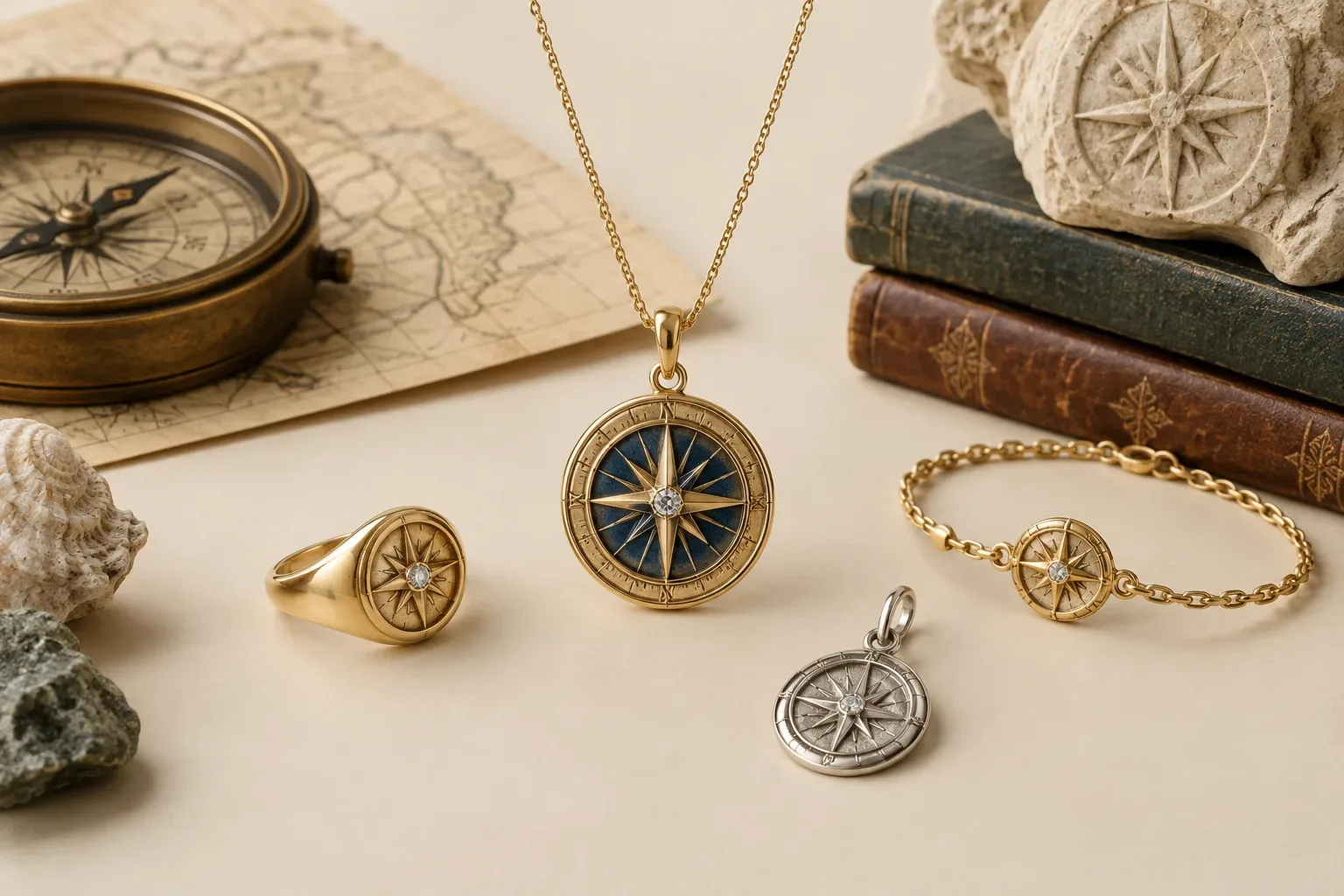
As a visual motif, compass designs appear in multiple jewellery types: pendants, brooches, rings, cufflinks and charms often incorporate the compass rose or directional points as a decorative pattern. Designers use the graphic geometry of the compass rose—radiating points, a central hub and often a star-like form—to create a recognisable symbol that reads at small scale.
Designers and makers vary materials and techniques. Enamel and engraved radiating lines emphasise the directional quality of the motif, a central gemstone or cabochon can mark the hub, and metalwork can render the points in low relief. Some contemporary pieces also reference antique styles or adopt a simplified, stylised compass for minimal jewellery.
Beyond flat decoration, jewellers sometimes take inspiration from navigational instruments in form or naming (for example, pieces described as "nautical"); however, careful provenance is needed before assuming an antique piece contains a functional miniature compass or has a specific historical use.
Gemstones, materials and what to look for
Gemstone choice and setting influence both the look and the practical wearability of compass jewellery. The Victoria and Albert Museum's resources on gemstones emphasise that different stones have different histories, colours and technical properties that affect how they are used in decorative objects. A bright central gem can act as the visual "hub" of a compass design, while contrasting stones can mark points.
When buying gemstones, consumer protections and disclosure rules are important. The Federal Trade Commission provides guidance on buying gemstones, diamonds and pearls and recommends that sellers disclose treatments, imitations and the nature of the gemstone. Ask for clear information about whether a stone is natural, heat-treated, dyed, lab-grown or a simulant, and request any available paperwork from reputable dealers.
Choosing or gifting compass jewellery—practical, respectful advice
Match the meaning to the recipient. If you choose a compass motif to convey "guidance," "new beginnings," or "safe travels," consider whether that reading resonates with the recipient's experiences. Some people prefer a purely decorative gift; others appreciate an explicit inscription or note that explains your intention. Personal conversation before gifting can prevent unintended implications.
Consider metal and gemstone durability. If the piece is intended for everyday wear, choose metals and stones suited to frequent use and ask the seller about stone hardness and setting security. The V&A’s guidance on gemstones can help you compare stones by durability and appearance, and the FTC advises confirming treatment disclosures that affect care and value.
Prioritise provenance and disclosure for antiques or high-value stones. If you are buying an antique compass-themed piece, ask about provenance, restoration work, and whether any components were replaced. For modern pieces, request documentation of gemstone origin and treatments where relevant. Reputable dealers provide clear information and will support returns or certification when appropriate.
Respect cultural associations. The compass motif is broadly secular in most documented museum contexts, but symbols can carry different meanings in particular communities or families. Avoid assuming a universal religious or ritual significance; if the recipient belongs to a cultural or religious tradition where directionality or particular symbols matter, ask respectfully before gifting a symbolically charged piece.
Care, wear and style tips
Design choice affects how you wear a compass piece. Pendants and charms tend to read larger and are good for visible symbolic statements; smaller rings or stud earrings are subtler. If you plan on wearing the piece while travelling, choose a secure setting and a durable metal.
Care instructions depend on materials. The V&A's gemstone information is useful for learning which stones need special handling. Always follow the seller’s care instructions and inquire about re-plating, stone tightening, and professional cleaning for heirloom pieces to keep the motif crisp and legible over time.
Balancing documented history with personal meaning
Museums and historical research give us a disciplined way to read jewellery as objects made within particular social and material contexts. That discipline tells us that the compass motif has become meaningful in different ways as travel and navigation entered public consciousness, but it does not support a single enduring symbolic meaning across all times and places.
At the same time, contemporary personal meanings are valid and important. If you choose compass jewellery to mark a life change, a shared journey, or to offer a wish for safe travel, make that intention clear to the recipient and select materials and craftsmanship that fit how the piece will be worn and valued.
Frequently asked questions
What does compass jewelry mean?
Compass jewellery commonly represents direction, guidance or travel in modern interpretation, but museum research shows these meanings are contemporary layers. Historically, compass and navigation-inspired motifs entered decorative practice as travel and maritime themes gained social prominence; that historical link is documented in museum overviews rather than as a single universal symbolic meaning.
Is the compass motif a religious symbol?
There is no single, universally documented religious meaning for the compass motif in the museum literature used here. Museums present jewellery motifs as historically contingent—tied to social, technological and fashion contexts—so any religious significance should be verified within a specific culture or community rather than assumed.
How can I tell if a compass-themed piece is antique or a modern reproduction?
Ask the seller for provenance and condition reports and request documentation of any restoration. Authenticity claims should be supported by written provenance, photographs, or expert appraisal. If in doubt, consult a reputable museum or certified appraiser and compare stylistic and material clues with museum references.
What should I ask about gemstones when buying compass jewellery?
Follow consumer guidance: ask whether stones are natural, treated, lab-grown or simulants, and request disclosure of any treatments or enhancements. Sellers should provide clear information about origin and treatment; reputable vendors will offer certification or written details.
How do I choose a compass piece that suits someone as a gift?
Consider the recipient’s relationship to travel or symbolism and whether they prefer visible statements or subtle motifs. Match metal and gemstone durability to intended wear, request treatment disclosures for stones, and consider adding a short inscription or note to explain your intention if the symbolic meaning is important.
Sources and further reading
- Bedazzled: A History of Jewellery — Victoria and Albert Museum
- An A-Z of Gemstones — Victoria and Albert Museum
- Buying Gemstones, Diamonds, and Pearls — Federal Trade Commission