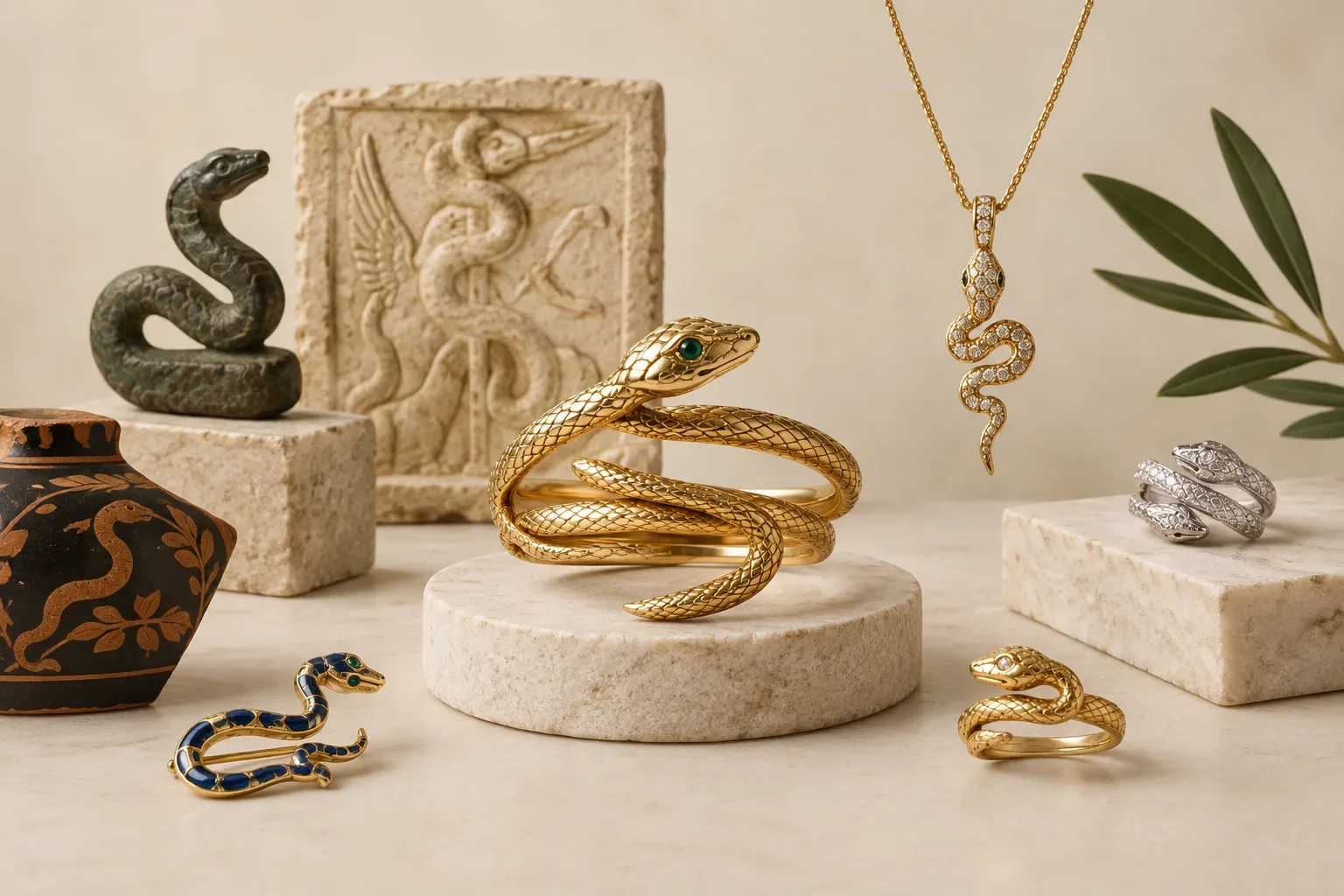
Meaning at a glance
Explain the documented history and changing contexts of the snake motif, separate cultural or religious evidence from later popular interpretations, and give practical guidance for choosing and wearing the motif in modern jewelry.
Short answer
Snake jewelry meaning is not a single, universal symbol. Historically the serpent motif has carried different documented meanings in different places and periods—ranging from protection and royal authority to healing, eternity, and fashionably sentimental statements—and those documented uses are distinct from modern personal or spiritual interpretations. This article explains what museums and consumer guidance note about the motif’s recorded history, how the design and gemstones appear in jewelry, and practical, respectful advice for selecting or gifting snake pieces today.
What the historical record shows (evidence and cultures)
The Victoria and Albert Museum (V&A) places the serpent as a recurring motif across many historical periods and geographies in the museum’s collections and interpretive materials. The V&A documents serpent imagery in ancient Egypt, classical Greece and Rome, Renaissance Europe, and in later European revivals such as the 19th-century Victorian interest in symbolic jewelry, as well as in stylistic movements that favored natural forms, such as Art Nouveau. These are museum-based observations about where the motif appears in surviving objects and in jewelry-making traditions rather than claims about a single meaning shared everywhere.
When discussing historical evidence, it is important to quote the provenance and context reported by museums like the V&A: museum labels, catalogues and exhibitions record where an object came from, how it was worn, and the visual language used by makers and wearers. The V&A’s multi-period holdings show that the same visual motif—an image of a snake—was adopted and adapted with different intentions in different places and times, which is why precise cultural identification matters when interpreting any single piece.
Documented historical meanings (separate from modern interpretations)
According to the V&A’s documentation, ancient Egyptian uses of serpent imagery often appear in contexts associated with protection and the symbols of rulership. In the classical world, museum records link serpents with medicine, renewal, and household cults in ways visible in art and personal ornaments. During the Renaissance and later in Europe, jewelers reused and reinterpreted classical and medieval motifs; museum examples show jewelled serpents used as amulets, decorative symbolism and as fashionable references to classical learning.
The V&A also documents a 19th-century European revival of the snake motif in personal jewelry. In that period, jewellers produced rings, brooches and pendants that were often read by contemporaries as symbolic of fidelity, devotion or memory. These meanings are based on documented usage, designs, and contemporary writings or purchase records preserved alongside objects in collections and exhibitions; they are not the same as modern attributions made without historical source evidence.
Modern personal and cultural interpretations — distinct from the record
Today many people choose snake jewelry for personal reasons that differ from the motif’s documented historical meanings. Contemporary wearers commonly report associations such as transformation, healing, protection, sexuality, or personal empowerment. Designers and spiritual writers sometimes attach ideas like rebirth or kundalini energy to serpent imagery as a modern symbolic vocabulary.
Those modern interpretations are valid as personal or contemporary cultural meanings, but they should be kept distinct from the historical record: museums like the V&A document earlier owners’ contexts and probable meanings based on evidence, while current wearers often reassign symbols to suit personal narratives, fashion, or contemporary spiritual practice. Neither is inherently superior, but conflating the two obscures what can be shown directly from surviving objects and records.
How the snake motif, gemstones and techniques appear in jewelry
The V&A’s collections and essays show the motif appearing in many formats: coiled rings and bracelets that suggest the animal’s shape, pendant and brooch forms that use the sinuous line of a snake as a compositional device, and ornament such as hairpins and armlets in cultures that used metalwork for body decoration. The ouroboros, a snake eating its own tail, appears occasionally as an explicit symbol of cyclicality and eternity in decorative contexts preserved in collections.
Historically, jewellers worked in available precious metals and decorative techniques for the period and place: goldsmithing, silverwork, enamel, gem-setting and engraved decoration appear repeatedly in museum examples. V&A resources on gemstones note that coloured gems and pearls have long been used in jewellery-making; snake pieces historically could be finished with gem 'eyes' or scale-like inlay and later pieces often combined diamonds or coloured gemstones with fine metalwork. The look and technique therefore change with technological and stylistic shifts recorded in museums.
Choosing or gifting snake jewelry—practical, respectful guidance
Start by considering the recipient’s culture, beliefs and tastes. Because the snake motif carries very different connotations across cultures and individuals, asking whether the recipient likes or is comfortable with animal imagery is a respectful first step. If the piece is meant as a memorial or intimate gift, choose a design whose historical meaning aligns with your intent and, if appropriate, explain the gesture when you present it.
Material and authenticity matter. The Federal Trade Commission (FTC) provides guidance about gemstones, diamonds and pearls and stresses the importance of clear disclosure about treatments, synthetics, and imitations. When buying a gemstone-set snake piece, ask the seller whether gems are natural, treated, synthetic or simulants and request written disclosures. For metalwork, check for quality marks and for any stated plating or alloys if the recipient has metal sensitivities.
Match form to function. Coiled or articulated snake bracelets and rings can be beautiful but need proper sizing and comfortable wear. Heavier, sculptural snake pendants and brooches make stronger visual statements and may suit evening wear rather than everyday use. For a first or surprise gift, a smaller, stylized pendant or pair of earrings is less likely to cause unintended offence than an overtly lifelike or culturally specific design.
Practical buying, care, and authenticity tips
Ask sellers for provenance, maker information and condition reports for antique or vintage snake pieces; museums like the V&A base interpretations on provenance and context because those details matter for meaning. For gemstones, follow the FTC’s practical advice: request disclosure of treatments and any lab reports for higher-value stones and understand the distinction between natural, lab-grown and simulated gems.
Care for snake jewellery as you would similar metalwork or gem settings: store pieces to avoid abrasion, clean according to the metal and stone manufacturer’s recommendations, and have articulated or hinged pieces inspected periodically by a professional jeweller to maintain clasps and movement. If a piece is antique, ask a conservator or reputable dealer about conservation rather than aggressive cleaning that could damage patina or historic enamel.
Final thoughts
Snake jewelry meaning is layered: museums like the Victoria and Albert Museum show that the motif has been reused across time for different, documented purposes; contemporary wearers then add new personal meanings. Keeping those layers separate—what the historical record shows, and what the present wearer feels—helps you choose, wear or gift snake pieces with respect for both history and individual preference.
Frequently asked questions
Is snake jewelry always a symbol of danger or evil?
No. The meaning of snake imagery varies by culture and period. Museum records show serpents have been associated with protection, royalty, healing and eternity in different historical contexts; modern personal interpretations add further meanings. Always consider the specific cultural and historical context of a piece.
Is it appropriate to gift snake-themed jewelry?
It can be appropriate, but check the recipient’s tastes and cultural background. Because the motif has diverse connotations, asking the recipient or choosing a stylized, subtle design reduces the risk of offence.
How can I tell if an antique snake piece is authentic?
Ask for provenance, maker’s marks, condition reports and, where relevant, specialist appraisal. Museums rely on provenance and context to interpret objects; reputable dealers and auction houses should provide documentation for antique pieces.
Are gemstones in snake jewelry usually treated or synthetic?
Gemstones in modern and historic jewellery can be natural, heat-treated, dyed or lab-grown. The FTC recommends asking sellers to disclose treatments and whether gems are natural, synthetic or simulants and to provide lab reports for high-value stones.
Can a snake motif be used for an engagement or commitment ring?
Historically some European pieces were read as symbols of fidelity or eternity, but meanings are not universal. If considering a snake motif for an engagement ring, discuss the symbolism with your partner to ensure it matches their preferences.
How should I care for articulated snake bracelets or hinged pieces?
Treat articulated pieces gently, store them to avoid kinking or abrasion, clean according to the metal and stone guidance, and have clasps and joints checked periodically by a professional jeweller to maintain movement and safety.
Sources and further reading
- Bedazzled: A History of Jewellery — Victoria and Albert Museum
- An A-Z of Gemstones — Victoria and Albert Museum
- Buying Gemstones, Diamonds, and Pearls — Federal Trade Commission