Meaning at a glance
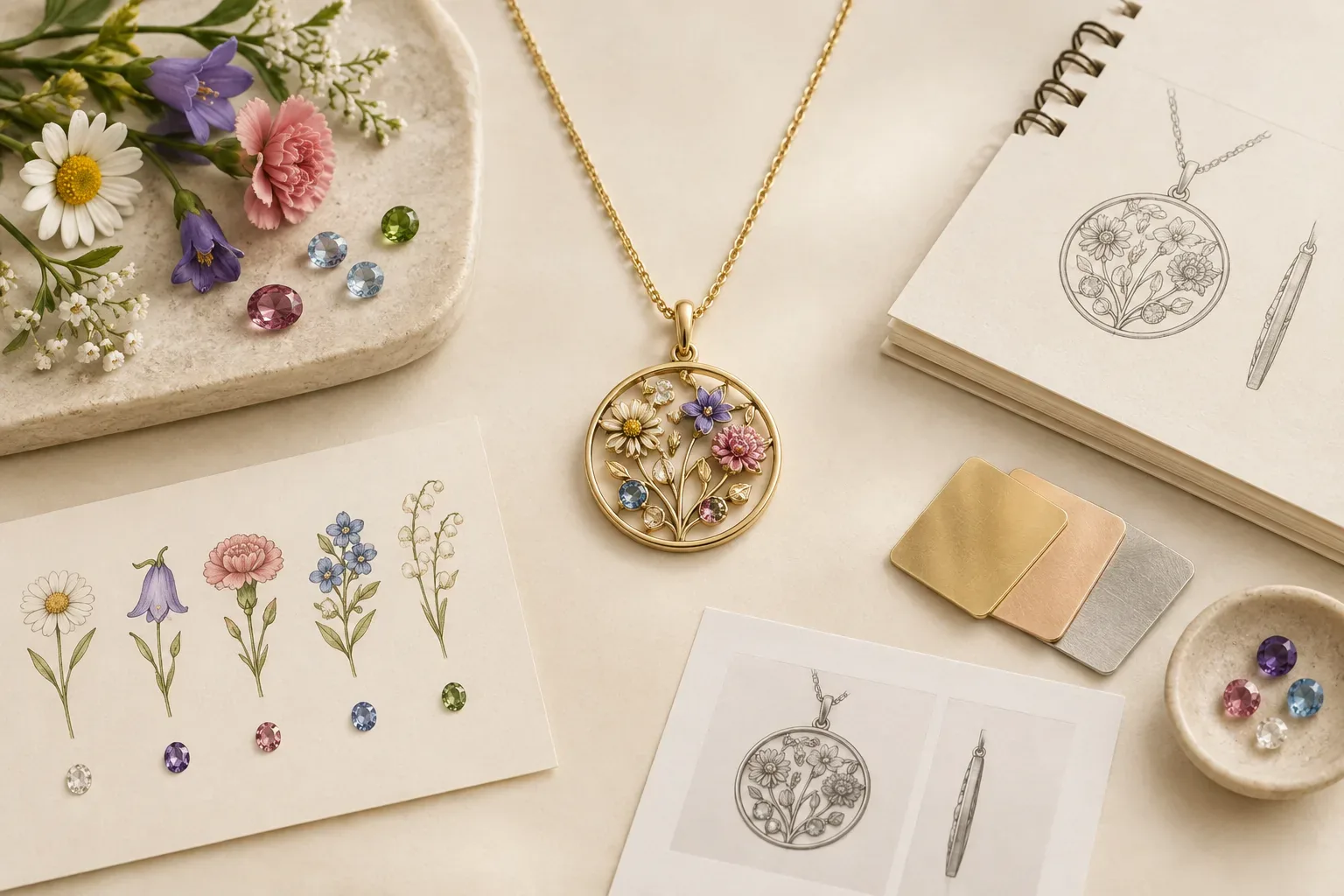
A step-by-step workflow to confirm month-to-flower choices, check spellings and dates, select engraving and layout, choose materials, review proofs, and complete final approval for personalized birth flower jewelry.
Historical evidence and cultural sources
Interest in floral symbolism and seasonal flowers is longstanding but varied across places and periods. Modern Western floriography—assigning specific sentimental meanings to particular flowers and compiling lists that associate flowers with months—grew in print culture in the 18th and 19th centuries, a development documented by the Library of Congress which notes how meanings circulated and changed through published guides and social practice.
Broader botanical and seasonal relationships also shaped how people used flowers for markers of time and identity. The Smithsonian Libraries and Archives traces how human plant relationships and seasonal histories influenced when and which plants were collected, cultivated, and celebrated, which in turn fed into popular lists of 'birth' or 'month' flowers.
Botanical accuracy and seasonality remain important for identifying the correct flower for a month, and the Royal Horticultural Society provides a horticultural context for plant identification and flowering periods that can clarify which species commonly represent a month in different climates and traditions.
Documented historical meanings versus modern personal interpretations
When planning a personalized piece, distinguish documented historical claims from contemporary personal meanings. Documentation about flower symbolism and the seasonal role of plants can be attributed to institutions that tracked print culture and horticulture, such as the Library of Congress and the Royal Horticultural Society. These sources show that meanings attached to particular flowers were not fixed and often depended on time, place, and published lists.
Modern personal interpretations—what a particular bloom means to a giver or wearer today—are distinct from those historic lists. A wearer might choose a birth flower because of an emotional memory, a family association, or aesthetic preference rather than any single, historically documented meaning. This personal layer is valid and often the primary reason for gifting personalized birth flower jewelry, but it is not the same as a universal historical meaning.
How the motif, gemstone, or tradition appears in jewelry
Floral motifs have long been used in jewelry as engraved silhouettes, filigree shapes, carved cameos, and three-dimensional miniature forms. Designers translate botanical characteristics into line, texture, and proportion so a wearer can recognize a daisy, rose, or poppy at a small scale. Historical patterns and the practice of referencing seasonal flowers are discussed in sources that overview human-plant relationships and print culture, which help explain why certain flowers became visually popular.
Gemstones are often paired with flower motifs to add color or to represent a birth month with a gem instead of, or alongside, a flower. When choosing gemstones, follow consumer protections and disclosure best practices outlined by the Federal Trade Commission. That guidance explains distinctions among natural, lab-grown, and imitation stones and highlights the importance of clear communication about treatments and origins.
Metal and construction choices affect how well a floral design reads at scale. Trade guidance from Jewelers of America explains format and fit considerations and can help artisans decide between cast, hand-fabricated, or laser-cut approach depending on the detail required and the metal selected.
A practical workflow for confirming month-to-flower choices, spelling, dates, engraving, layout, materials, proofs, and final approval
Begin by confirming the birth month and the authoritative source for the month-to-flower mapping you intend to use. Because lists vary by tradition and publication, ask the recipient or gift buyer which reference they prefer, for example whether they follow a widely used Victorian-era list, a modern florist's convention, or a regional association. Record the chosen source and, if relevant, the botanical species name to reduce ambiguity.
Verify name spellings and important dates directly with the recipient or purchaser. Ask for a clearly typed name and date in the exact format requested for engraving, including capitalization and punctuation. Read back the engraving text in full to the requester and require a written confirmation that the text is correct before moving forward.
Decide engraving layout and font early. Provide a set of options that show relative size and how the engraving will sit on the chosen piece. If the design includes flower motifs, determine whether the flower will be represented botanically, stylized, or as an abstract token; include scaled sketches that show the flower in context with the text and any gemstones.
Choose materials and document them. If gemstones are included, specify whether they are natural, lab-grown, or simulant and disclose any treatments, following the consumer guidance of the Federal Trade Commission. For metals and finishes, state karat, plating, and surface texture. Use trade association guidance such as that from Jewelers of America to confirm appropriate metal thickness, clasp types, and ring sizing methods.
Request and review proofs before production. A digital proof should show exact engraving text, font, spelling, layout, and an image of the finished composition at scale. For higher-cost or complex pieces, request a physical sample or an inexpensive prototype to assess scale and legibility. Allow time in the schedule for at least one revision cycle after the first proof.
Establish a final approval protocol. Require the purchaser to provide a written sign-off that refers to a specific proof version and includes an acknowledgment that the engraving text, spelling, dates, materials, and agreed finish are correct. Record the date and time of approval and retain correspondence. Only begin production once that sign-off is received.
Provide a clear timeline and change-order policy. Explain how long production will take after approval, whether last-minute corrections are possible, and any costs associated with changes once production starts. Communicate return and repair policies in plain language so the buyer understands remedies if engraving or material disclosures were incorrect.
Practical and respectful selection and gifting guidance
Respect cultural and personal meanings. If a recipient comes from a cultural background with distinct floral associations, ask respectfully whether they prefer a specific tradition or if a neutral design is better. Remember that the historical lists documented by institutions like the Library of Congress are only one source among many, and personal or familial meaning should take precedence when gifting.
Be precise with language when you ask for preferences. Offer visual options and botanical names for clarity and avoid relying solely on common names that vary by region. If the recipient is not available to confirm choices, choose a timeless approach such as a stylized motif paired with a neutral metal and a small gemstone, and include an option for engraving later.
Consider longevity and wear. Choose metals and finishes suited to the recipient's lifestyle and skin sensitivity. Use the Jewelers of America guidance on format and fit to select closures and ring profiles that minimize wear and maximize comfort. For heirloom intent, advise higher karat or durable alloys and discuss maintenance and cleaning recommendations.
When giving, include provenance and care information. A short note that states the flower source you followed, the gemstone disclosures, and care instructions adds transparency and meaning. This documentation respects the recipient’s right to know what materials are used and acknowledges that symbolic meanings can be personal rather than universal.
Frequently asked questions
How do I confirm which flower corresponds to a birth month?
Ask the recipient or purchaser which tradition or published source they prefer, and record that choice. Because month-to-flower lists vary by region and period, specifying the authoritative list you are following prevents misunderstandings.
What is the best way to ensure engraving text is correct?
Obtain the engraving text in writing, read it back exactly as it will appear, provide a digital proof that shows font and layout, and require a written sign-off on that proof before production begins.
Should I disclose whether gemstones are natural or lab-grown?
Yes. Follow Federal Trade Commission guidance and disclose whether stones are natural, lab-grown, simulants, or treated, and document this disclosure for the buyer to ensure transparency and trust.
What if the recipient prefers a different flower than their traditional birth flower?
Honor the recipient’s preference. Personal and family meanings are valid reasons to choose an alternative symbol; when in doubt, ask the recipient what floral or color motifs they prefer.
Is it necessary to request a physical sample before final production?
A physical sample is recommended for complex or costly pieces because it reveals scale, legibility, and finish in ways a digital proof cannot. For lower-cost items, a high-resolution digital mockup may suffice, but allow for at least one revision cycle.
Sources and further reading
- Blooming Flowers: A Seasonal History of Plants and People — Smithsonian Libraries and Archives
- Flowers and Their Meanings — Library of Congress
- Plants of the World — Royal Horticultural Society
- Buying Gemstones, Diamonds, and Pearls — Federal Trade Commission
- Jewelry Buying Guides — Jewelers of America