Meaning at a glance
Norse texts personify the sun and describe cycles, yet archaeological motifs and later sun-wheel designs are from varied times; jewelry makers often blend these sources, so make selections and gifts with attention to documented provenance and respectful modern meanings.
Direct answer: what 'Norse sun symbol meaning' usually refers to
Short answer: Norse textual tradition personifies the sun and places it within cosmic cycles, but there is no single, universally attested ‘‘sun symbol meaning’’ across Viking Age material culture. Modern sun-wheel jewelry frequently mixes literary ideas, archaeological motifs from different periods, and contemporary personal meanings, so items labeled as carrying an ancient Norse sun meaning should be read cautiously.
What the historical evidence shows, by culture and period
Written mythic sources from medieval Icelandic collections portray the sun as a female figure riding a chariot and describe larger cosmic motions and fates. The Uppsala Edda, published and made available by the Viking Society for Northern Research, records these kinds of mythic images and poetic descriptions from Norse literary tradition. Those texts are medieval compositions that preserve ideas from earlier Scandinavian belief, but they are not archaeological objects and reflect layers of oral tradition as they were written down.
Archaeological evidence from the Scandinavian Iron Age and Viking Age includes various solar and circular motifs found on metalwork, stone carving, and portable objects. The National Museum of Denmark explains that religious practice and symbolism in prehistoric and Viking Age Scandinavia were complex and localized, and that some motifs recur while others are ambiguous in meaning. Material finds rarely come with written explanations, so assigning a single ritual or theological interpretation to a motif risks overstating the evidence.
Modern syntheses, such as summaries on World History Encyclopedia, contextualize these textual and material strands and stress interpretive limits. Together the sources show a pattern: Norse mythology personified the sun and situated it in a cosmic narrative, archaeology provides motifs that may have solar associations, and historians caution that direct one-to-one mapping from a motif to an exact ancient ‘‘meaning’’ is often unsupported.
Distinguishing documented historical meanings from modern interpretations
Documented historical meanings come in two forms: what texts say and what objects can be directly contextualized. The medieval Eddic texts that the Viking Society for Northern Research publishes show the sun as a named entity subject to cosmic events. Archaeological finds, as curated and discussed by the National Museum of Denmark, show recurring wheel-like and circular motifs but rarely include captions or inscriptions that give unambiguous symbolic definitions.
Modern interpretations extend beyond that evidence. Contemporary makers and wearers often read wheel motifs as solar discs, sources of life, protection, or continuity, and may attach neo-pagan or personal spiritual meanings. Those modern claims are legitimate personal meanings but are not the same as statements of historical fact. World History Encyclopedia and museum discussions both note that later communities and modern designers frequently synthesize motifs across eras and cultural influences when creating jewelry labeled ‘‘Norse’’ or ‘‘Viking.’'
As an editor, it is important to keep these categories separate: document what the texts record and what the archaeological record contains, and then present modern attributions as contemporary additions rather than proven ancient beliefs.
How sun motifs and related traditions appear in jewelry
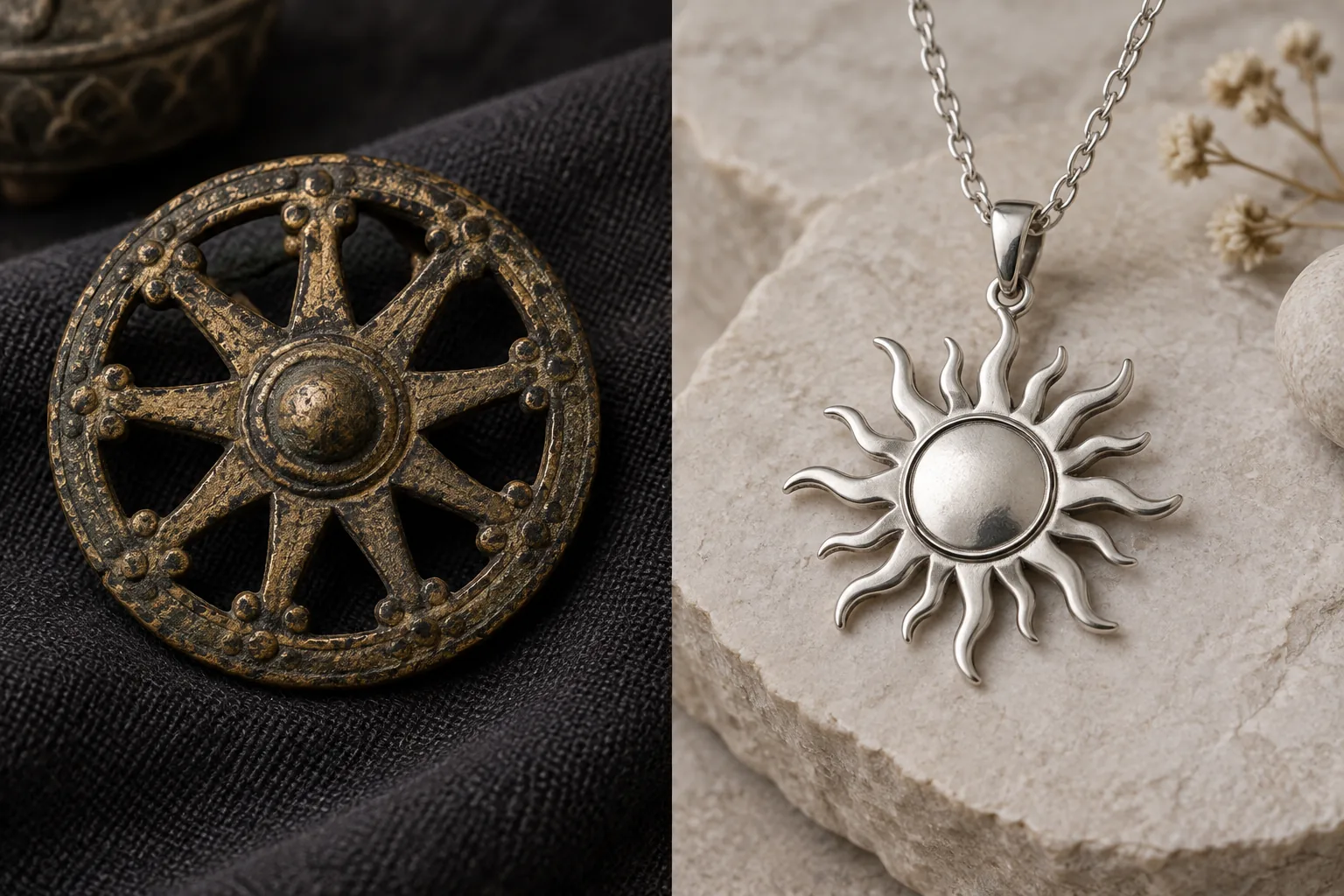
Archaeological motifs that appear on recovered metalwork—ranging from simple punched circles to more elaborate rosette and wheel carvings—have inspired modern jewelry design. Some contemporary pieces reproduce radial sun-wheels, stylized solar discs, or blends of knotwork with circular centers. Designers sometimes cite Viking Age finds as inspiration without specifying whether the design element comes from a Late Iron Age brooch, a medieval manuscript illumination, or later folk ornament.
Gemstones and materials also carry layered meanings. Historically, Norse metalwork used silver and bronze extensively; gem settings are less common in surviving Viking Age jewelry than in later medieval pieces. Modern sun-inspired pieces often use amber, garnet, or patterned enamel to evoke warmth and light. Using a warm-colored stone like amber or citrine in a sun motif is a contemporary design choice that references associations of the sun with warmth and fertility but is not a direct continuation of a single documented Viking practice.
Manufacturers also adapt motifs for various jewelry types: pendants that mimic disc shapes, signet-style rings with radial engraving, and brooches that merge a central circle with radiating arms. When shops or sellers label a design ‘‘Norse sun,’’ they frequently mean an aesthetic inspired by Scandinavian sources rather than an object preserved intact from a particular archaeological context.
Practical guidance for selecting or gifting sun-motif jewelry respectfully
If you want a piece that reflects documented Norse sources, look for clear provenance that ties the design to a specific artifact, period, or text. Museums and reputable academic reproductions will often describe whether a motif is copied from a Late Iron Age brooch, a medieval illustration, or a later folk carving. The Viking Society for Northern Research and museum catalogs are good models for the kind of contextual detail to expect.
If your priority is symbolic or personal meaning rather than strict historicity, choose a piece whose modern symbolism is clearly stated by the maker. Many artisans produce sun-wheel pendants intended to symbolize continuity, renewal, or the life cycle; those are contemporary meanings and can be meaningful gifts when framed as such. Be cautious about labeling an item as ‘‘authentically Viking’’ or claiming an ancient ritual use unless the maker provides verifiable sources.
Consider materials and wearability. Historically inspired pieces in silver or bronze reflect common metals from Scandinavian finds and age well; amber or warm-toned stones fit the sun motif aesthetically. For a gift, explain the provenance and your intention: if the design is a modern take inspired by Norse myth, say so. That respects both the historical record and recipients who may value cultural specificity or have their own spiritual associations.
If the recipient identifies with Heathenry or modern Norse religious practice, ask discreetly about symbols to avoid inadvertently gifting imagery that has particular ritual uses. Likewise, avoid co-opting symbols associated with extremist ideology by researching contemporary contexts; museums and reputable academic sources can help clarify whether a motif has been appropriated in modern politics.
How to read museum and vendor descriptions
When you see a vendor or catalog claim about Norse sun symbolism, check whether the description cites a primary source or a specific artifact. A trustworthy description will say if the design is ‘‘inspired by’’ a particular find or if it is a creative reconstruction. The National Museum of Denmark emphasizes the value of archaeological context; without that context, a motif’s ancient meaning remains interpretively limited.
Academic and museum publications, like those from the Viking Society for Northern Research, will usually distinguish between what the texts say and what objects suggest. Use those distinctions as a template when evaluating product descriptions and pair their statements with the broader historical summaries found in resources such as World History Encyclopedia.
Final thoughts
Norse mythic texts and Scandinavian archaeology both contribute pieces of the picture: the sun is personified and embedded in cosmic narratives in literary sources, and circular motifs occur in material culture. Modern sun-wheel jewelry often combines those threads along with contemporary symbolism, so read labels carefully and treat modern claims about ‘‘authentic’’ ancient meanings with healthy skepticism. Choosing a piece can be both a celebration of historical aesthetics and an expression of present-day meaning—both approaches are valid when presented honestly and respectfully.
Frequently asked questions
What does the Norse sun symbol mean historically?
Historically, Norse literary sources personify the sun and place it within cosmic cycles, but there is no single archaeological symbol that is proven to convey one fixed meaning; museums and academic editions such as the Uppsala Edda and the National Museum of Denmark stress interpretive caution.
Is the sun-wheel a confirmed Viking symbol?
Wheel- and disc-like motifs occur in Scandinavian archaeology, but calling any single sun-wheel design a confirmed Viking symbol overstates the evidence; reputable sources note that the motifs can span periods and contexts and require careful provenance to support a specific claim.
Were gemstones used historically in Norse sun jewelry?
Surviving Viking Age metalwork shows extensive use of silver and bronze, with fewer gemstone settings than some later medieval jewelry; modern use of amber, garnet, and citrine in sun-motif pieces is primarily a contemporary aesthetic choice.
How can I choose a respectful sun-motif piece as a gift?
Choose pieces with clear provenance if you want historical accuracy, and when buying contemporary designs, look for makers who state whether a motif is inspired by a particular artifact or is a modern interpretation; explain your intention to the recipient and avoid asserting unsupported ancient meanings.
Can modern sun-motif jewelry be used in contemporary Norse religious practice?
Some modern practitioners adopt sun imagery in personal or ritual contexts, but whether a piece is appropriate depends on the individual's community and practice; ask or research respectfully rather than assuming ancient ritual continuity.
Sources and further reading
- The Sun and the Moon in Norse Myth — World History Encyclopedia
- The Uppsala Edda — Viking Society for Northern Research
- The old religion — National Museum of Denmark