Meaning at a glance
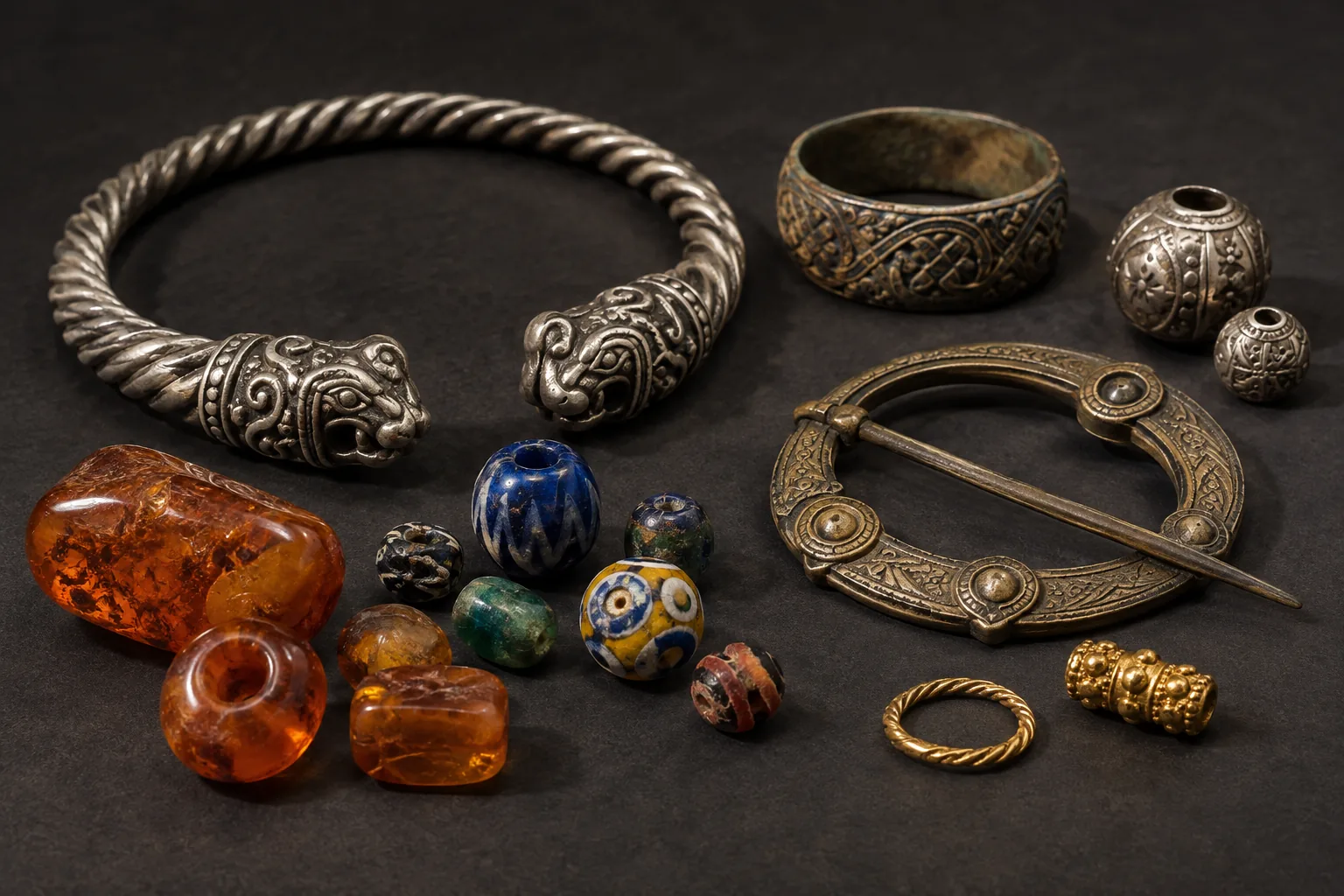
Viking-period adornment used metals, glass, amber, wood, and other materials whose survival and distribution reflect craft, trade, status, and archaeological preservation.
Short answer
Viking-period jewelry was made from a range of materials—primarily silver and bronze, with smaller amounts of gold, plus amber and glass—each surviving in different quantities because of how they were used, traded, and preserved. This summary statement reflects archaeological patterns and museum research rather than a single cultural prescription, and it is the foundation for the more detailed evidence below.
What the archaeological record and museums tell us
Archaeological finds and museum studies form the basis of our knowledge about Viking-period jewelry. The National Museum of Denmark summarizes how clothing and jewellery from the Viking period appear in burials, hoards, and settlement contexts, and it highlights the practical roles of different materials in everyday and ceremonial dress. The museum’s account emphasizes that surviving objects reflect what was worn, lost, intentionally deposited, or buried rather than a complete inventory of what people made or valued.
The pattern of imports and traded goods recorded by the National Museum of Denmark shows that materials and finished objects moved long distances during the Viking period. Glass beads and certain types of gold and silver objects often arrived as imports or as the result of trade, raiding, and gift exchange, so the presence of a material in a grave or hoard can indicate contact with other regions as well as local production.
The British Museum’s Viking gallery materials and educational resources also stress that surviving objects are shaped by preservation and collecting. Museums note that organic materials such as textiles and wood rarely survive unless conditions are exceptional, while metals, amber, and glass survive more readily and therefore dominate the archaeological record. Museums caution against reading every item as a fixed symbolic statement and encourage interpreting finds within their archaeological context.
Materials in detail: silver, bronze, gold, amber, and glass
Silver: Archaeological collections show silver was the most abundant metal in Viking-period finds across Scandinavia and in many regions where Vikings were active. National Museum of Denmark materials and hoard studies illustrate silver’s use in coins, arm rings, ingots, and beads. Silver objects survive well in graves and hoards, making them prominent in museum displays. The distribution of silver underlines its importance as both ornament and portable wealth.
Bronze: Bronze appears frequently in fittings, brooches, and everyday items. The National Museum of Denmark describes how bronzework provided durable decorative elements and practical closures for garments. Because bronze is an alloy that corrodes differently from iron and silver, it often survives in recognizable decorative forms such as clasps and small fittings.
Gold: Gold objects are rarer in the archaeological record but are present in high-status contexts and as imported items or recycled metalwork. Museums point out that gold’s scarcity in many finds reflects both its value and the limited quantities that circulated locally; where gold appears it often marks wealth or special connections to trade networks.
Amber: Baltic amber appears commonly in bead necklaces and pendants found in graves and settlement deposits. The National Museum of Denmark explains that amber was widely used for personal adornment and that its presence in graves points to trade links with amber-producing areas. Amber survives well in many burial environments, which helps explain its strong archaeological visibility.
Glass: Glass beads and elements appear frequently on Viking‑period necklaces and in burial contexts, and many were imported or made locally by reworking imported glass. The National Museum of Denmark and the British Museum note that glass beads in particular are prevalent in excavated women’s dress assemblages, often as part of multi‑strand necklaces combined with amber and metal beads.
Documented historical meanings versus modern interpretations
Documented meanings: Museums caution that direct evidence for what people in the Viking period 'meant' by wearing particular materials is limited. The archaeological contexts recorded by the National Museum of Denmark and the British Museum indicate that materials served social and economic functions—signalling wealth, indicating connections to trade networks, functioning as portable wealth for exchange, and forming part of dress that identified gender, age, or status in particular contexts. These are evidence‑based inferences drawn from find contexts, hoards, and imported material patterns.
Modern personal and commercial interpretations: Modern attributions of spiritual, astrological, or universally fixed symbolic meanings to Viking materials are contemporary interpretations rather than documented historical facts. While amber or silver may have personal or symbolic significance for wearers today, museums emphasize that such meanings cannot be assumed to match those of people in the Viking period unless supported by contextual archaeological or textual evidence.
How motifs, gemstones, and traditions appear in Viking jewelry
Motifs and techniques recorded by museums show up in a variety of object types. Metalwork often appears as arm rings, finger rings, riveted and cast brooches, and fittings used to fasten garments. Brooches and pins are among the most visible elements in female dress assemblages, while arm rings and penannular rings appear as wrist or upper‑arm ornaments and as portable wealth.
Gemstones and organic materials appear as beads and pendants. Amber is most commonly encountered as graduated bead necklaces and single‑piece pendants, while glass appears primarily as small, often brightly colored beads. Metal beads and cloisonné or inlaid work occur in more elaborate pieces. Museums describe multi‑strand bead necklaces combining glass, amber, and metal beads as a common feature of female grave assemblages.
Decorative motifs—interlace, animal styles, and geometric patterns—are present in metalwork and in some composite pieces. Museums document a variety of regional styles and workshop practices, which means motifs and techniques can help archaeologists link objects to particular production centers or trade connections.
Practical and respectful advice for selecting or gifting Viking-style jewelry
Choose provenance and transparency: If you want jewelry that respects archaeological heritage, look for makers who identify whether pieces are modern reproductions, inspired designs, or made from reclaimed metals. Museums encourage buyers to avoid purchasing objects of dubious provenance that may be illicitly removed from archaeological sites.
Respect cultural context: Recognize that museum research makes no universal claims about spiritual or cultural meanings for materials. If you give Viking‑style jewelry as a gift, frame it as a historically informed design or a personal symbol rather than a claim about authentic Viking beliefs. This approach respects both scholarship and personal intention.
Consider materials and care: Silver and bronze require different care than amber and glass. Contemporary silvers will tarnish and need polishing, bronze develops a patina, amber is sensitive to heat and chemicals, and glass can chip. Ask makers for care instructions and consider the recipient’s lifestyle when choosing materials.
Support ethical craft: Prefer modern artisans who work with certified or recycled metals and who disclose their sources for amber and glass. Museums’ emphasis on trade and context reminds us that many materials were historically mobile; today’s ethical choices help avoid contributing to unsustainable or illegal extraction.
Select for authenticity in design, not illicit objects: If you value historical accuracy in motifs and construction, consult museum publications or responsible craftsmen who reproduce techniques and styles documented by institutions such as the National Museum of Denmark and the British Museum. Buying a well‑made, labeled reproduction allows appreciation of style without supporting the market for unprovenanced antiquities.
Summary
Archaeology and museum research show that Viking-period jewelry was made from a mix of metals, amber, and glass, with survival and distribution shaped by trade, function, and preservation. The National Museum of Denmark and the British Museum both stress that finds must be interpreted in context and that modern symbolic readings are separate from the documented archaeological record. Choosing or gifting Viking‑style jewelry today can be done respectfully by prioritizing provenance, ethical sourcing, and clear communication about contemporary meanings.
Frequently asked questions
Were all Viking jewelry items made of the same materials across Scandinavia?
No. Archaeological evidence presented by museums such as the National Museum of Denmark shows variation by region, context, and access to trade; silver and bronze are widespread, while gold is rarer and amber and glass appear where trade or local resources supplied them.
Does amber or silver in a grave indicate a specific belief or magic use?
Not necessarily. Museums caution that while materials could carry social or economic meaning, direct evidence for specific religious or magical uses is limited; interpretations should be based on archaeological context rather than modern assumptions.
How can I tell if a piece is an authentic period artifact or a modern reproduction?
Authentic artifacts are sold and displayed with provenance and documentation by reputable museums and dealers. Modern reproductions typically come with maker information and should be labeled as such; if provenance is unclear, ask for documentation and avoid purchasing items of dubious origin.
Is it respectful to wear Viking-style jewelry today?
Yes, wearing historically inspired jewelry can be done respectfully if you acknowledge the distinction between modern interpretation and the archaeological record, and if you avoid promoting objects of illicit origin.
What care do these materials need?
Silver benefits from occasional polishing, bronze will develop a patina, amber should be kept away from high heat and chemicals, and glass should be handled to avoid chips. Ask dealers for specific care instructions for a given piece.
Where can I learn more about documented Viking jewelry finds?
Museum publications and collections—such as those from the National Museum of Denmark and the British Museum—are strong starting points because they present finds in their archaeological context and discuss interpretive limits.
Sources and further reading
- Clothes and jewellery — National Museum of Denmark
- Imports — National Museum of Denmark
- Vikings gallery activities — The British Museum