Meaning at a glance
This guide explains the three common earring formats—studs, drops, and hoops—how paired stones and settings affect appearance and wear, what metals and findings suit sensitive ears, what to ask about treatments and disclosure, and basic care to keep birthstone earrings secure and attractive.
Quick answer
Choose birthstone earrings in one of three common formats—studs for everyday simplicity, drops for movement and presence, and hoops for a contemporary or layered look—while matching stone size and cut to the format and expected paired-stone symmetry. Consider metals with appropriate hardness and hypoallergenic performance for pierced ears, and look for secure findings (screw-backs, locking hoops, or well-made lever-backs) to prevent loss. Ask sellers for full disclosure about treatments, lab-grown or imitation materials, and return or warranty policies, and follow simple care steps—gentle cleaning, safe storage, and professional inspections—to preserve settings and gemstones.
Historical evidence and origins
The modern idea of assigning gemstones to months and occasions has a layered history rather than a single origin. The Gemological Institute of America (GIA) provides a useful overview showing that associations between specific gems and pieces of jewelry have appeared in multiple times and places, and that modern month-by-month lists evolved over time from a mixture of earlier lists and popular practice.
GIA documents link the broader practice of associating stones with personal identity and calendar cycles to long-standing cultural traditions and to jewelry collections in Europe and North America. While some modern birthstone lists were standardized by jewelers’ organizations and trade groups in the modern era, GIA emphasizes that lists and uses have changed and been adapted by different communities and retailers.
Documented historical meanings versus modern personal interpretations
When researching the historical record, rely on documented sources rather than generalized claims. GIA’s material on birthstones cites historical associations and shows how lists changed through time; those documented meanings are what scholars and museum curators cite as evidence rather than universal beliefs. Historical meanings recorded by institutions often relate to practical, symbolic, or religious contexts of specific periods and places rather than to a single, fixed interpretation.
Modern personal interpretations—what a wearer feels a stone represents today—are different in kind from these documented historical meanings. Contemporary wearers commonly choose birthstone earrings for personal reasons such as celebrating a birth month, honoring a loved one, matching a color palette, or assigning private symbolic value. Those modern meanings are valid as personal or cultural expression, but they should not be presented as universal historical facts.
How birthstone motifs, gemstones, and tradition appear in earrings
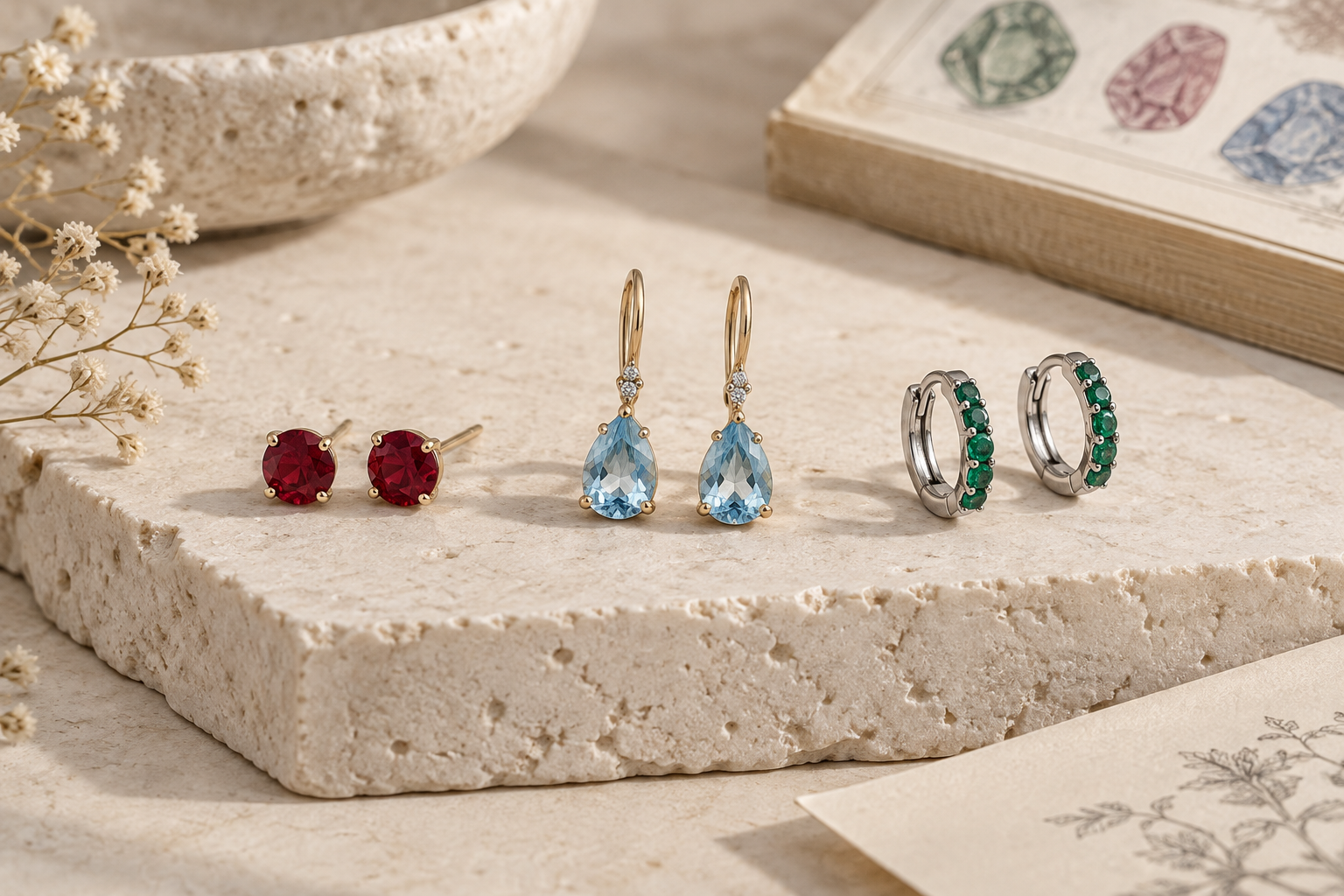
Birthstone earrings appear in many design languages. Simple bezel-set studs present a single focal gem and are often used when the wearer wants a discreet, daily-wear version of their birthstone. Drop or dangle earrings pair the birthstone with accent stones, metal motifs, or colored elements to add length and motion. Hoop styles incorporate small birthstones either set along the hoop or as a suspended charm to combine a modern silhouette with a personal touch.
Designers also translate traditional motifs into earring form. For example, engraved metalwork around a stone, paired or graduated gemstone arrangements, and symbolic shapes that reference season or personal meaning are common ways the birthstone tradition is expressed in earrings. The choice of cut, setting, and accent materials changes how the same gemstone reads visually and symbolically in different earring formats.
Styles explained: studs, drops, and hoops
Studs are typically a single stone set close to the earlobe. They are the most common choice for birthstone earrings because they highlight one gem cleanly, are comfortable for daily wear, and pair naturally as matched sets. Small studs of higher-quality stones often make a striking, subtle statement.
Drop or dangle earrings suspend the gemstone below the earlobe. This format allows for larger stones or paired stones, and designers use graduated sizes, accent diamonds or metal motifs to create movement. Drops are a good choice if you want the birthstone to be more visible or to incorporate multiple stones in a single earring.
Hoops present a circular silhouette that can be plain metal with a single suspended birthstone, or a hoop set with a row of small birthstones. Hoops range from thin huggie styles—where a small gemstone is set onto a loop that sits close to the ear—to larger circular styles that offer more room for decorative settings or multiple gems. Hoops work well for layering and for a contemporary look.
Metals, skin sensitivity, and secure findings
Metal choice affects durability, appearance, and skin compatibility. Common metals for birthstone earrings include gold (yellow, white, and rose), sterling silver, and platinum. Trade guidance from Jewelers of America highlights how different metals and finishes influence color coordination, weight, and long-term wearability, and how professional settings affect how securely a stone is held.
If you have sensitive skin, opt for higher-karat gold, platinum, or metals explicitly labeled hypoallergenic. Nickel content in some alloys is a frequent cause of irritation, and the Federal Trade Commission (FTC) recommends that consumers ask sellers about metal content and finishes when they have metal sensitivity concerns. Proper plating can wear off over time, so ask whether a plated piece has a solid core metal.
The type of earring finding significantly affects security. Post-and-friction-back studs can be fine for small stones, but screw-backs or locking backs add security for valuable pieces. For drops and hoops, well-made lever-backs, latch backs, and locking hoops reduce the chance of accidental opening. Inspect the hinge, closure, and solder joints, and ask the seller about manufacturing standards if loss prevention is a priority.
Buying guide: disclosure, paired-stone expectations, and care
Ask for full disclosure before you buy. The FTC provides clear consumer guidance about treatments, lab-grown gems, and imitations; reputable sellers will tell you if a gemstone has been heat-treated, irradiated, fracture-filled, dyed, or produced in a laboratory. These treatments affect appearance, value, and care requirements, so disclosure is essential for an informed purchase.
When purchasing a matched pair of birthstone earrings, expect close color and size matching rather than perfect identity; natural stones vary, and reputable jewelers will match pairs for eye-visible similarity. For multi-stone earrings that pair your birthstone with diamonds or other accents, ask about the provenance and grade of accent stones if those details matter to you.
Inspect settings and ask about warranties and return policies. A clear return window and a written warranty provide protection should a stone loosen or a finding fail. Jewelers of America recommends verifying workmanship—look for even bezels, consistent prong profiles, and smooth hinges—and request any certification or grading reports that may exist for value or insurance purposes.
Care for birthstone earrings with gentle cleaning and safe storage. Many stones tolerate mild soapy water and a soft brush, but some require special handling; for example, porous or fracture-filled stones may be damaged by harsh chemicals or ultrasonic cleaners. Schedule a professional inspection annually for prongs and settings, and store pairs together in a soft pouch or compartmented box to avoid scratches and tangling.
Practical and respectful selection and gifting guidance
Select birthstone earrings with the recipient’s lifestyle and preferences in mind. Choose low-profile studs for someone active or who wears earrings to work, choose drops when the recipient enjoys dressier or statement jewelry, and choose hoops for someone who prefers trend-forward or layered looks. Consider metal allergies and daily activities that might catch delicate settings.
If gifting across cultural or personal contexts, be mindful that the symbolic meaning of a particular stone can vary. Present a birthstone gift as a personal sentiment rather than as a universal cultural claim. When gifting to mark a life event, include information about any treatments and a note about care and warranty to show respect for both the piece’s physical longevity and the recipient’s right to informed ownership.
Finally, personalize without assuming. If you are unsure whether the recipient prefers a particular metal color or the look of a larger stone, choose a versatile design or include a gift receipt to allow an exchange. A thoughtful note explaining why you chose that birthstone—month, memory, or color—adds meaning without overclaiming historical symbolism.
Frequently asked questions
How do I clean and care for birthstone earrings?
Use mild soapy water and a soft brush for most non-porous gemstones, rinse thoroughly, and dry on a soft cloth. Avoid ultrasonic cleaners and harsh chemicals for porous or fracture-filled stones. Store earrings separately to prevent scratches and have settings checked by a jeweler annually.
What should I ask the seller before buying birthstone earrings?
Ask whether the gemstone is natural, lab-grown, or an imitation, and request disclosure of any treatments. Ask about metal composition and possible nickel content, the type of earring finding, warranty and return policy, and whether the pair is matched for color and size.
Are there hypoallergenic metal options for sensitive ears?
Yes. Higher-karat gold, platinum, and metals advertised as nickel-free or hypoallergenic are commonly recommended. Also consider titanium or surgical-grade stainless steel for posts if you have known nickel sensitivity; confirm metal content with the seller.
Can birthstone earrings be insured?
Valuable birthstone earrings can be insured through a homeowner’s or renter’s policy endorsement or a standalone jewelry policy. For insurance, obtain written appraisals or receipts and keep documentation of any certification, treatments, and purchase details.
How closely do paired stones need to match in a set of earrings?
Reputable jewelers will match paired stones for visible color, size, and cut symmetry rather than microscopic identity. Natural stones vary, so expect close visual matching; ask the seller to show the actual pair and describe matching standards prior to purchase.
Sources and further reading
- Birthstones — Gemological Institute of America
- Birthstones: Gems Through the Ages — Gemological Institute of America
- Buying Gemstones, Diamonds, and Pearls — Federal Trade Commission
- Jewelry Guides — Federal Trade Commission
- Jewelry Buying Guides — Jewelers of America