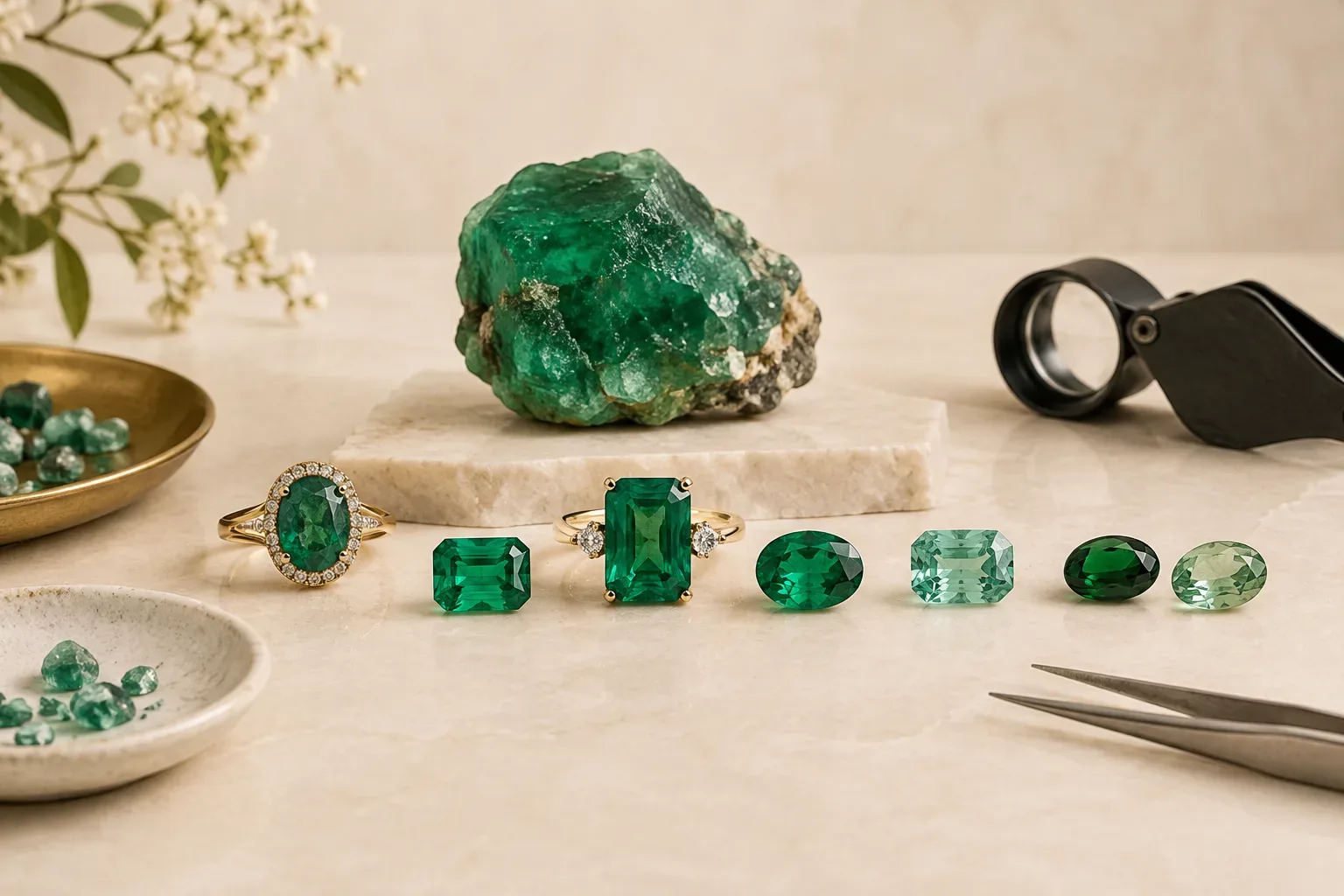
Meaning at a glance
This emerald authenticity guide defines natural, lab-created, treated and imitation emeralds; explains the consumer trade-offs, basic tests a buyer can perform, care needs, and what only a qualified jeweler or gemological laboratory can confirm.
Quick answer
Natural, lab-created, treated and imitation emeralds are distinct categories with different values and care requirements. Natural emeralds are dug from the earth and often show inclusions; lab-created emeralds are manufactured to the same chemical formula and visual appearance as natural stones; treated emeralds are natural stones altered to improve appearance; and imitations are other materials made to look like emerald. This guide explains how the categories differ, the practical trade-offs for shoppers, safe care, and what a buyer cannot conclusively verify without a qualified jeweler or gemological laboratory.
Definitions and decision criteria
Natural emerald: A natural emerald is a gem-quality variety of the mineral beryl formed by geological processes. Natural stones frequently contain internal features called inclusions that affect appearance and durability, and those inclusions are part of how gemological laboratories identify a stone as natural.
Lab-created emerald: A lab-created emerald (sometimes marketed as synthetic or cultured) has essentially the same chemical composition and crystal structure as a natural emerald but was grown in controlled conditions. Because the material is genuine beryl, many gemologists treat lab-created emeralds as 'real emeralds' in material terms, even though their origin differs.
Treated emerald: Many natural emeralds are intentionally treated to improve clarity or stability. Common treatments are oiling and resin-filling; these changes alter optical properties and may require special care. Treatments can often be detected by experienced gemologists using instruments and magnification.
Imitation emerald: An imitation is a different mineral or glass made to look like an emerald. Imitations can be inexpensive and are typically identified by their different physical and optical properties.
Decision criteria: When choosing, weigh authenticity, budget, aesthetic priorities, durability and long-term value. Natural stones usually command higher prices and collector interest, lab-created stones give the look of emerald at lower cost and with better clarity, treated stones can offer an attractive price-to-appearance ratio, and imitations are for costume or fashion-focused purposes.
Historical evidence and cultural context — what is documented
Historical statements about emeralds should be anchored to documentary evidence. The Gemological Institute of America (GIA) and other gemological references document that emeralds have been prized in multiple regions and periods for their green color and rarity, and that historical trade and treatment practices shaped how people used the gem.
Archaeological and written records show that green beryl was valued in antiquity across different cultures, and the modern gem trade’s classification and treatment knowledge has evolved considerably since the 19th and 20th centuries as laboratory techniques developed. For detailed technical histories and the science of treatments, the GIA is a primary, evidence-based reference for how modern gemology separates natural formation from human alteration.
Documented historical meanings versus modern personal interpretations
Documented historical meanings: Historical sources recorded in gemological and museum literature show that particular cultures associated value and prestige with emeralds, often linking the green color to fertility, renewal or status. These are context-specific cultural meanings rather than universal facts, and scholarly and museum records underpin such claims rather than oral tradition alone.
Modern personal interpretations: Today people choose emeralds for many individual reasons including birthstone symbolism, color preference, fashion trends and emotional meaning. These personal or contemporary symbolic uses are valid for the wearer but should be distinguished from historically documented beliefs. The two layers—historical record and private meaning—can overlap but are not the same.
How emeralds appear in jewelry today
Emeralds appear across many jewelry styles from fine solitaire rings to intricate vintage and contemporary settings. Market research tracking jewelry demand shows growing interest in gemstone rings, birthstone necklaces and sculptural gemstone pieces, and emeralds frequently feature in those categories because of their distinctive green hue and association with color-driven designs, as reported by Professional Jeweller and the industry trends tracked by Imaginaire Digital.
Designers use emeralds as center stones in engagement rings, as accent stones in cluster and halo settings, and as beads or cabochons in necklaces and bracelets. The stone’s clarity and cut choices influence setting decisions because emerald inclusions affect how light travels through the gem, and many settings are chosen to protect the stone’s edges and surface.
Practical selection and gifting guidance
Set your priorities first: Decide whether you want geological origin (natural), price-efficiency and flawless clarity (lab-created), improved appearance at a lower price (treated natural), or just the look (imitation). Your budget, intended wear frequency and the recipient’s values should guide the choice.
Ask for written disclosure and documentation: The Federal Trade Commission advises consumers to seek clear distinctions and written disclosures for natural, lab-created, treated and imitation gemstones. Request any available laboratory reports, treatment statements and return policies before purchase.
Match setting to use: If the gemstone will be worn daily, choose a protective setting and consider a stone with fewer surface-reaching fissures. Treated stones may require gentler care; lab-created stones can give higher clarity for similar carat sizes at lower cost.
Consider resale and sentimental value: Natural, untreated emeralds with documented origin and grading generally hold collector appeal, but lab-created stones offer affordable beauty for fashion jewelry and are increasingly accepted for contemporary engagement rings. When gifting, disclose the stone type truthfully; many recipients value honesty about origin and treatment as part of the gift’s meaning.
Care, durability and special handling
Emeralds are a variety of beryl with moderate hardness but often brittle due to internal inclusions. The GIA notes that many treatments affect durability and care needs, and treated emeralds may be more sensitive to heat, ultrasonic cleaners and harsh chemicals.
Cleaning and storage: Use mild soap, warm water and a soft brush for most emerald jewelry. Avoid ultrasonic or steam cleaning for heavily included or fracture-filled emeralds unless a gemologist confirms it is safe. Store emeralds separately from harder gems to prevent surface abrasion.
Service and maintenance: If an emerald is oiled or filled, address these treatments with the jeweler. Re-oiling or re-filling is sometimes part of maintenance. For repairs or stone removal, disclose treatments to the jeweler to prevent accidental damage during setting work or while using heat-bearing tools.
What you can and cannot verify without a lab or qualified jeweler
What you can check yourself: Inspect the stone under good light and a 10x loupe to look for characteristic inclusions, surface-reaching fissures and overall consistency of color. Ask the seller for clear photographs and for any laboratory reports. Request written disclosure of treatments and whether a stone is lab-created.
What requires a jeweler’s tools: Optical properties like refractive index, specific gravity and birefringence, and the identification of common treatments such as oiling or resin filling often require magnification, microscopic imaging and instruments available to a trained jeweler.
What requires a gemological laboratory: Origin claims (country of origin), the definitive detection of certain low-visibility treatments and definitive differentiation between some high-quality imitations or highly convincing synthetics and natural stones can only be established by a recognized gemological laboratory using spectroscopy and other advanced testing. The Federal Trade Commission emphasizes the consumer’s right to disclosure and the limits of unaided visual inspection.
Practical shopping checklist
Ask for written disclosures, a detailed purchase receipt and any available laboratory report. Inspect the stone visually or have a qualified jeweler do so before finalizing a purchase. Balance aesthetics, expected wear and budget against the stone’s disclosed origin and treatments. Remember that treatments and lab-grown material are legitimate market categories but must be disclosed and considered in value decisions.
Final advice
Use this emerald authenticity guide as a decision framework: know the four categories, request disclosure and documentation, match the stone and setting to how the piece will be used, and consult a qualified jeweler or a gemological laboratory for definitive identification or for high-value purchases. Clear disclosure and informed selection will maximize satisfaction whether you prioritize natural provenance, affordability, or appearance.
Frequently asked questions
How can I tell if an emerald is natural or lab-created?
A visual inspection with a 10x loupe can reveal growth features and inclusions typical of natural stones, but definitive identification often requires instruments that measure optical and spectroscopic properties. For certainty, request a report from a reputable gemological laboratory or consult a qualified jeweler.
Are lab-created emeralds 'real' emeralds?
Lab-created emeralds are chemically and physically beryl and are considered real emerald material in a scientific sense, but their origin is man-made. Sellers must disclose when a stone is lab-created, and consumers should weigh origin as part of value and meaning.
What is the most common emerald treatment and does it matter?
Oiling and resin filling are common treatments used to improve appearance and stability. Treatments change care requirements and should be disclosed; treated stones may need gentler cleaning and occasional maintenance.
Can I test an emerald at home?
You can do basic visual checks for obvious signs of imitation and ask for paperwork, but many subtle distinctions and treatments cannot be reliably detected at home. The Federal Trade Commission recommends seeking written disclosures and laboratory reports for certainty.
Should I buy a lab report for an expensive emerald?
Yes. For high-value purchases, a report from a respected gemological laboratory is a worthwhile expense because it documents natural versus lab origin, notes treatments and provides objective data that helps with valuation and insurance.
Sources and further reading
- Imaginaire Digital — Imaginaire Digital
- Professional Jeweller / PRYA Jewellery Search Insights — Professional Jeweller / PRYA Jewellery Search Insights
- Gemological Institute of America — Gemological Institute of America
- Federal Trade Commission — Federal Trade Commission