Meaning at a glance
Emerald engagement ring guide: Emeralds are a beautiful, historically prized gemstone that can make distinctive engagement rings when chosen and protected thoughtfully; buyers should weigh beauty versus durability, get clear written disclosure about treatments, consider protective settings such as bezel or halo, and follow gentle cleaning and inspection routines while understanding that origin and some treatments require a gemological laboratory to verify.
Quick answer
Emerald engagement ring guide — concise answer: Emeralds can be excellent choices for engagement rings if you value color and character over maximum scratch resistance; select stones and settings that protect the gem, insist on written disclosure about treatments or origin, and commit to gentler care and regular inspections. The thesis of this guide is to define the choice criteria, trade-offs, safe care, and what you cannot verify without a qualified jeweler or gemological laboratory.
Historical evidence and where emeralds appear in the record
Documented historical evidence identifies emeralds as gemstones that attracted interest in multiple regions and periods. Reference gemological resources note that emeralds have been prized in ancient and historic contexts, including royal and court settings across different cultures, and have been mined and traded in several historical mining regions, according to the Gemological Institute of America (GIA).
Because historical associations vary by culture and era, precise claims about who valued emeralds and when should rely on specialist sources; gemological references summarized by GIA are a reliable starting point for understanding those patterns rather than a single universal story.
Documented historical meanings versus modern personal interpretations
Documented historical meanings are those recorded in period sources, inventories, or later scholarly summaries and cited by gemological authorities. For example, gemological literature records that emeralds were incorporated into high-status jewelry in several historical contexts, which is a statement about usage rather than a universal symbolic meaning.
Modern personal interpretations are contemporary choices and associations buyers assign to an emerald engagement ring today. While historical records show emeralds were often associated with status or elite ownership in some cultures, modern couples may choose an emerald because they prefer green, have a personal connection to the stone, or like the vintage or Art Deco look. These modern meanings are subjective and not a continuation of a single historical symbolism across all cultures.
How emeralds and their motifs appear in jewelry
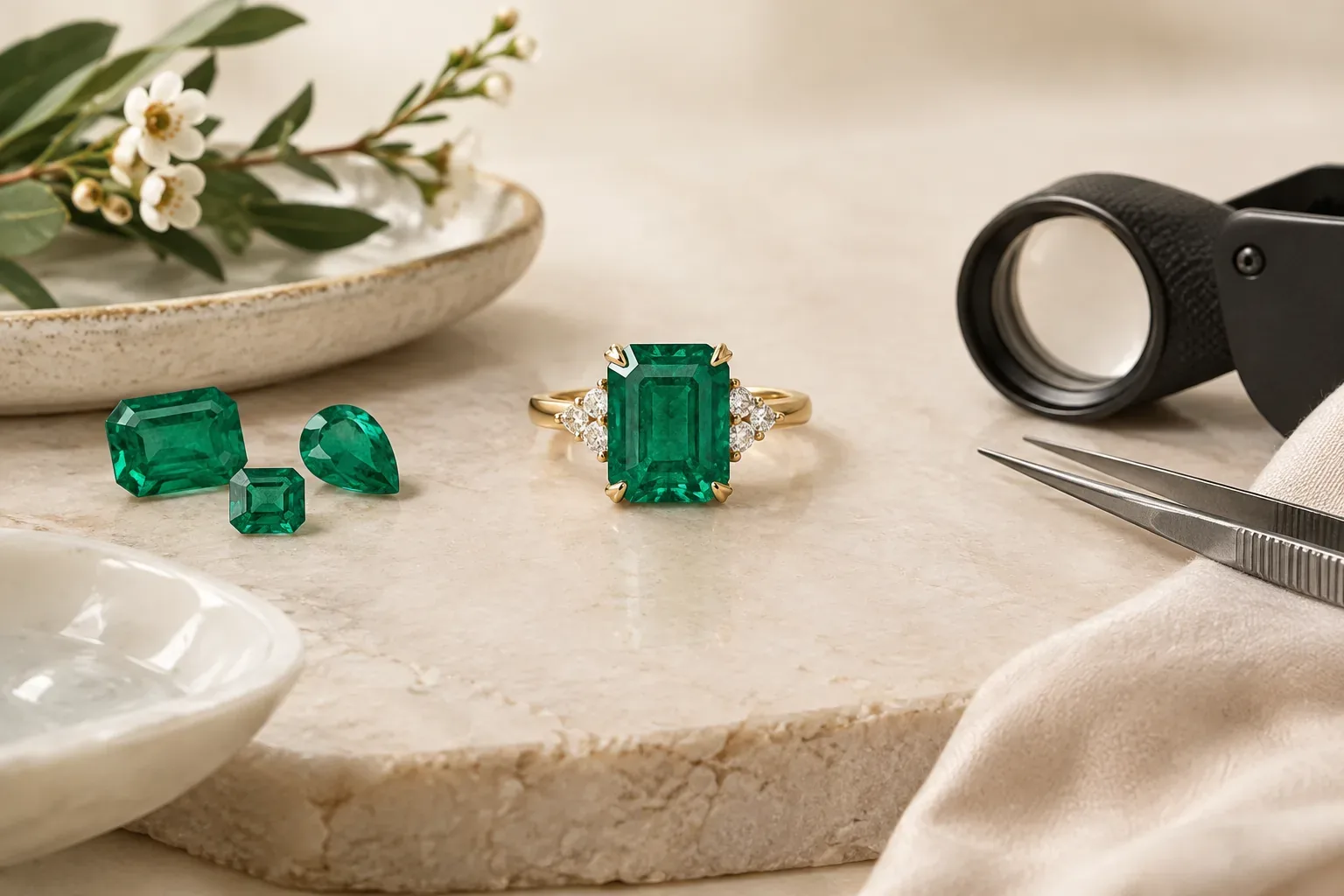
Emeralds appear in jewelry as single-stone centerpieces, clusters, accents, and as part of period-inspired designs. The emerald cut — a rectangular step-cut designed originally for emeralds — is commonly associated with the stone because its large facets emphasize color and reduce the appearance of inclusions. Gemstones of similar color may also be used in pavé or halo arrangements to accentuate a central emerald.
Trends in studio and retail jewelry influence how emeralds are styled. Industry trend research indicates growing interest in sculptural jewelry and Art Deco styles, which often pair well with step-cut gemstones and geometric settings, so emeralds fit naturally into those looks. Contemporary designers also use emeralds in mixed-gem compositions, cluster rings, and asymmetrical settings that emphasize color and texture.
Suitability: durability, appearance, and everyday wear
Emeralds are valued chiefly for their rich green color, but they usually contain internal features—known as inclusions—that can affect durability. Gemological authorities explain that many emeralds are treated to improve clarity, and such treatments can influence cleaning and repair options. Because inclusions are common, emeralds are not as inherently robust under rough wear as many faceted diamonds or sapphires.
For an engagement ring worn daily, suitability depends on the stone and setting. A high-quality emerald in a protective setting can serve well as a center stone if you accept that it will need gentler handling and more frequent inspection than a harder, clearer gemstone might. If you lead a very active lifestyle or work with your hands frequently, consider protective settings or companion stones, or choose a lab-grown or alternative gem with comparable color if you want similar looks with different durability characteristics.
Settings and design trade-offs
Settings that expose more of the gemstone show off color and brilliance but offer less protection. Prong settings present the most visible surface area, maximizing color display for emeralds and allowing light to enter the stone, but they leave edges and corners more vulnerable to chips, especially on rectangular or step-cut shapes.
Bezel settings and halo surrounds reduce risk of edge damage and can make an emerald engagement ring more suitable for daily wear. Bezel settings wrap metal around the stone's girdle, protecting edges, while halo settings use smaller accent stones to shield and visually reinforce the center gem. Designers often combine protective settings with lower-profile prongs to balance visibility and safety.
Practical selection guidance and required disclosures
Ask for specific, written disclosures about whether an emerald is natural, lab-created, treated (for example, oiled or resin-treated), or an imitation. The Federal Trade Commission advises consumers to obtain clear distinctions among natural, lab-created, treated, and imitation materials and to demand written seller disclosures.
For higher-value purchases, request an independent gemological report from a reputable laboratory. Gemological institutions can identify many treatments and provide grading or identification reports; the Gemological Institute of America and other labs are the kind of organizations whose documentation adds confidence in what you are buying. The FTC guidance means sellers should not rely on casual claims alone.
Care and safe maintenance
Cleaning: Clean an emerald set in jewelry using warm water, mild soap, and a soft brush, rinsing thoroughly and drying with a soft cloth. Avoid steam and ultrasonic cleaners for emeralds that have been treated or oiled, because those processes can force cleaning agents or heat into micro-fractures and disturb commonly used clarity treatments.
Routine care: Remove your emerald engagement ring for heavy manual tasks, sports, gardening, or chemical exposure. Have a jeweler check the setting periodically for loose prongs or wear. Because many emeralds are clarity-enhanced, occasional re-oiling or professional maintenance may be recommended by a qualified jeweler familiar with the exact treatment history of the stone.
What a shopper can and cannot verify without a lab or qualified jeweler
What you can verify yourself: You can confirm measurable details such as carat weight, visible cut shape, overall color appearance, dimensions, and the presence of visible surface damage. You can also check for a seller's written disclosure and view any appended gemological report and warranty documents.
What you cannot verify without expert testing: The presence and extent of many treatments, a gemstone's geographic origin, and some lab-grown versus natural distinctions often require specialized testing by a qualified gemologist or an accredited gemological laboratory. The GIA and consumer guidance indicate that treatments, detectability, and durability questions create distinct consumer needs and often require laboratory-level assessment to resolve definitively.
Practical, respectful selection and gifting guidance
Respect the recipient's preferences: Ask about style and lifestyle discreetly or involve them in the selection if appropriate. An engagement ring is both a technical purchase and a personal gift; consider favorite colors, metal types, and whether a protective setting is preferred for daily wear.
Budgeting and alternatives: If budget or durability are concerns, consider lab-grown emeralds, other green gemstones, or smaller center emeralds paired with accent diamonds or sapphires. Prioritize written disclosures and, for significant purchases, an independent report. Finally, include insurance and routine maintenance in the total ownership plan so the ring can be cared for responsibly over time.
Frequently asked questions
Are emeralds a good choice for an engagement ring?
Emeralds are an excellent choice if you prioritize rich green color and unique character; however, they often contain inclusions and may be clarity-enhanced, so they require gentler care and protective settings compared with harder stones like diamonds or sapphires.
How should I clean and care for an emerald engagement ring?
Clean with warm water, mild soap, and a soft brush, avoiding steam and ultrasonic cleaners if the stone has been treated or oiled; remove the ring for heavy work and have a jeweler inspect the setting periodically.
Can I tell if an emerald is treated or lab-grown without a lab report?
No. While you can look for surface damage and verify seller paperwork, many treatments and origin or lab-grown distinctions require testing by a qualified gemologist or an accredited laboratory to confirm.
What settings are best for protecting an emerald?
Bezel and halo settings offer more protection for edges and corners, while lower-profile prong settings can balance protection and visibility; choose a setting that matches the recipient's lifestyle.
What documentation should I request when buying an emerald engagement ring?
Request written disclosures about whether the stone is natural, lab-created, treated, or imitation, and for higher-value stones, ask for an independent gemological report from a reputable laboratory as recommended by consumer guidance.
Sources and further reading
- Imaginaire Digital — Imaginaire Digital
- Professional Jeweller / PRYA Jewellery Search Insights — Professional Jeweller / PRYA Jewellery Search Insights
- Gemological Institute of America — Gemological Institute of America
- Federal Trade Commission — Federal Trade Commission