Meaning at a glance
This ruby durability guide explains hardness (Mohs 9), toughness (moderate, affected by inclusions), common treatments, daily-wear trade-offs, safe care practices, and what requires lab or jeweler verification.
Hardness, toughness, and what those words mean for rubies
Hardness and toughness are different measures of a gemstone’s durability. Hardness (commonly expressed on the Mohs scale) measures scratch resistance. Rubies are a variety of corundum and are widely recognized for a high Mohs hardness around 9, which makes them far more scratch-resistant than most other gemstones used in jewelry.
Toughness describes a material’s resistance to breaking, chipping or cleavage when struck. Rubies have generally good but not exceptional toughness: they can chip or fracture if struck at a vulnerable point, especially if internal inclusions or feather-like fractures are present. A well-cut, included-free or clean stone with a secure setting will withstand daily activities better than a fragile or heavily included one.
Practical consequence: scratches are unlikely from ordinary contact for rubies, but impacts, sudden knocks, and stress at the setting—particularly on thin prongs or bezel edges—are the real everyday risks.
Treatments, disclosures, and how they affect durability
Treatments such as heat treatment are common for rubies and affect color and sometimes clarity; the Gemological Institute of America (GIA) explains that treatments, detectability and disclosure are central consumer concerns for gemstones and can influence how a stone performs and how it should be cared for.
Many treatments are stable for everyday wear, but some enhancement methods require special handling or change what you should expect in terms of future maintenance. For this reason the Federal Trade Commission (FTC) emphasizes clear, written seller disclosures and distinguishes natural, lab-created, treated and imitation materials so buyers can make informed decisions.
Before daily wear, ask the seller for documented disclosure about any treatment. If durability under unusual conditions (for example ultrasonic cleaning or exposure to chemicals) matters to you, confirm that with the seller or a qualified jeweler and, when relevant, request laboratory reporting.
Historical evidence and cultural uses (what the approved sources show)
The sources approved for this guide primarily address modern trade, consumer questions, and gemology rather than primary cultural histories. The industry publishers Imaginaire Digital and Professional Jeweller focus on contemporary search trends and jewelry market behaviours, while GIA and the FTC focus on gem treatment, disclosure, and consumer protection. Those sources show strong modern demand for gemstone rings, birthstone necklaces and sculptural jewelry and underline consumer questions about treatment and durability rather than offering primary historical accounts.
Because the approved evidence does not supply direct primary historical documents, this article does not claim specific ancient beliefs or precise dated attributions for rubies in particular cultures. Specialist academic or museum sources should be consulted for scholarly accounts of ruby significance in particular historical periods or cultures.
Documented historical meanings versus modern personal interpretations
Documented historical meanings require primary historical sources or museum records, which are beyond the scope of the approved evidence for this article. What the approved evidence does document is modern consumer behaviour and concern: industry reporting shows that gemstones (including birthstones and colored gems) are important in current ring and necklace demand, and gemological authorities and regulators focus on treatment and disclosure.
Modern personal interpretations are common today: many people choose rubies for romantic symbolism, birthstone associations (July), or simply for color and durability. These contemporary meanings are personal and social rather than universal. When a buyer values a ruby for a specific symbolic reason, that meaning is a valid personal interpretation but it is distinct from any historically documented cultural claim and should be stated as such.
How rubies typically appear in jewelry
In current market reporting, colored gemstones—including rubies—appear across engagement rings, statement rings, necklaces, pendants, earrings and bracelets. Professional Jeweller and imagery from industry insights note growing interest in sculptural jewelry, birthstone necklaces and gemstone rings, reflecting consumer demand for visible color and individuality in pieces.
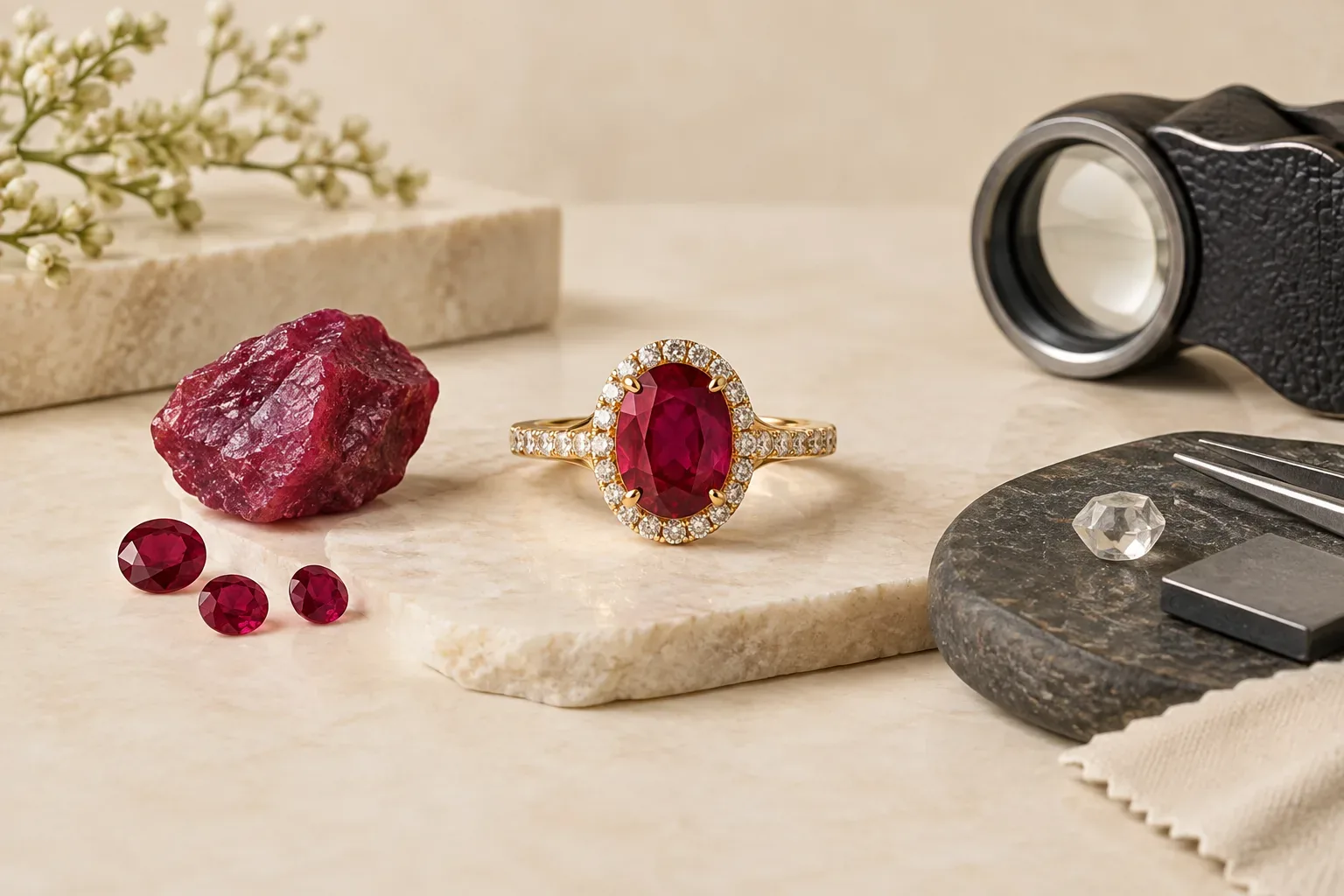
Design-wise, rubies are used as center stones in solitaire and halo engagement settings, as accent stones flanking diamonds, and in cluster or multi-stone compositions. Because of their hardness, rubies can be faceted into durable everyday rings; because of toughness concerns, settings that protect the girdle and edges—such as bezel settings, protective prongs, or lower-profile mountings—are common choices for active wearers.
Practical selection and gifting guidance
Decide your priority: color and appearance, maximum durability, origin, or budget. A purchaser focused on daily wear should prioritize clean-looking stones with solid settings and ask for information on treatments and expected care. If the recipient is active with hands-on hobbies, consider lower-profile settings, bezel mounts, or using the ruby as a pendant or earrings rather than a high-prong ring.
Ask the seller for written disclosures about whether the ruby is natural, lab-created, treated, or an imitation, as the FTC recommends. If origin, surgical testing resistance, or subtle treatments matter to you, request a report from an accredited gemological laboratory or at minimum an evaluation from a qualified independent jeweler. The GIA materials on treatments emphasize that detectability and disclosure vary by technique, so a lab report provides stronger verification.
Be mindful of trade-offs: highest color and clarity often come with higher cost. A well-cut, moderately included ruby set in a protective setting will usually deliver better real-world durability than an eye-clean but poorly set stone. For gifting, include care instructions and the seller’s disclosure so the recipient has accurate information about maintenance and future resale.
Care, cleaning, and storage recommendations
Routine cleaning for rubies is straightforward: warm soapy water and a soft brush are safe for most rubies and settings. The GIA notes that treatments and special care guidance are important consumer questions, so confirm with the seller whether a specific stone or its setting requires avoidance of ultrasonic cleaners or harsh chemicals.
Avoid exposing rubies to extreme temperature changes, strong blows, and abrasive household chemicals. Remove ruby rings during heavy manual work, contact sports, and when using solvents. Store ruby jewelry separately from softer gems and metals to prevent accidental knocks and tangling.
Have settings checked periodically by a qualified jeweler to make sure prongs and bezels remain secure; a loose setting is a far more common cause of loss or damage than the ruby’s hardness alone.
What you cannot reliably verify without a lab or qualified jeweler
Visual inspection and seller information can answer many practical questions, but some things require specialist tools and reporting. The FTC emphasizes that consumers need clear distinctions among natural, lab-created, treated and imitation materials and written disclosures; verifying origin, confirming the presence of subtle treatments, and detecting some heat or diffusion processes generally requires a gemological laboratory report.
If the stone’s geographic origin, the presence of specific treatments that affect value, or precise durability testing under extreme conditions are important to your purchase decision, factor in the additional cost of laboratory testing or a professional appraisal before finalizing the sale.
Final practical checklist for buyers and gifters
Before you buy or gift a ruby for daily wear, confirm seller disclosures in writing, check the setting for protection and stability, prefer a secure low-profile or bezel design for active wearers, follow conservative cleaning and storage practices, and consider a lab report for high-value stones where origin or treatment materially affects value. Use the seller’s information together with an independent jeweler’s inspection when in doubt.
Frequently asked questions
Is a ruby durable enough for everyday wear?
Yes, in most cases. Rubies are very hard (corundum) and resist scratching well, but their toughness can vary with internal inclusions and cutting. Choose a protective setting and follow care guidance to reduce the risk of chips or fractures.
How should I clean a ruby ring?
For routine cleaning use warm soapy water and a soft brush. Confirm with the seller whether a specific stone or treatment requires avoiding ultrasonic cleaners or chemicals, as the Gemological Institute of America recommends checking treatment-related care guidance.
Do treatments affect how I should wear or care for a ruby?
Some treatments are stable and do not change daily care needs, but others can affect durability or cleaning options. The GIA highlights that treatment type affects detectability and disclosure, and the FTC recommends getting written information from the seller so you can follow appropriate care.
Can I verify a ruby’s origin or subtle treatments at home?
No. Determining geographic origin or detecting some subtle treatments generally requires gemological testing by a qualified jeweler or an accredited laboratory. For important purchases, request a lab report or an independent appraisal before buying.
Should I get a lab report for a ruby I plan to wear daily?
A lab report is advisable for high-value stones or when origin and treatment materially affect value or care. For modest stones, seller disclosure and an independent jeweler’s inspection may be sufficient; the FTC recommends written disclosures in all cases.
Sources and further reading
- Imaginaire Digital — Imaginaire Digital
- Professional Jeweller / PRYA Jewellery Search Insights — Professional Jeweller / PRYA Jewellery Search Insights
- Gemological Institute of America — Gemological Institute of America
- Federal Trade Commission — Federal Trade Commission