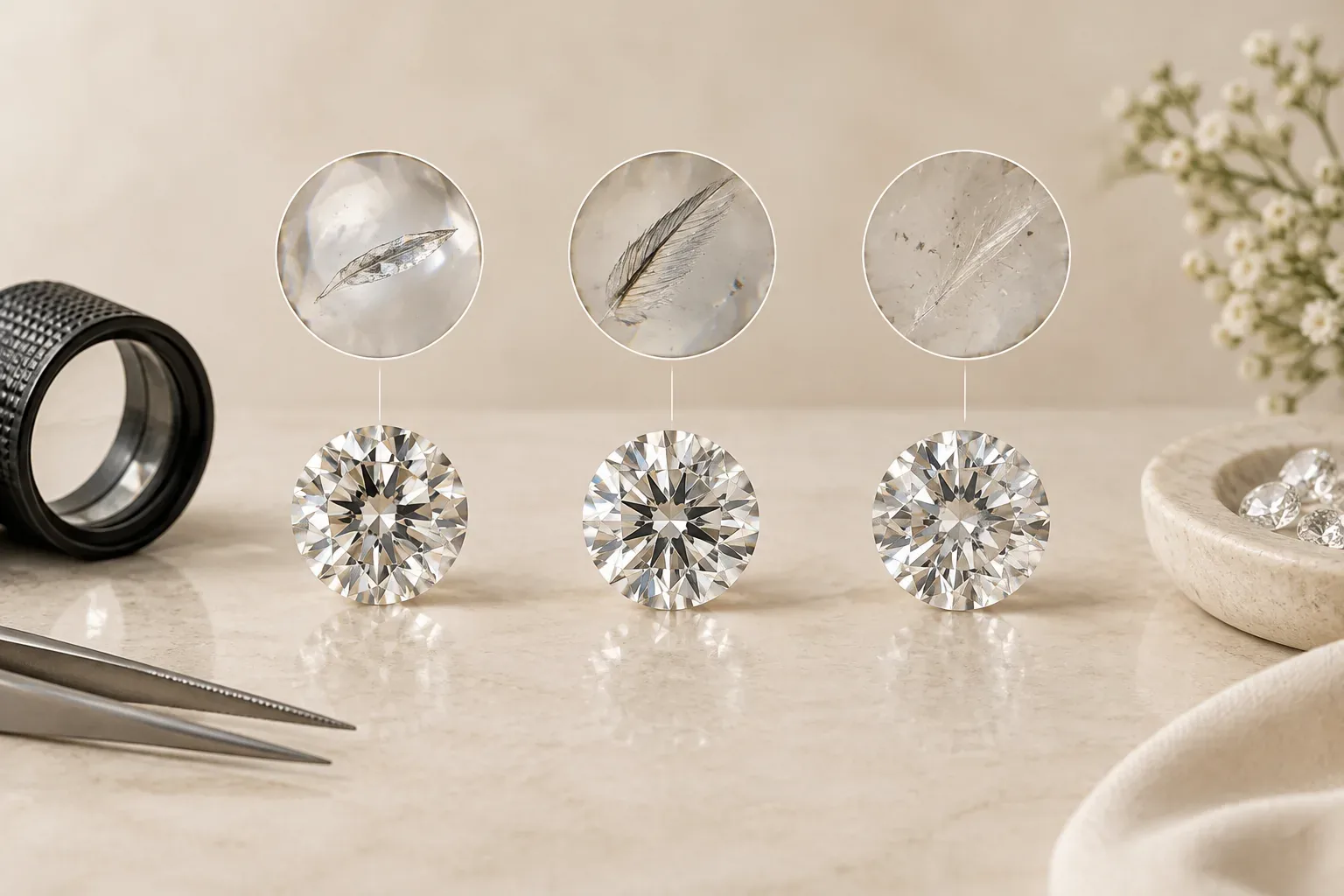
Meaning at a glance
Feather inclusions are internal fractures whose visibility, effect on durability, and price depend on size, location, orientation, and whether they reach the surface; consumers should evaluate high-magnification images or a lab report, insist on full disclosure, weigh visual trade-offs against budget, and consult a qualified jeweler or gemological laboratory for definitive verification.
What gemologists mean by a 'feather' and what we can say with confidence
In trade usage gemologists describe a small internal fracture or crack in a diamond as a 'feather'. Such features vary from tiny, visually insignificant white reflections to larger, surface-reaching breaks that may be visible to the naked eye or affect durability. The Gemological Institute of America (GIA) explains that fractures and inclusions can affect a gemstone’s durability, detectability, and require special care in some cases, and that some treatments exist to alter or stabilize features.
Because lab-grade grading and treatment disclosure affect what buyers can verify and expect, rely on written reports and clear seller statements. The Federal Trade Commission (FTC) underscores that consumers need clear distinctions among natural, lab-created, treated, and imitation materials, and that sellers should provide appropriate disclosure in writing. Where a feather might be a simple clarity characteristic or represent a structural weakness, only a trained professional can reliably assess the risk to durability and the presence or absence of treatments.
How feather inclusions change a diamond’s appearance
Feathers affect look primarily through visibility. A very small or shallow feather may only be visible under 10× magnification and have no perceptible effect in daily wear, while a larger feather positioned directly under the table or near the center of the face-up view can catch the eye and appear as a white or dark streak depending on lighting, surrounding facets, and viewing angle.
Contrast matters. A feather that creates a dark locus against a lighter facet junction will draw attention more than one that disperses light and appears faint. Cut and facet arrangement also influence whether a feather is masked or emphasized. A deeper pavilion feather can be less visible face-up than one sitting under the table, and certain cuts or facet junctions may either hide or spotlight an inclusion.
Orientation and surface-reaching fractures change appearance with movement and light. A feather that reaches the surface can reflect differently from one enclosed entirely by crystal because surface-reaching cracks interact with external light and may collect dirt or moisture, making them appear more noticeable over time.
How feather inclusions affect price and valuation
Clarity is one of the factors in a diamond’s price, and feather inclusions are assessed within an established clarity framework. The impact on price depends on whether the feather lowers the clarity grade, whether it is eye-visible, and whether it creates a measurable durability concern. Small, internal feathers that do not change the eye-visible appearance tend to have little effect on price beyond standard clarity-grade differentials, while larger, eye-visible, or surface-reaching feathers can push a stone into a lower price bracket.
There is no single formula that converts a feather’s measured dimensions into a fixed price change because price also depends on carat weight, color, cut quality, market demand, and seller pricing practices. Market demand for engagement rings and certain diamond styles remains strong in major markets according to Imaginaire Digital’s 2026 UK search estimates, and buyers should balance clarity considerations with the other attributes they prioritize.
Finally, any treatment, enhancement, or repair that affects a feather must be disclosed and may change price. The GIA cautions that treatments, detectability, and durability issues create distinct consumer questions, and the FTC requires seller disclosure regarding treated or otherwise altered gems. Expect treated or fracture-filled diamonds to be priced and labeled differently than untreated stones, and insist on documentation.
Documented historical meanings versus modern personal interpretations
The approved evidence for this article does not include primary academic or historical sources that document precise cultural meanings attached to feather-shaped inclusions in diamonds. The three evidence sources used here—GIA, FTC, and Imaginaire Digital—focus on gemology, consumer protection, and market demand rather than cultural symbolism.
That distinction matters: documented historical symbolism for feather motifs in jewelry, such as associations of feathers with flight, communication with the divine, or status in specific cultures, falls outside the scope of the provided sources. Modern wearers and designers often assign personal or contemporary symbolic meanings to feather shapes or inclusions—for example, interpreting a small internal feather as a poetic 'mark of nature' or a reminder of fragility—but these interpretations are personal and not established documentary evidence in the supplied references.
How the motif, the inclusion, or the tradition appears in jewelry
The feather motif can appear in jewelry in two different senses: as a deliberate decorative motif in metal or gem carving, and as a naturally occurring internal feature inside a gemstone such as a diamond. Designers may incorporate feather shapes in metalwork, engravings, or as accent stones. Separately, a diamond’s internal feather is a natural characteristic that can be part of the stone’s individuality and may be visible or hidden depending on the mounting.
When a feather inclusion is visible after setting, some designers use it as a design cue—placing accent elements or bezel edges to draw attention to or disguise the feature. Other jewelers select settings and stone orientations to minimize visibility of inclusions. Because appearance changes with mounting and lighting, ask for photographs of the actual mounted stone or for videos showing the diamond from multiple angles if you are evaluating how an inclusion will look in finished jewelry.
Practical selection and respectful gifting guidance
Start with priorities. Decide whether visual perfection, budget, durability, or natural character ranks highest for you or the recipient. If visual purity is paramount, choose a clarity grade where feathers are not eye-visible in the mounted setting. If budget is a constraint and you are comfortable with small internal feathers that are not eye-visible, prioritize cut and carat while accepting a lower clarity grade.
Request documentation and images. Ask the seller for a clarity plot and a current close-up photo or video of the exact stone mounted in the chosen setting. The GIA’s guidance about treatments and detectability and the FTC’s guidance on disclosure both support insisting on written reports and clear statements about any treatments or enhancements.
Be culturally sensitive when gifting. Some recipients may prefer a flawless aesthetic, while others appreciate visible natural features as part of a stone’s individuality. Because documented cultural meanings for feather inclusions are not provided in the available evidence, treat symbolic interpretations as personal or culturally specific and ask the recipient about their preferences when possible.
Safe care and maintenance
If a feather is an internal fracture or surface-reaching crack, avoid sudden temperature changes and hard knocks. The GIA explains that fractures and certain treatments influence a gemstone’s durability and care needs, and stones with surface-reaching feathers may be more vulnerable to chipping if struck near the compromised area.
Ask whether ultrasonic cleaning or steam cleaning is recommended for your specific stone. Some fractures can be exacerbated by aggressive cleaning methods, and gemological guidance will vary by stone and by whether any treatment has been applied. When in doubt, use a gentle cleaning method such as mild soap, warm water, and a soft brush, and consult the seller or a qualified jeweler for tailored care instructions.
What buyers can verify and when to consult a professional
You can reasonably verify the following without a laboratory test: whether a feather is visible in seller-supplied 10× magnification photos or videos, whether the feather appears to reach the surface in those images, and whether the seller has disclosed any treatments, enhancements, or fracture-filling. The FTC supports consumer rights to clear written disclosure on treatments and origin.
You cannot, with certainty, verify long-term durability consequences, the presence of microscopic treatments that are not disclosed, or the full internal three-dimensional character of the inclusion without a qualified jeweler’s hands-on inspection or a gemological laboratory report. For important purchases such as engagement rings or heirloom pieces, obtain a grading report from a reputable lab or a hands-on assessment by an independent qualified jeweler before finalizing a purchase.
Final shopper checklist
Ask for a clarity plot and a lab or grading report that names any treatments. Ask for current, high-magnification photos or videos of the actual stone mounted in your chosen setting. Confirm the return policy and whether the piece can be re-evaluated by an independent gemologist within the return window. Weigh visibility against price and durability—small internal feathers that do not affect clarity face-up may be good value, while surface-reaching feathers warrant closer examination and possible treatment disclosure. When in doubt about long-term durability or treatment status, consult a qualified jeweler or a gemological laboratory for definitive answers.
Frequently asked questions
What is a diamond feather inclusion?
A feather inclusion is an internal fracture or crack inside a diamond; its size, location, and whether it reaches the surface determine visibility and any impact on durability. For treatment and detectability concerns, see GIA guidance on treatments.
Will a feather inclusion make a diamond break?
Not necessarily. Many feathers are small and do not affect day-to-day wear, but surface-reaching fractures can present a greater risk. Only a hands-on inspection by a qualified jeweler or a gemological laboratory can assess long-term durability with confidence.
How much does a feather inclusion reduce price?
There is no fixed price reduction; the effect depends on whether the feather lowers the clarity grade or is eye-visible, and on the stone’s carat, color, and cut. Request a clarity grade or lab report and compare similar graded stones to estimate price differences.
Can feather inclusions be treated or filled?
Some fractures can be treated or fracture-filled, and any treatment should be disclosed. The GIA discusses treatments and detectability; the FTC requires sellers to disclose such alterations in writing.
How can I tell if a feather is visible without buying first?
Ask for high-magnification photos and a video of the actual stone in the proposed setting, and for a clarity plot or lab report. If you still have doubts, arrange an independent inspection by a qualified jeweler before purchase.
Are feather inclusions considered symbolic historically?
The approved evidence used here does not provide documented historical symbolism specific to feather inclusions in diamonds. Modern symbolic readings are personal or cultural and are not documented in the supplied gemological and consumer-protection sources.
Sources and further reading
- Imaginaire Digital — Imaginaire Digital
- Gemological Institute of America — Gemological Institute of America
- Federal Trade Commission — Federal Trade Commission