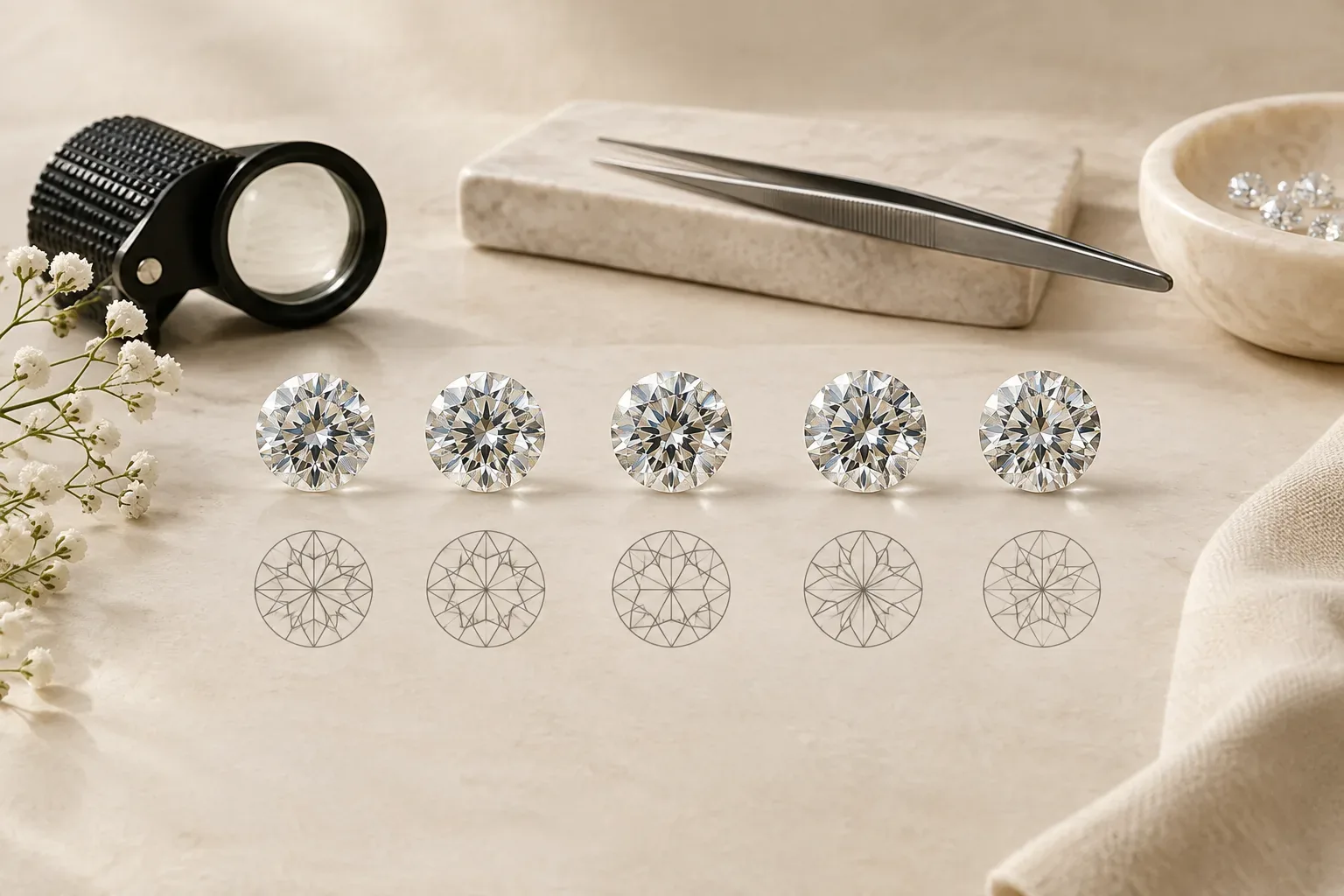
Meaning at a glance
Diamond symmetry describes how precisely the facets of a cut diamond are arranged; small symmetry differences can subtly change brilliance and face-up appearance and may alter price more than durability. Shoppers should weigh visual priorities, certificate notes, and budget: verify obvious symmetry with loupe or high-resolution photos, insist on written disclosures for treatments or origin, and use a qualified jeweler or gem lab for definitive grading or treatment detection.
What gemologists mean by symmetry (short definition)
In practical terms, symmetry refers to the placement, alignment and proportional relationships of a diamond’s facets relative to its center and girdle. Ideal or Excellent symmetry means facets are well-aligned and meet predictable angles and proportions; lower symmetry grades indicate facet misalignment, off-center culets, or uneven facet sizes. Symmetry is one component of cut assessment that influences light return, scintillation and the evenness of reflections across the table and crown.
Historical evidence and modern regulatory context
Documented developments in how consumers learn about diamonds, including cut and symmetry, are rooted in modern gemological science and consumer protection efforts. Regulatory guidance and consumer recommendations from the Federal Trade Commission show that written disclosures and clear distinctions among natural, lab-created, treated and imitation materials are essential for buyers. The FTC’s materials emphasize the modern marketplace requirement that sellers provide accurate, written information about a gemstone’s nature and treatments.
Similarly, gemological organizations document why treatments, detectability and special-care issues matter to consumers. The Gemological Institute of America (GIA) explains how treatments affect detectability, durability and disclosure obligations, which in turn influence how grading reports present cut and symmetry. These modern sources together form the best-documented historical record for how symmetry and related attributes are communicated to shoppers in the contemporary trade.
Distinguishing documented history from modern personal interpretation
Documented history in this guide means industry records, regulatory guidance and gemological standards created and published by organizations such as the FTC and GIA. Those records describe how symmetry is graded, disclosed and used in consumer decisions. By contrast, modern personal interpretation includes individual preferences—such as valuing a ‘characterful’ stone with visible inclusions or asymmetry for emotional reasons—or cultural fashions that favor particular shapes or finishes. Personal meanings are valid but are not part of formal grading or disclosure; they are statements of taste rather than verified gemological facts.
How symmetry changes appearance in jewelry
Symmetry affects the way light behaves inside a diamond and thus what you see when the stone is set and worn. A diamond with strong symmetry will typically show even light patterns across the table and predictable flashes of white light (brilliance) and colored light (fire). Slight asymmetry can cause uneven light distribution, localized dark areas, or off-center reflections that may be visible when viewed face-up or in certain angles.
The visual effect of symmetry is also shape-dependent. Round brilliants are designed for rotational symmetry, so minor misalignments can be more noticeable in pattern consistency. Fancy shapes—ovals, pears, marquises and cushions—have different symmetry expectations and can hide or highlight asymmetry depending on how facets meet. When set in jewelry, metal color, setting type, and halo or bezel treatments can mask or emphasize symmetry issues, so what you observe in a mounted ring may differ from the loose stone view.
How symmetry affects price and value
Symmetry is one of several variables graders consider when assessing cut quality; a higher symmetry grade often supports a higher price relative to a visually similar stone with poorer symmetry. Market pricing reflects buyer demand—recent industry searches show continued strong interest in engagement rings and other diamond styles—so symmetry-linked premium depends on shape popularity, carat size and current retail trends, all of which influence scarcity and willingness to pay, as summarized in industry visibility research.
The practical trade-off is that small symmetry differences may be visually subtle yet command a measurable premium. Conversely, sellers sometimes price down stones with noticeable symmetry faults to move inventory. Buyers should weigh whether the additional cost for a higher symmetry grade produces a meaningful visual improvement for their priorities and budget.
What you can verify yourself and what requires a jeweler or laboratory
Shoppers can perform several useful checks before purchasing. Use high-resolution photos or videos under natural light, and if possible view the stone in person with a 10x loupe or a jeweler’s loupe to look for off-center tables, uneven facet junctions, and visible dark areas from off-axis views. Request clear images of the crown and pavilion facet junctions and ask the seller for certification images or light-performance photos if available.
However, limits exist. A consumer cannot reliably detect certain treatments, determine whether a stone is natural or lab-grown with the naked eye, or produce a definitive symmetry grade comparable to a laboratory report. For these determinations, and for an authoritative symmetry grade, you need a qualified jeweler’s inspection and, for legal-grade certification, a gemological laboratory report from a recognized lab. The FTC emphasizes that sellers must disclose material facts in writing; the GIA explains that detection and disclosure of treatments and modifications are specialist tasks best handled by labs and trained professionals.
Practical selection and gifting guidance
Decide which visual attributes matter most. If you prioritize maximum sparkle and optical evenness, target stones with Good, Very Good or Excellent symmetry as reported on the certificate and compare photographs. If you prioritize size or color over microscopic symmetry, accept small symmetry trade-offs to allocate budget to carat or color improvements. Use certificate images and independent labs wherever possible to reduce uncertainty.
When buying a gift, be respectful of the recipient’s style and the social context. For an engagement ring, confirm return and resizing policies and obtain written disclosures about treatments or lab origin per FTC guidance. If the recipient prefers vintage or characterful stones, discuss whether slight asymmetry is desirable as part of the design. Always keep purchase documentation and any lab reports with the gift, and, if appropriate, arrange for a post-purchase appraisal from a qualified jeweler so the recipient has clear ownership records.
Care, durability and ongoing considerations
Symmetry itself does not generally affect a diamond’s durability, but settings that expose edges or points (for example, pointed tips on marquise and pear shapes) can be more vulnerable to damage. GIA guidance about treatments and care highlights that treated or otherwise modified stones can have special handling and durability considerations. Ask the seller about any treatments and follow care recommendations for the setting type to minimize risk.
Maintain documentation. If you plan to insure the piece, carriers and appraisers will rely on lab reports and documented descriptions of symmetry and cut. For later resale, accurately disclosing symmetry grade and any known treatments or origin—consistent with FTC recommendations—is important for transparency and value retention.
Summary and decision checklist
In sum: symmetry influences appearance and price but is only one factor among cut, carat, color and clarity. Use high-resolution images and a loupe to check for visible asymmetry, insist on written disclosures about treatments and origin, rely on reputable certificates for definitive grades, and consult a qualified jeweler or gem lab for verification beyond a consumer inspection. Align choices with visual priorities and budget, and keep documentation for care, insurance and resale.
Frequently asked questions
Does symmetry affect a diamond’s durability?
Symmetry itself does not typically affect diamond hardness or intrinsic durability; however, poor symmetry can coincide with design features—such as thin points in marquise or pear cuts—that are more exposed in a setting. For any concerns about durability or special-care needs, consult the seller and check for disclosed treatments, as explained by the GIA.
Can I see symmetry problems in photos or do I need a lab report?
You can spot obvious symmetry issues in high-resolution photos and with an in-person loupe inspection; however, precise symmetry grading and detection of certain treatments or origin cannot be reliably done without a qualified jeweler or a gemological laboratory report.
Should I prioritize symmetry over carat, color, or clarity?
There is no universal rule. Prioritize the attribute that most affects what you value visually within your budget. Small symmetry differences may be less noticeable than gains in color or carat for many buyers, but symmetry can be important if you want maximum optical evenness. Balance trade-offs according to your preferences.
What documentation should I ask for before buying?
Ask for any available lab reports, written disclosures about treatments and origin as recommended by the FTC, detailed photos, and the seller’s return, warranty and insurance information. For irreplaceable purchases, arrange an independent appraisal after purchase.
Can treatments make symmetry less important?
Treatments and enhancements can affect detectability and care needs. They may lower market value or change how a diamond behaves optically. Always ask sellers to disclose treatments in writing and consult a lab report when treatment status could affect long-term value or care, per GIA and FTC guidance.
Sources and further reading
- Imaginaire Digital — Imaginaire Digital
- Gemological Institute of America — Gemological Institute of America
- Federal Trade Commission — Federal Trade Commission