Meaning at a glance
This guide defines diamond symmetry and its role within cut grading, explains decision criteria and reasonable trade-offs between symmetry grade, other cut factors, and budget, gives safe care and verification limits, and lists the precise questions shoppers should ask a seller or a qualified lab.
What diamond symmetry is (clear, evidence-led definition)
In gemological practice, symmetry refers to the regularity and alignment of a finished diamond’s facets, edges and facet junctions. Symmetry is graded by trained graders and appears on many laboratory reports as a separate facet of the cut evaluation or as part of an overall cut grade. Symmetry is related to, but distinct from, polish and the broad dimensional proportions (table, depth, crown and pavilion angles) that determine how light moves through the stone.
Because the Gemological Institute of America (GIA) is an industry-standard reference for gemological testing, shoppers should expect symmetry grades to be recorded and described on established laboratory reports and to ask for that report when comparing stones. The grade itself quantifies visible and measurable alignment issues that can include off-center culets, misaligned facets, uneven facet sizes, or disturbed facet junctions.
Historical evidence and cultural context (what the approved sources show)
Among the approved sources for this guide, the focus is technical, consumer-protection and market-demand information rather than broad cultural history. The Gemological Institute of America provides technical guidance on gem treatments, detectability and special-care implications, which affects how one treats and verifies diamonds that may have been altered. The Federal Trade Commission emphasizes the need for clear written disclosure about whether a gem is natural, lab-created, treated or imitation and the limits of consumer verification without laboratory testing. Imaginaire Digital documents market trends showing strong consumer demand in categories that commonly feature diamonds, such as engagement rings and studs, which helps explain why buyers prioritize reliable grading and disclosure today.
None of these approved sources is a primary cultural history reference for diamond symbolism in specific historical periods or distinct cultures. Because this guide uses only the approved evidence, it does not invent or attribute historical cultural meanings beyond what those sources document. If you need a detailed cultural history, consult dedicated historical or anthropological sources in addition to gemological references.
Documented history versus modern interpretation
Documented, evidence-based statements in the approved sources concern gem treatments, detectability, consumer disclosure and market demand rather than longstanding cultural symbolism. The GIA’s guidance is about identifying treatments and how those affect care and valuation; the FTC’s guidance concerns legal expectations for sellers. These are factual claims about materials, testing and commerce, not claims about symbolic meaning.
Modern interpretations—what a purchaser or recipient believes a diamond symbolizes—are personal and social. Contemporary shoppers often attach meanings like commitment, status, milestone or personal taste to diamonds, but those are modern cultural and individual interpretations and should be treated as distinct from laboratory facts about cut and treatment. This guide separates the technical, verifiable features a lab can report from the sentimental or cultural meanings an owner might assign.
How symmetry appears in finished jewelry
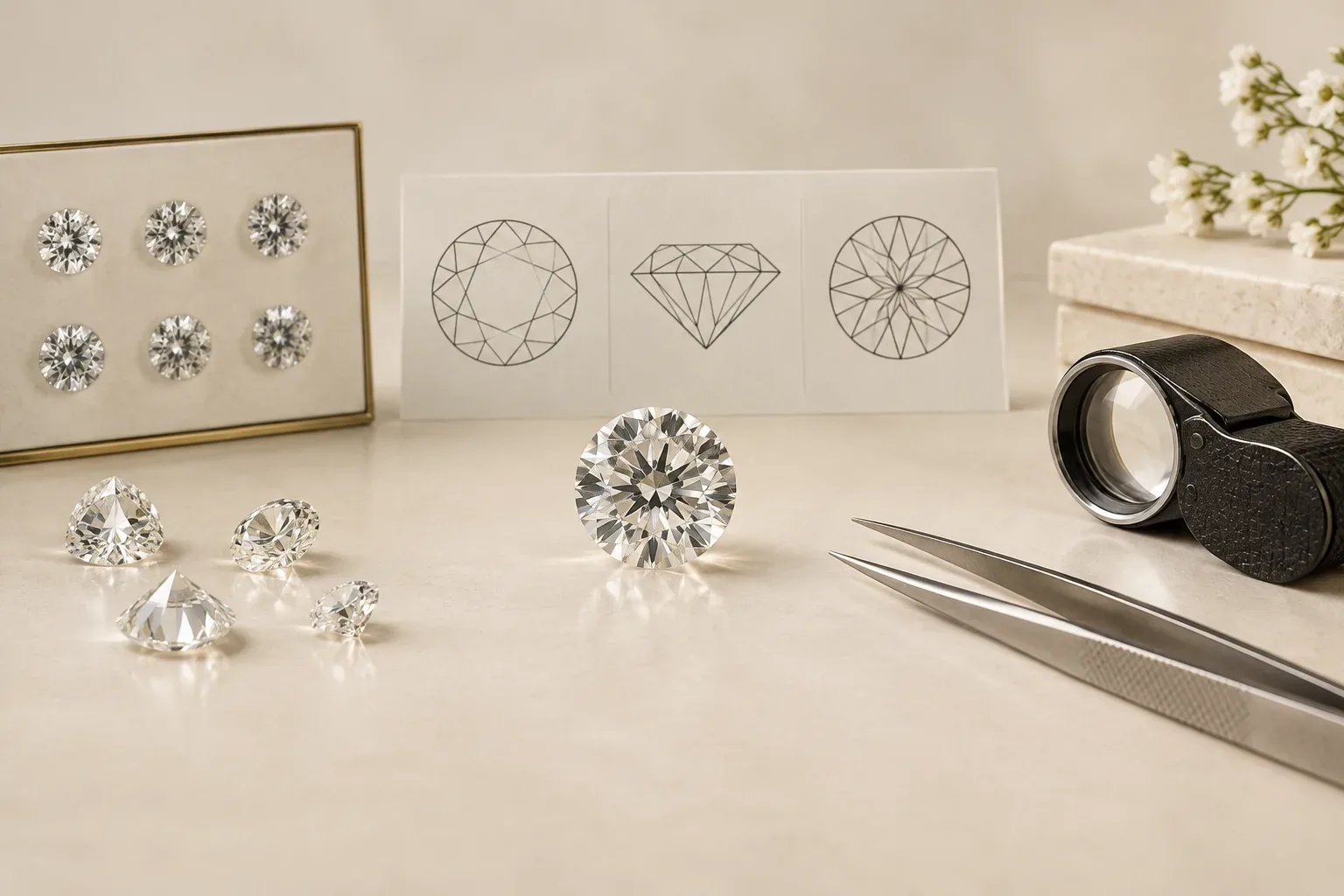
Symmetry is most visible in faceted shapes where repeated facet patterns are central to the design, such as round brilliants, ovals, pears, marquis and radiant cuts. In a round brilliant, perfect symmetry produces a balanced star or pattern when viewed face-up under magnification; in fancy shapes, symmetry affects how the outline looks at the girdle and how light sparkles across the surface.
Settings can emphasize or hide symmetry. A well-centered, symmetrical diamond will sit neatly in a classic four- or six-prong setting and align with halos or side stones. Conversely, a stone with alignment or symmetry issues can appear off-center in a setting or create subtle unevenness in the way light is returned to the eye. For many buyers, the synergy of diamond symmetry, precise setting and overall design determines the perceived quality in finished jewelry more than an isolated number on a report.
Practical buying trade-offs and decision criteria
Treat symmetry as one factor among several. Overall cut quality and proportions typically have a larger effect on brilliance and face-up appearance than symmetry alone, so prioritize a certified overall cut grade when available. Good symmetry improves light return and eye appeal, but the visible difference between adjacent symmetry grades (for example, 'Very Good' versus 'Excellent' or 'Ideal') is often subtle and depends on the stone’s shape, size and the wearer’s expectations.
Budget-conscious buyers can often choose a stone with a very good symmetry grade and allocate savings to a larger carat, higher clarity or a better setting. Buyers who desire the absolute top visual precision—competitive collectors or those seeking top resale value—may reasonably pay a premium for the highest symmetry and cut grades, supported by an independent laboratory report.
Questions to ask sellers and labs
Before committing, get written documentation and ask the seller to answer these specific questions: Which laboratory issued the report and can you see a copy? What is the symmetry grade and the overall cut grade? Are there any treatments or clarity enhancements disclosed? Is the diamond natural or lab-created, and is that stated in writing? What return, exchange and appraisal policies apply? The Federal Trade Commission requires clear written disclosure about origin and treatments, so insist on that documentation.
Ask whether the seller will allow an independent inspection by a qualified jeweler and whether they will permit a buyer to send the stone to an outside gemological laboratory for verification. Remember that certain claims—such as the absence of undisclosed treatments or the stone’s precise optical performance—cannot be definitively verified without a qualified gemological laboratory examination.
Safe care guidance tied to treatment and verification limits
Follow the Gemological Institute of America’s guidance on treatments and special care: if a diamond has been clarity enhanced, fracture-filled or otherwise treated, those treatments can affect both appearance and durability and typically require specific care. Ask for written disclosure about treatments. If a treatment is disclosed, ask the lab or the seller for the manufacturer’s cleaning recommendations and whether ultrasonic or steam cleaners are safe to use.
For untreated modern diamonds, routine care usually consists of gentle cleaning with a mild detergent and a soft brush, periodic professional checks of settings and prongs, and prompt attention to any chips or knocks. Do not assume a diamond is safe for any cleaning method without confirming the stone’s treatment history and setting construction.
Verification limits and when to use a professional lab
Without a qualified jeweler or an accredited laboratory report, most shoppers cannot reliably verify a diamond’s symmetry grade, the presence of subtle treatments, or whether a diamond is natural versus lab-grown. The Federal Trade Commission underscores that consumers need written seller disclosures and that some distinctions require laboratory-grade testing. If the correct grading, treatment status, or origin materially affects value or care, arrange for an independent gemological report from a recognized laboratory before finalizing a high-value purchase.
Use reputable labs and reports as your primary verification tools. If comparing certificates, understand that different laboratories may use slightly different grading terminology and that independent visual inspection by an experienced gemologist can add valuable context to a written report.
A practical buying checklist
Obtain and read the laboratory report; verify the issuing lab’s name and reputation. Confirm the symmetry grade and the overall cut grade, and ask how symmetry interacts with the stone’s proportions. Request written disclosure of any treatments or whether the diamond is lab-created. Balance symmetry against other priorities—proportions, carat, clarity, color, setting and budget. If the stone is a major investment, plan for an independent laboratory verification and ensure a reasonable return or inspection window with the seller.
Frequently asked questions
Is symmetry the most important factor in a diamond’s appearance?
No. Symmetry is an important component of cut quality but is not the sole determinant of brilliance. Overall cut proportions and polish often have a larger effect on face-up appearance. Treat symmetry as one factor to balance with cut grade, proportions, carat, color, clarity and budget.
Can I tell symmetry quality with the naked eye or a loupe?
Some obvious symmetry problems (severe misalignment or off-center culets) can be visible, but subtle differences between adjacent grades usually require trained grading and magnified inspection. For definitive results, rely on a reputable laboratory report or an independent gemologist.
What documentation should I insist on when buying?
Ask for a current laboratory report from a recognized gemological laboratory showing cut, symmetry and any treatments; written disclosure of whether the diamond is natural or lab-created; and the seller’s return, appraisal and inspection policies. The Federal Trade Commission expects such clear written disclosures.
How do treatments affect symmetry and care?
Certain treatments, such as clarity enhancements, are unrelated to symmetry but can affect durability and cleaning recommendations. The Gemological Institute of America advises that treated gems may require special care and that treatment disclosure is important for both value and safe maintenance.
When should I send a diamond to a lab for testing?
If origin (natural vs lab-grown), undisclosed treatments, or precise grading materially affect value or care, arrange independent laboratory testing before final purchase or finalize the transaction only after a lab verifies the seller’s claims.
Sources and further reading
- Imaginaire Digital — Imaginaire Digital
- Gemological Institute of America — Gemological Institute of America
- Federal Trade Commission — Federal Trade Commission