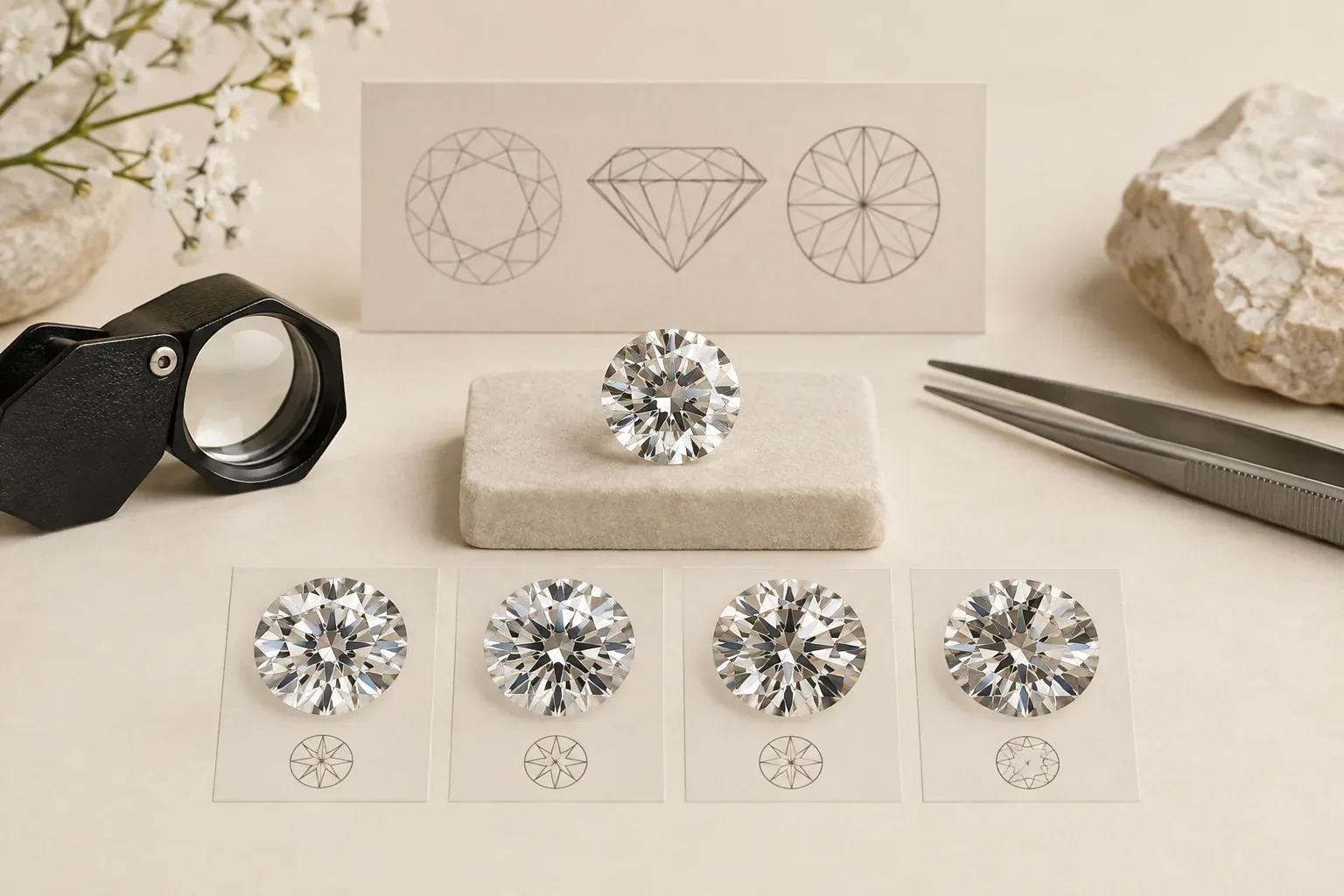
Meaning at a glance
Diamond symmetry refers to the precision and regularity of a diamond’s facet arrangement and outline; it’s one of several technical factors labs grade, it affects light performance and face‑up appearance in subtle ways, and buyers should weigh symmetry against the other 4Cs, budget, setting and intended use while relying on qualified gemological reports and seller disclosures to verify claims.
Direct answer — diamond symmetry explained in one line
Diamond symmetry explained: symmetry is the measure of how evenly and precisely a diamond’s facets, outline and angles are cut relative to the stone’s ideal proportions; it is a technical grading facet that can subtly influence sparkle, pattern and value, but it is only one of several factors a shopper should use when deciding which diamond to buy.
What symmetry means and how it is judged
In gemological terms, symmetry describes the evenness, alignment and repeatability of a diamond’s facet pattern and overall outline. When a cutter places facets, they aim to create balanced shapes and consistent facet junctions so that light behaves predictably inside the stone. Poor symmetry can produce misaligned facets, uneven facet sizes or an irregular outline.
Laboratories and trained graders evaluate symmetry separately from the familiar color, clarity and cut judgments. Symmetry assessments are based on visual inspection and magnified analysis of the facet arrangement and outline. The grade assigned reflects how closely the faceting matches an accepted ideal for that cut and shape, and how many and what kinds of deviations are present.
Historical evidence and cultural context
Published consumer and gemological literature accessible to shoppers today focuses on the technical and market implications of symmetry more than on long‑standing symbolic meanings attached specifically to symmetry. The Gemological Institute of America (GIA) highlights questions consumers raise about treatments, disclosure and care for gemstones, which reflect how modern gemology has created standardized concepts that buyers rely on rather than long, uniform cultural symbolism.
Regulatory guidance such as the Federal Trade Commission’s consumer information emphasizes the need for clear written seller disclosures about a gemstone’s origin and any treatments. That emphasis shows that the contemporary concerns around accuracy, grading and disclosure are products of modern trade and lab practice rather than consistent, timeless cultural descriptions of symmetry itself.
Because the available consumer and trade sources concentrate on present‑day grading, purchase protections and technical detection, documented historical claims tying specific cultures or periods to a defined symbolic meaning for diamond symmetry are not prominent in the consumer literature listed above. Where historical symbolism exists for diamonds more broadly, it is typically discussed under cultural or artistic studies rather than the trade and consumer guidance documents cited here.
Documented history versus modern personal interpretation
Documented history in the context of modern gemology refers to measurable, recorded practices such as when labs began grading and how disclosure rules developed; consumer and regulatory sources document those practical developments rather than a uniform symbolic language for symmetry across cultures. This article therefore treats historical claims about symmetry conservatively and separates them from personal or contemporary symbolic interpretation.
Modern personal interpretations are individual or market‑driven. Some buyers describe excellent symmetry as representing balance, precision, or emotional harmony; others do not notice small symmetry differences and focus on overall brilliance or budget. Those personal attributions are valid as individual meanings but are modern interpretations rather than universally documented historical meanings in the trade literature cited here.
How symmetry shows up in jewelry
Symmetry affects the look of a faceted diamond when you examine it face‑up or under magnification. In well‑symmetrical stones, facet junctions are regular, the table and culet (if present) align with the crown and pavilion, and reflective patterns appear balanced. In poorly symmetrical stones you may see off‑center tables, uneven kite or star facets in round brilliants, or a lopsided outline in fancy shapes.
Symmetry also interacts with setting choice. Prong and bezel settings can mask small asymmetries along the girdle or outline, while open or low settings that reveal more of the diamond’s crown and pavilion make symmetry — and other optical effects — more apparent. In cluster or halo styles, overall ring design can distract from minor symmetry issues in a center stone.
What you can verify without a lab and what requires experts
A shopper can verify some aspects of symmetry with careful, unaided inspection: face‑up visual balance, an easily noticeable off‑center table, or a visibly irregular outline are detectable in store or with a jeweler’s loupe. Photos and video can also reveal obvious misalignments. However, subtler symmetry deviations and an official symmetry grade require a trained grader, a qualified jeweler’s instrument, or a gemological laboratory report for reliable assessment.
The Federal Trade Commission advises buyers to seek written disclosures about a diamond’s origin, whether it is lab‑created, and any treatments or enhancements. Similarly, the Gemological Institute of America emphasizes that treatments, disclosure and detectability matter for consumer decision making. If a seller or listing claims a specific symmetry grade, ask to see the lab report or a qualified independent appraisal rather than relying solely on sales copy or unauthenticated images.
Decision criteria and practical trade‑offs
When you evaluate symmetry alongside other qualities, consider the intended use, the wearer’s priorities and your budget. Symmetry is one element of cut quality; light performance, proportions and polish also strongly influence how lively a diamond appears. For many buyers, a stone with very good overall face‑up brightness but a moderately reduced symmetry grade can be a sensible value choice, especially when funds are limited.
If you prioritize optical precision and want a stone that is technically close to the ideal, aim for higher symmetry as reported by a reputable lab. If you prefer to maximize carat weight or color for the same budget, accept that symmetry may be a secondary trade‑off. Always decide with the whole package in mind: setting type, metal choice and the partner’s taste can all alter how much symmetry will matter in daily wear.
Safe care and handling
Symmetry itself does not change the physical durability of a diamond — diamonds are extremely hard — but setting type and facet integrity can affect how the stone handles knocks and routine wear. Follow standard care guidance for diamonds and jewelry. The Gemological Institute of America reminds consumers that treatments, detectability and special care are relevant to maintenance and longevity, so follow any specific instructions the seller provides for mounted stones.
Routine practices include removing diamond jewelry during heavy manual work, exposure to harsh chemicals or activities likely to impact the setting, and having the mounting inspected periodically by a qualified jeweler to ensure prongs and bezels remain secure. For treated or specially altered stones, follow the seller’s care guidance and confirm any restrictions in writing.
Selection and gifting guidance
Ask for a lab report when symmetry is part of your purchase criteria. A reputable lab report will identify the stone’s shape and provide a separate notation for symmetry or cut precision so you can compare stones objectively. If the seller cannot provide a current lab report from a recognized laboratory or a qualified independent appraisal, treat symmetry claims as unverified.
When gifting, match the diamond’s technical qualities to the recipient’s taste and lifestyle. If the recipient values technical excellence or is knowledgeable about gemstones, prioritize a stronger symmetry grade together with a trusted lab report. If they prefer bold size, color warmth, or a particular design, balance symmetry against those preferences so the finished piece delights the recipient in everyday wear.
Summary
Diamond symmetry explained in practice means understanding it as a technical measure of facet regularity and outline that contributes to appearance and value but does not alone determine a diamond’s attractiveness. Use lab reports and seller disclosures to verify symmetry claims, weigh symmetry against other cut and 4C factors, and make care and setting choices that reflect the recipient’s style and intended use.
Frequently asked questions
What exactly does a symmetry grade tell me?
A symmetry grade describes how evenly a diamond’s facets and outline are cut relative to an accepted ideal. It summarizes visible and measured deviations in facet placement, shape and alignment; minor deviations may be invisible to the naked eye, while larger ones can affect face‑up balance and patterning.
Can I check symmetry myself in a store?
You can spot obvious asymmetry by looking face‑up and by asking to view the stone under magnification. However, subtler symmetry issues and an official grade require a trained grader or a lab report from a recognized gemological laboratory.
Does symmetry affect a diamond’s durability?
Symmetry itself does not change the diamond’s hardness. Durability concerns relate more to the presence of structural fractures, chips, or the security of the setting rather than symmetry grades.
Should I prioritize symmetry over carat or color?
There is no universal rule. If optical precision and a technically balanced appearance are your priority, give symmetry greater weight. If size or a warmer color is more important to you or the recipient, you may accept a lower symmetry grade as a reasonable trade‑off within your budget.
What documentation should I request when symmetry matters to me?
Ask for a current lab report or an independent appraisal that records the symmetry grade or comments on facet alignment, and request written disclosure about treatments or origin. The Federal Trade Commission advises getting clear written disclosures from sellers about origin and treatments.
How should I care for a diamond to protect its appearance?
Handle diamonds with care: avoid exposure to harsh chemicals when possible, remove rings during heavy manual tasks, and have settings inspected periodically by a qualified jeweler. Follow any special care instructions from the seller if the stone has been treated or enhanced, as noted by the Gemological Institute of America.
Sources and further reading
- Imaginaire Digital — Imaginaire Digital
- Gemological Institute of America — Gemological Institute of America
- Federal Trade Commission — Federal Trade Commission