Meaning at a glance
Before buying a toi et moi engagement ring, ask about the stones' origin and treatments, request written disclosures and any lab reports, confirm setting security and resizing options, and weigh trade-offs between mixed gemstones and durability—recognizing that some claims (like origin or certain treatments) require a qualified gemological laboratory to verify.
What the phrase and motif mean (and what the approved evidence shows)
The French phrase toi et moi literally means "you and me" and in modern jewelry use refers to a two-stone, side-by-side setting that visually represents two elements placed together. None of the approved evidence sources in this package provide primary historical provenance for the motif, so the detailed origins and cultural origins are not documented here in those sources. Instead, contemporary industry sources emphasize present-day market behavior around such styles rather than tracing their historical beginnings.
Documented history versus modern interpretation
Because the approved references do not include original historical research about the toi et moi motif, a publication-ready article must separate verifiable documentation from contemporary interpretation. The documents provided speak to current market demand and consumer protections rather than historic meanings. Jewelers Mutual reports 2026 trends that emphasize fluid forms, modern stacking, colored gemstones, craftsmanship and versatility, which helps explain why two-stone designs like toi et moi are popular today. Imaginaire Digital’s 2026 UK search overview shows strong consumer interest in engagement-related searches, indicating demand rather than provenance.
Modern interpretations—commonly presented by retailers and consumers—tend to treat a toi et moi ring as symbolic of two people or complementary qualities. Those symbolic readings are personal, cultural, and promotional; they are not universally documented facts in the approved sources. Treat modern symbolic meanings as personal or marketing interpretations unless you have historical scholarship or primary source evidence that says otherwise.
How the motif, gemstone choices and setting appear in jewelry (what to expect)
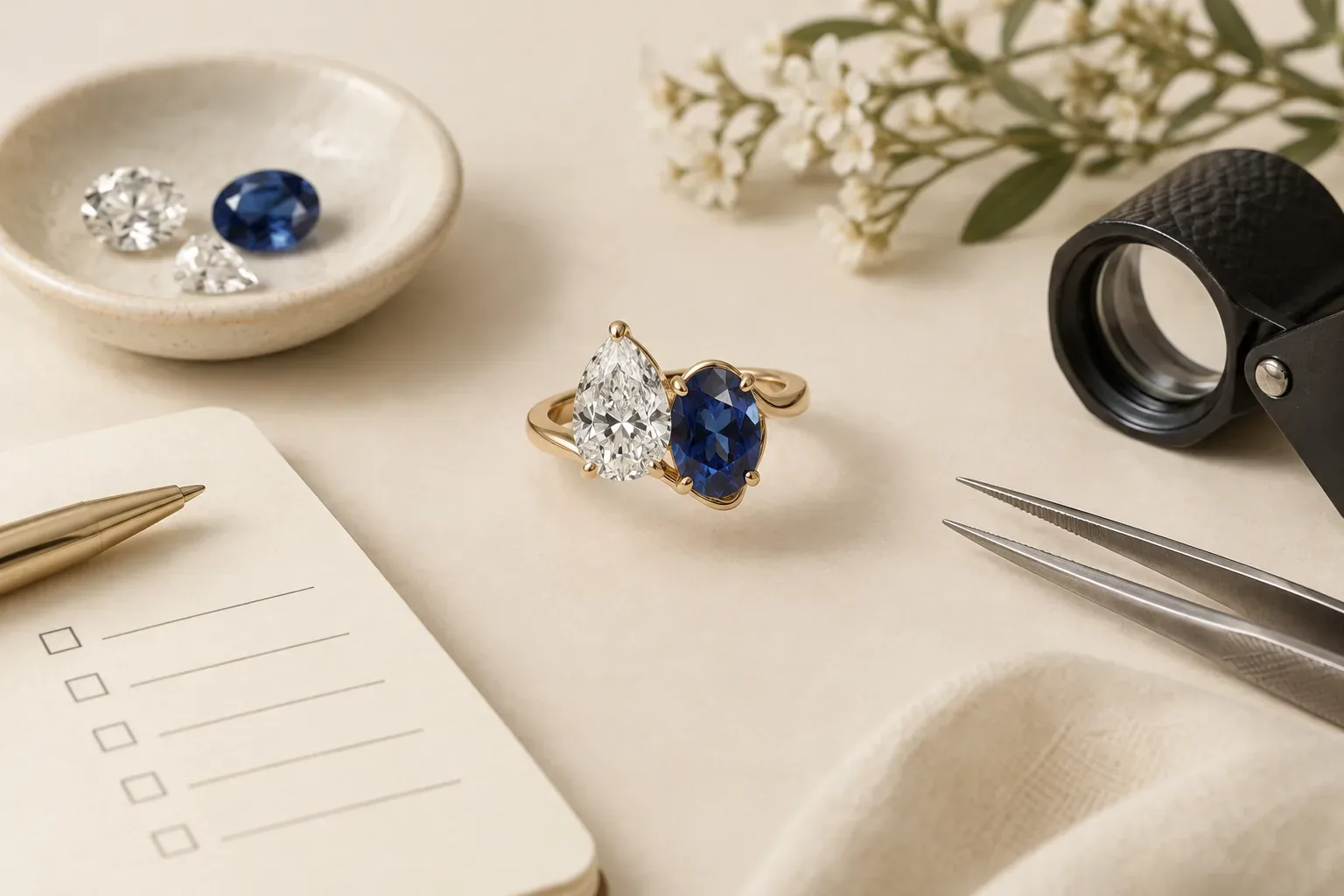
In contemporary jewelry the toi et moi motif appears as two principal stones set side by side or slightly overlapping, often with different shapes, sizes or colors to create contrast or balance. Jewelers may pair a diamond with a colored gemstone, two diamonds of different shapes, or two colored stones. The design can be delicate and flowing or more sculptural, depending on the maker; Jewelers Mutual’s 2026 trends note a market preference for fluid forms and craftsmanship that supports these varied looks.
Because mixed stones are common in modern toi et moi rings, expect varied technical choices: prong or bezel settings for protection, asymmetric mounts, and sometimes accent side stones or a shared gallery. The Gemological Institute of America reminds consumers that treatments, disclosure and durability vary by gemstone, so appearance and long‑term care depend on the exact materials used.
Practical buying checklist: questions to ask every seller
Start with clear identification: ask the seller to state in writing what each principal stone is (natural, lab-created, treated, or an imitation) and what the metal alloy is. The Federal Trade Commission requires clear distinctions among natural, lab-created, treated, cultured and imitation materials and written seller disclosures, so insist on those disclosures in your receipt or invoice.
Request documentation: ask whether either stone has a grading report from a recognized laboratory and, if so, obtain a copy. For diamonds, this might be a diamond grading report; for colored gemstones, documentation varies by lab and gem. Certificates will list weight, cut/shape, color and clarity grades when applicable and help you compare value propositions.
Ask about treatments and detectability: directly ask whether stones have been heat-treated, fracture-filled, dye-treated or otherwise enhanced. The Gemological Institute of America explains that treatments affect durability, detectability and care, and some treatments require lab testing to detect reliably. If the seller claims a stone is untreated, request that claim in writing and be prepared to pay for independent verification if provenance is important to you.
Confirm setting security and workmanship: ask how each stone is mounted (prongs, bezel, tension, etc.), whether settings have reinforcement for daily wear, and whether the ring’s design will snag or require frequent maintenance. Two‑stone settings can create small gaps where dirt collects or prongs can experience uneven wear; ask about routine servicing recommendations.
Discuss metal and sizing: confirm the metal alloy and finish, stamp authenticity (for example, karat mark) and the seller’s resizing policy. Two-stone rings with sculptural mounts may be harder or costlier to resize; ask whether the shank design permits safe resizing and whether resizing affects warranties.
Warranty, return and appraisal: get the seller’s written return, repair and warranty policy and whether you can obtain an independent appraisal for insurance. Jewelers Mutual notes the 2026 consumer focus on craftsmanship and versatility; a trusted warranty and repair option is part of that craftsmanship promise.
Care and longevity: ask how to care for the specific stone pair. If the ring mixes a hard gem (diamond, sapphire) with a softer gem (opal, emerald, pearl), discuss special cleaning, daily‑wear limits, and expected service intervals. The GIA emphasizes that treatments and durability create distinct consumer care questions.
Price and trade-offs: ask how price is allocated between the two stones and whether replacing one stone in the future is expected to be straightforward. Two-stone rings can offer versatility (mixing color and shape) but may be more complex and costly to repair if settings are custom.
What you can verify without a lab or qualified jeweler — and what you cannot
Without a qualified jeweler or laboratory you can verify visible details and documentation: you can check that the seller provides a written description and any available certificates, you can inspect the metal hallmarks and view the mounting style, and you can compare the ring’s appearance to the seller’s listing. You can test basic comfort, fit and immediate visual symmetry in person.
You cannot reliably verify many subsurface or origin claims without professional equipment: gemstone origin, some types of treatments, whether a stone has undergone high‑tech or low‑detectability enhancements, and accurate identification of certain natural versus synthetic materials usually require gemological instruments and an experienced analyst. If origin, treatment history or identification are important to you, plan to have the stone(s) examined by a qualified jeweler or to obtain an independent laboratory report.
Care guidance tied to the materials
Follow material‑specific care: for hard stones like diamond and sapphire, routine cleaning with warm water, mild soap and a soft brush is usually safe, but settings should be checked periodically. For softer or treated stones, follow the seller’s instructions and the Gemological Institute of America’s guidance: some treatments reduce durability or require gentler cleaning and storage. Avoid exposing mixed‑gem rings to harsh chemicals, ultrasonic cleaners or steam unless a jeweler confirms the stones and settings will tolerate those methods.
Document care for insurance: if you are insuring the ring, provide the insurer with the item description, any lab reports and the seller’s care advice. Many insurers require professional appraisals and may recommend periodic inspection to maintain coverage.
Respectful selection and gifting guidance
Treat symbolic meanings as personal choices: do not assume the toi et moi motif conveys the same cultural meaning to every recipient. Modern marketing often presents the two‑stone ring as symbolizing partnership, balance or complementary personalities, but those meanings are contemporary and personal rather than universal. Ask about the recipient’s style, gemstone preferences and whether they favor sentimental symbolism or practicality.
Consider sizing and surprise: if you plan to surprise, try to confirm probable ring size and preferences, or choose a jeweler with a reasonable return or resizing policy. If the recipient follows a cultural or religious tradition regarding engagement jewelry, check whether a two‑stone ring aligns with that tradition or whether another design might be more appropriate.
Be transparent about provenance when gifting: if the story behind the stones matters to the recipient (for example, natural versus lab‑created or traceable sourcing), include the documentation and disclose any known treatments. The Federal Trade Commission stresses clear distinctions and written disclosures, which supports respectful gifting rooted in honesty.
Final considerations and limits to verification
A toi et moi engagement ring offers aesthetic versatility and a strong narrative for personalization, but buyers should balance style choices with practical concerns such as stone durability, setting security and documentation. Imaginaire Digital’s search data shows contemporary consumer interest in engagement styles, and Jewelers Mutual’s trend reporting highlights the market preference for craftsmanship and versatility that benefits two‑stone designs.
Remember the limits: certain technical claims are beyond what a consumer can confirm alone. If you need absolute certainty about materials, treatments or origin, plan to obtain independent laboratory testing or an appraisal from a qualified gemologist. Use the checklist above to direct your questions and documentation requests when comparing sellers.
Frequently asked questions
What exactly is a toi et moi engagement ring?
A toi et moi engagement ring features two principal stones set side by side to create a paired or complementary look; in modern use it symbolizes a duo or partnership but meanings vary by individual and culture.
Can I mix a diamond and a colored gemstone in a toi et moi ring?
Yes; mixing a diamond with a colored gemstone is a common toi et moi choice, but confirm the colored stone’s durability and any treatments because some gems require gentler care than diamonds.
How can I verify whether the stones are natural or lab‑created?
Ask the seller for written disclosure and any laboratory reports; many identification and origin claims require testing by a qualified gemological laboratory to verify definitively.
Will a toi et moi ring be harder to resize than a single‑stone ring?
Possibly; sculptural or asymmetric settings can complicate resizing. Ask the jeweler about resizing limits and whether resizing affects the warranty or structural integrity of the setting.
How should I care for a mixed‑gem toi et moi ring?
Care depends on the softer or treated stone: follow seller and Gemological Institute of America guidance, avoid harsh chemicals and ultrasonic cleaners unless a jeweler confirms safety, and have the setting inspected periodically.
Sources and further reading
- Imaginaire Digital — Imaginaire Digital
- Jewelers Mutual — Jewelers Mutual
- Gemological Institute of America — Gemological Institute of America
- Federal Trade Commission — Federal Trade Commission