Meaning at a glance
A Toi et Moi setting uses two stones side-by-side; style it by balancing total face width, stone shapes and band width against finger length and width, choosing settings that meet lifestyle needs, and asking the seller for written disclosures and lab verification when needed. For treatments, origins or exact material identity you must rely on written seller disclosures or a gemological laboratory; for sizing, proportion and comfort you can test options in person or with measured mock-ups.
Direct answer: the styling thesis
A Toi et Moi engagement ring is a two‑stone setting whose visual success depends on proportion: the combined face width and the relationship between each stone's size, shape and orientation should sit comfortably within the wearer’s finger length and width while matching their lifestyle. Decide first on the overall face scale (subtle, balanced, or dramatic), then choose stone shapes and band width to support that scale. Verify ring construction, sizing and written disclosures with the seller; verification of treatments, origin or natural vs lab‑created status requires a gemological laboratory or qualified jeweler.
What the approved evidence says about context and modern trends
The sources approved for this guide do not provide a primary historical record of the Toi et Moi motif’s origin. Contemporary industry reporting and trade guidance focus on present demand and consumer questions rather than provenance. Imaginaire Digital’s 2026 search analysis highlights strong consumer demand for engagement rings among other categories, which helps explain why classic motifs like two‑stone settings remain visible in the market. Jewelers Mutual’s 2026 trends note that shoppers prefer fluid forms, modern stacking, colored gemstones, craftsmanship and versatility—qualities that feed into modern interpretations of Toi et Moi styling. For questions about gemstone treatments, disclosure and detectability, the Gemological Institute of America and the Federal Trade Commission provide the standard consumer guidance cited below.
Historical evidence versus modern interpretation
Because the approved sources do not supply direct historical documentation for the Toi et Moi motif, treat commonly repeated origin stories as modern interpretation unless you find a referenced primary source. Popular narratives often attach romantic origins to two‑stone rings, but those stories are not documented in the cited professional materials used here. Separate that folklore from verifiable modern practice: contemporary trade and consumer guidance—documented by Jewelers Mutual, Imaginaire Digital, the GIA and the FTC—drive how these rings are made, sold and cared for today.
How the motif, gemstone and tradition appear in jewelry now
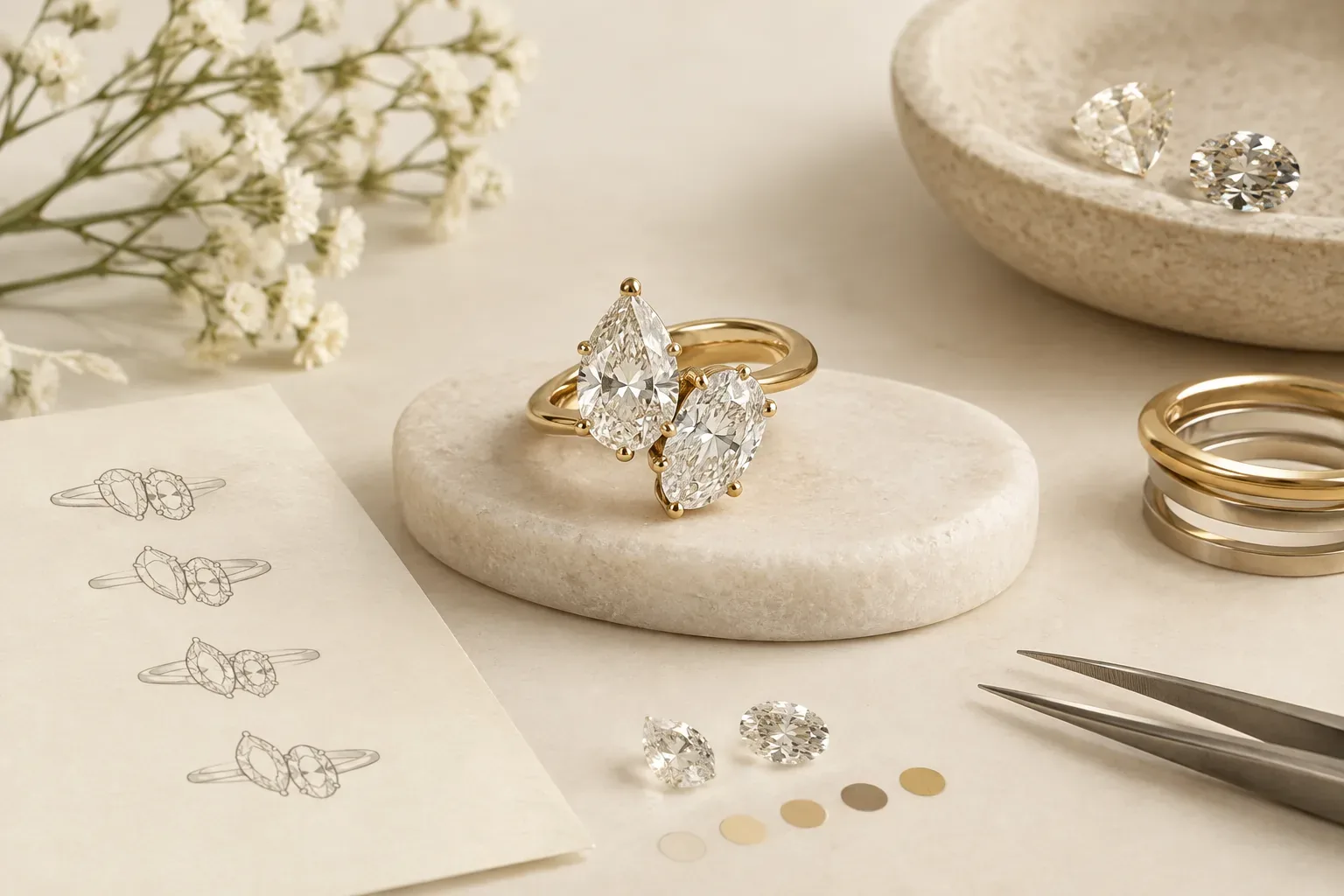
In modern practice the Toi et Moi appears as two stones set side‑by‑side or in a gentle bypass, often with slight asymmetry in size, shape or color. Jewelers pair diamonds with colored gemstones, two diamonds of contrasting shapes, or gems of equal size and shape for symmetry. Band styles vary from delicate solitaires to wider split shanks, halos or pavé that visually increase coverage. The motif is also used in gender‑neutral and bespoke designs, reflecting the market trends noted by Jewelers Mutual toward versatility and colored gemstones.
Finger coverage and proportion: design decision criteria
Start with the wearer’s finger dimensions: longer fingers can carry taller face heights and vertical orientations; shorter fingers generally benefit from lower profiles and horizontal or diagonal layouts that avoid looking top‑heavy. Consider the combined face width—the visible span across both stones—rather than the individual stone diameter alone. A small, delicate look usually has a combined face width that does not exceed the wearer’s finger width; a balanced, classic look matches the finger width closely; a statement look intentionally exceeds it but with trade‑offs in practicality.
Stone shapes change perceived coverage. Round and oval stones read larger face‑on than equivalent carat weights in elongated cuts. Pear and marquise shapes can extend perceived length, which can slim a finger when oriented vertically. Two differing shapes can emphasize asymmetry; two matched shapes emphasize a singular face. Band width and profile must be chosen to visually anchor the stones: a very narrow band can make large stones appear unsupported, while a wide band can overwhelm small stones.
Height, prong count and setting style affect comfort and snag risk. Low bezels and flush settings reduce snagging and are more practical for active wearers, while open prongs and high settings display stone depth and sparkle but increase the chance of catching on fabric or suffering impact.
Practical trade‑offs and how to prioritize them
Choose durability over pure spectacle if the wearer uses their hands a lot. A durable guide prioritizes lower profiles, secure settings (bezel or closed prongs), and harder stones for everyday wear. Choose spectacle—larger combined face or high settings—if daily impact is unlikely and visual impact is the priority.
Balance symmetry against personal style. Matched stones offer formal symmetry and easy matching with a wedding band; mismatched stones give a personalized, contemporary look and often make the ring feel like a conversation piece. The trade‑off is that asymmetry can complicate designing a flush wedding band or stacking.
Consider resizing and future maintenance. Rings with complex bypass bands, tight pavé, or stones extending down the shank can be harder to resize. If future resizing is likely, discuss construction options that make resizing easier with your jeweler.
Selection and gifting guidance — practical and respectful
Start by observing the recipient’s current jewelry: what band widths, metal colors, stone sizes and ring profiles do they already wear? That observation tells you more than attempting to guess a single perfect size. If in doubt, choose a design that is slightly understated so it can be worn daily or dressed up with other pieces. For surprise proposals, consider an interchangeable setting or an adjustable temporary setting paired with the promise (and receipt) of a custom final ring once preferences are known.
Request written disclosures from the seller. The FTC requires clear distinctions among natural, lab‑created, treated, cultured and imitation materials, so ask for and keep that documentation. For colored gemstones and diamonds, request any available laboratory reports and treatment disclosures before purchase. If authenticity or treatment status is critical to you, plan to obtain independent verification from a gemological laboratory.
Think about matching a future wedding band. If you prefer a flush wedding band, discuss this up front so the jeweler designs a Toi et Moi setting with a compatible profile or offers a custom wedding band. If stacking is a priority, look for lower profiles and straight shanks that allow other rings to sit comfortably.
Care guidance and limits on what you can verify
Follow gemstone‑specific care. The Gemological Institute of America outlines that treatments, disclosure, detectability and durability raise distinct consumer questions. Softer or treated stones may require gentler cleaning and avoid ultrasonic or steam cleaning; hard stones like diamonds tolerate more robust cleaning but still risk damage from improper settings or impacts.
Seller statements versus laboratory verification. The FTC emphasizes that consumers need clear written disclosures. Sellers should disclose whether a stone is natural, lab‑created, treated or imitation. However, whether a specific treatment was applied or a stone’s geographic origin requires laboratory testing to verify. Only a qualified jeweler or a gemological laboratory can confirm many material attributes such as undisclosed treatments, clarity enhancements, or origin claims.
Insurance and maintenance. Given the two‑stone arrangement, seek an insurance appraisal or valuation and consider regular maintenance checks for prongs and settings. Jewelers Mutual highlights the market emphasis on craftsmanship and durability; regular servicing prolongs that craftsmanship’s life.
Final checklist before you buy or gift
Confirm the combined face width and visual scale against the recipient’s finger or a known ring they wear. Get written disclosures that specify whether stones are natural, lab‑created or treated. Ask whether the setting is compatible with a wedding band or stacking, and request a resizing policy because complex shanks may restrict resizing options. Insist on documented return, warranty and insurance appraisals and, if material identity or treatment matters, plan for independent lab verification.
Frequently asked questions
How do I choose the right combined face width for a Toi et Moi ring?
Compare the ring’s combined face width—the visible span across both stones—with the wearer’s finger width. A subtle look is noticeably narrower than the finger, a balanced look approximates the finger width, and a statement look exceeds it. Try a physical mock‑up or a ring sizer to judge proportion in person.
Can a Toi et Moi engagement ring be resized later?
Many Toi et Moi rings can be resized, but complex bypass bands, tight pavé or stones set down the shank may limit options. Ask the jeweler about construction and resizing policies before purchase.
Should the two stones be the same size and shape?
Either approach works and reflects different styles: matched stones give symmetry and easier band pairing; mismatched stones create a contemporary, personalized look but may complicate creating a flush wedding band or stacking.
How can I verify whether a gemstone is treated or lab‑created?
Ask the seller for written disclosures and any gemological reports. Under FTC guidance sellers must disclose treatments and whether stones are natural or lab‑created, but independent laboratory testing is needed to confirm treatment status or origin definitively.
What care does a two‑stone ring need?
Care depends on the gems’ hardness and treatments. The GIA advises that treatments affect durability and cleaning choices—avoid ultrasonic or steam cleaning for some treated or fragile gems. Arrange periodic professional checks for prongs and settings and follow any care guidance from the stone’s report or the seller.
Sources and further reading
- Imaginaire Digital — Imaginaire Digital
- Jewelers Mutual — Jewelers Mutual
- Gemological Institute of America — Gemological Institute of America
- Federal Trade Commission — Federal Trade Commission