Meaning at a glance
A successful toi et moi setting wedding band pairing balances the two-stone motif's geometry and gap with a band that secures comfort, daily wear, and aesthetic intent; use shape and negative space as your decision criteria, prefer metal choices that match or intentionally contrast for a clear trade-off, follow safe care and disclosure checks (see GIA and the FTC), and get a qualified jeweler or laboratory for any authentication you must rely on.
What a 'toi et moi' engagement setting is (and what it commonly symbolizes today)
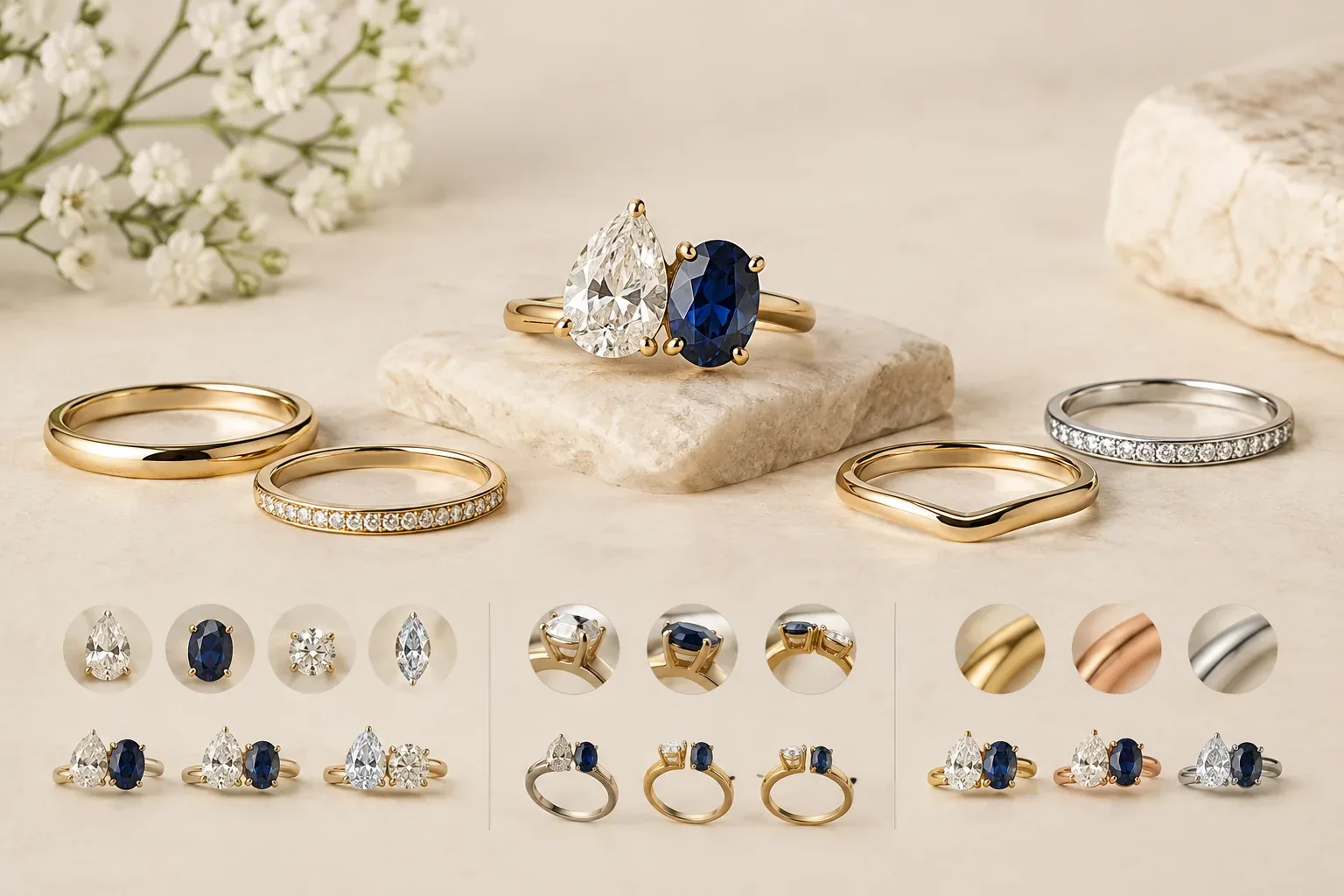
In modern jewelry language, the toi et moi motif describes a two-stone setting that places two primary gems side-by-side so they visually interact, often interpreted as 'you and me.' The motif appears across shapes and sizes: matched pairs (two diamonds), matched-but-different shapes (a round and a pear), or mixed materials (a diamond with a colored gemstone). This contemporary symbolic reading—two beings, two stories, or partnership—belongs to modern personal interpretation rather than a single, universal historical meaning.
Historical evidence and how the record should be read
Among the sources approved for this article there is no detailed primary documentary history that establishes precise cultural origins for the toi et moi motif, so a strict, evidence-led history cannot be offered here. Statements that tie the motif to a specific century, court, or region should be treated as anecdotal or commercial lore unless supported by primary archival research.
What the available professional sources do document are modern consumer trends and buyer concerns: Imaginaire Digital reports strong, continued online demand for engagement rings and certain shapes in contemporary UK search data, while Jewelers Mutual documents 2026 trends that emphasize fluid forms, modern stacking, colored gemstones, craftsmanship and versatility. Use those modern trend signals to understand contemporary popularity rather than as a historical provenance for the motif.
Documented meanings versus personal interpretation
There is a clear distinction between documented historical meanings and personal, modern interpretations. The evidence set for this article supplies modern market and care guidance but does not supply a verified ancient symbolic meaning for toi et moi. The sentimental reading—two stones as two people, two moments, or two family lines—is a modern interpretive layer and is a perfectly valid personal or cultural meaning for the wearer, but it should not be presented as a single, historically proven symbolism.
How the motif, gemstone choices and traditions appear in jewelry practice
In practice you will see toi et moi arrangements in a range of executions: matched diamonds for symmetry, a diamond paired with a colored gem for contrast, asymmetric shapes to emphasize motion, and settings that tilt stones toward one another to create intimate negative space. Designers often use the gap between stones as a focal point for accent diamonds or metalwork, or they leave it deliberately open to preserve the visual 'meeting' of two centers.
The modern jewelry market favors versatility and colored gemstones according to industry reports, which means toi et moi pieces today often feature non-diamond center stones or creative metal choices to suit contemporary stacking and gender-neutral styling (Jewelers Mutual and Imaginaire Digital). These market tendencies affect what options you will commonly find available and what retailers will recommend.
Decision criteria: shape, gap, and metal
Shape: Let the dominant profile of the engagement stones guide your band choice. A toi et moi that pairs two round stones creates a compact silhouette that typically pairs easily with low, rounded bands; contrasting shapes like round-and-pear create directional negative space and are often best accompanied by a band that either mirrors that sweep or offers a small c-shaped notch to sit closer without crowding the points. Think in terms of overall silhouette rather than matching cut names alone.
Gap: The gap between the two stones is both an aesthetic and functional element. A small gap makes it tempting to fit a flat or contoured band closely for a seamless look, but a closely mated band increases the risk of stress on prongs and reduces room for maintenance. A deliberate gap permits a straight or slightly curved band to live alongside the setting without mechanically interfering, and it offers space for accent bands or milgrain detailing.
Metal: Metal choices carry visual and practical trade-offs. Matching the engagement ring metal (for example, yellow gold with yellow gold) creates continuity and fewer visible seams. Intentionally contrasting metals (for example, a rose-gold band against a white-gold toi et moi) emphasize the two-stone focal point and suit eclectic, mixed-metal wardrobes. Metals differ in surface hardness and long-term appearance; discuss finish and maintenance expectations with your jeweler to understand which metal fits your lifestyle best.
Practical trade-offs and common pairing strategies
Flush fit versus protection: A contoured or notched 'shadow' band that hugs the engagement setting produces a cohesive look but increases contact points that can transmit knocks to prongs. A straight band leaves a small gap that reduces mechanical stress and makes ring removal and cleaning easier. Decide whether visual seamlessness or long-term safety and maintenance is your priority.
Stacking and accent bands: Because the toi et moi motif allocates visual weight to two stones, many people add slim accent bands rather than chunky bands to preserve the motif's dialogue. Jewelers Mutual's market reporting notes a continuing interest in modern stacking and versatile combinations; lean toward bands that complement the pair rather than overpower it.
Resizing and future adjustments: Any contoured or pierced band that echoes the engagement ring’s negative space is more challenging to resize. If you anticipate multiple size changes over a lifetime, consider a simpler band profile or accept that a jeweler will need to rework the set later.
Safe care guidance and verification limits
Care: Gemstone durability, treatments, and special-care requirements vary by material. The Gemological Institute of America explains that treated gems and certain materials need specific handling and cleaning; ask about treatments for colored stones and follow the recommended care instructions for those materials to avoid damage. For routine cleaning, consult your jeweler for a method compatible with both the stones and the setting.
Disclosure and authentication: The Federal Trade Commission requires clear distinctions among natural, lab-created, treated, cultured and imitation materials and expects written seller disclosures. Ask the seller for written documentation about origin and treatments. For qualities that materially affect value—such as whether a stone is natural or lab-grown, whether it has been heat- or clarity-treated, or whether it is an assembled gem—a qualified gemological laboratory or an experienced independent appraiser is the appropriate verifier; these determinations are generally not reliable from photographs alone.
Insurance and risk: Because toi et moi settings create exposed edges and prong relationships between two stones, consider insuring the set and discussing prong protection or periodic maintenance with your jeweler. Jewelers Mutual emphasizes modern consumer focus on craftsmanship and durability; protect your purchase with appropriate coverage and documented regular inspections.
Respectful selection and gifting guidance
Consider the recipient’s daily life and style first. If they use their hands heavily, prioritize a band profile that reduces snagging and preserves prong integrity. If they favor mixed-metal jewelry, an intentional metal contrast can be a thoughtful and modern choice. If the ring is a surprise, choose a versatile band profile or buy adaptable options (a temporary simple band followed by a custom contoured band after sizing).
Communicate meaningfully. If the toi et moi motif is being presented for symbolic reasons, share that interpretation explicitly in a note or conversation so the recipient understands your intent without assuming a singular historical meaning. If the pairing is a joint selection, plan a jeweler visit to test combinations on the hand and to confirm comfort.
When to consult a professional
Bring a sketch or photos and the engagement ring to a competent jeweler to try different band profiles in person; silhouettes that look balanced in isolation often behave differently on the finger. For any questions about gemstone identity, treatments, or grading that affect price or insurability, obtain written disclosures from the seller and get a laboratory report from a recognized gemological institution. For preservation and safety, schedule a professional inspection at least annually or after any hard knocks.
Frequently asked questions
Can a toi et moi engagement ring be paired with a straight wedding band?
Yes. A straight band can work well when the toi et moi has a small gap; it creates a clean contrast and is easier to resize and maintain than a contoured band. If you want a closer fit, try a jeweler-made contoured or notched band but expect slightly more complex maintenance.
Should the wedding band match the engagement ring metal?
Matching metals create continuity, while mixed metals create a deliberate contrast. Neither choice is inherently superior—consider the wearer’s existing jewelry, maintenance preferences, and whether you want a cohesive look or a contemporary mixed-metal style as noted in recent market trends.
How can I check whether the center stones are treated or lab-created before buying?
Ask the seller for written disclosures and certificates. For confirmation of origin or treatments that materially affect value, obtain a report from a qualified gemological laboratory; the FTC expects clear written distinctions and the GIA explains that some treatments require laboratory testing to detect.
What band profiles protect a toi et moi setting best?
Bands that leave a small protective gap or that are lower in profile reduce force transfer to prongs, but they sacrifice a seamless look. Protective settings and regular professional inspections are important because the two-stone geometry can create exposed edges.
Is a custom contoured band worth it for a toi et moi setting?
If you prioritize a seamless, built-for-the-ring appearance and are willing to accept higher initial cost and potentially more complex resizing later, a custom contoured band is worth considering. Try temporary options first if sizing is uncertain.
How often should I have a toi et moi ring inspected?
Schedule a professional inspection at least once a year and after any significant impact. Inspections preserve prong integrity and identify loose stones early; consult your jeweler for a schedule tailored to your lifestyle and the specific materials involved.
Sources and further reading
- Imaginaire Digital — Imaginaire Digital
- Jewelers Mutual — Jewelers Mutual
- Gemological Institute of America — Gemological Institute of America
- Federal Trade Commission — Federal Trade Commission