Meaning at a glance
East-west setting engagement ring styling centers on the horizontal orientation of an elongated or oval stone and how that orientation changes finger coverage, visual proportion, and everyday wear; this guide defines the look, gives decision criteria and trade-offs, explains safe care, and clarifies what only a qualified jeweler or gemological laboratory can verify.
What an east-west setting is and how it appears in jewelry
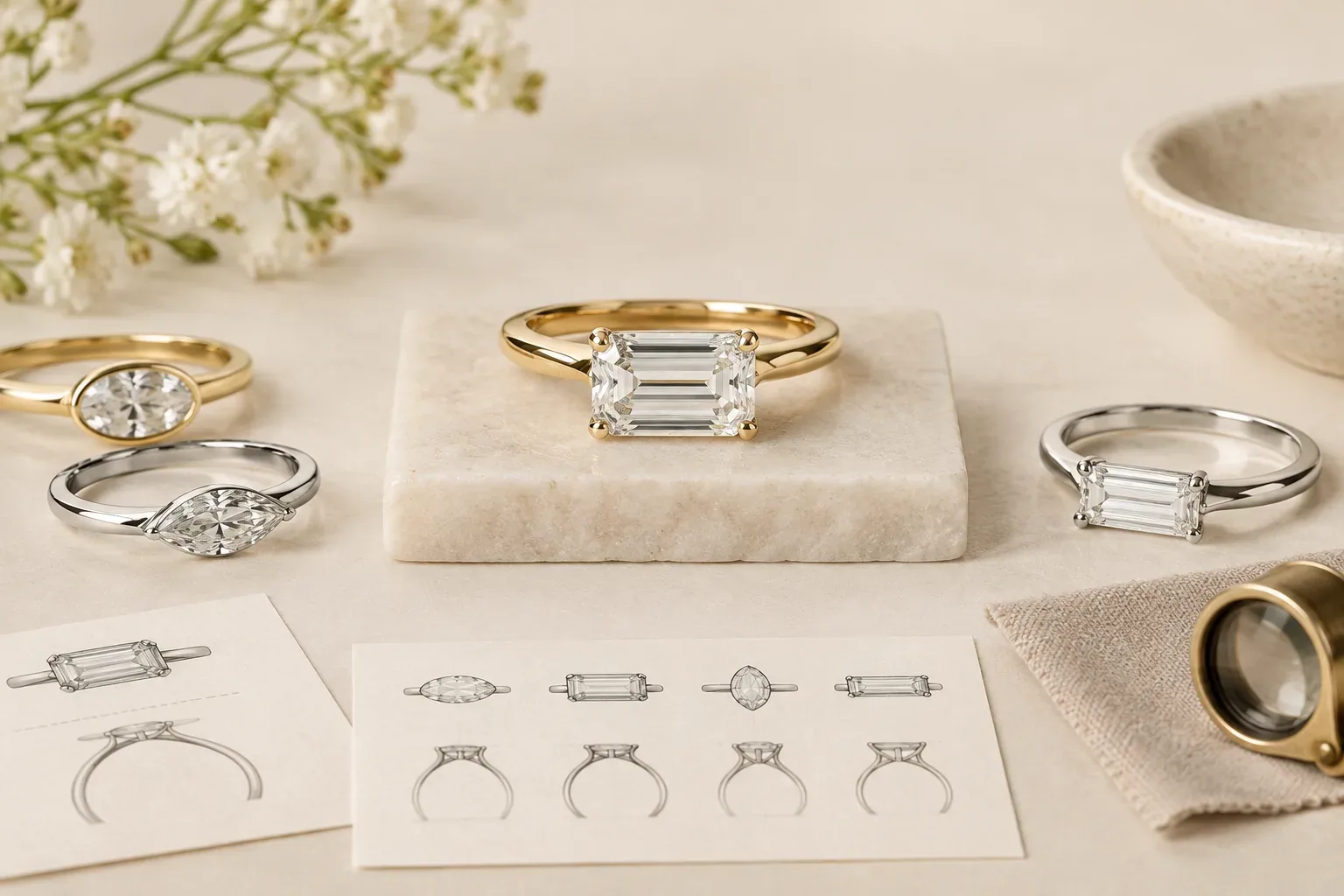
An east-west setting places an elongated or oval stone so that its longest measurement runs left-to-right across the finger rather than up-and-down. The effect is horizontal emphasis: a horizontally oriented oval, marquise, or emerald cut reads wider on the hand than an identical stone set vertically, and it often makes the ring look lower-profile because the stone’s length follows the line of the finger rather than extending above the band.
In practice, designers pair east-west set stones with a variety of mounting styles. Solitaires can be framed to emphasize the horizontal axis, three-stone rings use side stones to extend or balance the width, and halo settings can be elongated to follow the stone’s orientation. Jewelers also integrate east-west stones into stacked looks and mixed-metal bands to create a modern, fluid silhouette.
Historical evidence and cultural attribution
There is limited documentation in the approved sources about a specific historical origin for the east-west setting as a named tradition. The stylistic choice of orienting a stone horizontally is not widely treated in older academic jewelry histories within the provided evidence base. Contemporary industry reporting places east-west setting firmly within modern, stylistic trends rather than a discrete historical period.
Recent market and trend analysis supports the classification of east-west settings as a modern styling choice linked to current consumer preferences for fluid forms and gender-neutral design. Jewelers Mutual’s 2026 trends reporting highlights demand for fluid forms, modern stacking, colored gemstones, craftsmanship, versatility, and gender-neutral styling, which aligns with the practical and aesthetic drivers behind east-west settings. Imaginaire Digital’s 2026 UK search estimates show strong consumer interest in engagement-ring shapes such as oval engagement rings, a shape commonly used in east-west mounts. These sources describe present-day demand and do not assert a historic, cultural origin for the motif.
Documented historical meanings versus modern personal interpretation
Because the approved sources do not attribute a specific cultural or historical symbolism to the east-west orientation, any interpretive meaning is primarily modern and personal rather than documented. In other words, the east-west setting should be understood first as an aesthetic and functional choice supported by contemporary trends rather than as carrying a single historical meaning.
Modern wearers and designers sometimes ascribe symbolic or personal significance to horizontal placements—such as signaling non-traditional taste, intentional gender neutrality, or an emphasis on understated profile—but these are personal readings and not universally documented traditions. When communicating meaning with a gift, be explicit about the sentiment you intend rather than assuming a shared historical symbolism.
Finger coverage and proportion: how the east-west orientation changes appearance
Finger coverage describes how much of a finger’s visible surface the ring occupies when viewed from above. An east-west setting typically increases lateral coverage—how wide the ring appears across the finger—while reducing vertical projection. This makes the ring read as broader and often more modern or band-like at first glance.
Proportion involves the relationship among the stone’s dimensions, the wearer’s finger width, band thickness, and the size of any side or halo stones. For narrow fingers, a horizontally set oval or marquise can visually widen the finger, which some wearers prefer and others do not. For wider fingers, the same orientation can balance proportions by creating the impression of lower height and a more substantial band.
Design detail matters. A thin band with a large east-west stone can still appear delicate if the stone’s table and bezel are small. Conversely, a heavy bezel or wide shoulder will amplify perceived coverage. Decide whether you want the stone itself to be the visual anchor or whether you want shoulders, halos, or a broad band to contribute to coverage.
Decision criteria and practical trade-offs
When choosing an east-west engagement ring, begin with three practical questions: how much lateral coverage do you want, how important is low profile versus vertical sparkle, and how much daily wear and tear will the ring face? The horizontal orientation typically reads as low-profile and comfortable for many activities, but bezels and horizontal prongs that protect the stone sometimes reduce perceived brilliance because they cover more of the girdle and pavilion.
Trade-offs are inherent. A horizontal mount often reduces snagging when compared with a high vertical solitaire, but it may also show wear differently because lateral impact is more likely when the hand brushes against surfaces. Highly elongated stones can produce an elegant band-like look but require accurate proportioning: too wide a stone on a narrow finger can look top-heavy. Conversely, a very small stone set east-west on a wide finger may appear lost unless accompanied by a design element that increases perceived scale.
Another trade-off involves cut and light performance. Certain elongated cuts display their best brilliance when oriented to maximize light return. Setting orientation does not change a stone’s cut quality, but a bezel or low-profile horizontal head can slightly alter perceived brightness versus prong settings that allow more light from above.
Gemstones, treatments, and what a shopper can verify
The gemstones used in east-west settings are the same as those used in conventional mounts: diamonds, sapphires, emeralds, and other colored stones. Market reporting shows a general increase in consumer interest in colored gemstones and craftsmanship, connecting to the popularity of alternative cuts and orientations (Jewelers Mutual 2026; Imaginaire Digital 2026).
When it comes to treatments, durability, and disclosure, buyers should rely on the rules and practical limits explained by authoritative bodies. The Gemological Institute of America explains that treatments, detectability, durability, and special care affect consumer questions about gemstones and that some treatments require laboratory methods to detect reliably. The Federal Trade Commission’s guidance emphasizes the need for clear distinctions among natural, lab-created, treated, cultured, and imitation materials and written seller disclosures. Based on these authorities, buyers can reasonably verify some attributes themselves—visual proportion, ring size, general symmetry, and the presence of obvious chips or surface damage—while identification of treatments, origin, or the determination of whether a stone is natural or lab-grown requires qualified gemological testing.
Care guidance for east-west rings
Care for an east-west setting follows the same fundamental principles as care for any engagement ring, with a few orientation-specific notes. Low-profile east-west settings are often less prone to catching, but lateral impacts can stress side prongs or bezel edges. Regular inspection of prongs, bezels, and stone seats is important to prevent loosening. Clean gently according to the stone’s needs and the metal’s finish; avoid aggressive ultrasonic cleaning for stones known to be treated or fragile without having a professional confirm suitability.
Because treatments and specific gemstone durabilities vary, consult documentation and ask the seller for recommended cleaning and storage. The GIA’s resources on treatments provide a reminder that treatment type influences what cleaning methods are safe. When in doubt, have a jeweler check the mount and setting annually and before any resizing or repair.
Practical and respectful guidance for selecting or gifting an east-west engagement ring
Selection and gifting should start with clear observation and conversation. If you know the recipient’s ring size and general preferences, compare how different stone orientations affect their current rings or jewelry. If privacy or surprise is important, use a comparable band or seek help from a trusted friend to confirm proportions.
Respectful gifting also means clear disclosure about the stone’s identity, treatments, and the ring’s care requirements. The Federal Trade Commission guidance stresses the buyer’s right to transparent information about whether the gemstone is natural, lab-created, treated, or an imitation. Include written documentation with the gift where possible, and if the ring includes treatments or uncommon materials, explain what that means for durability and care. Finally, consider lifestyle: if the recipient works with their hands, favor protective settings such as a bezel or low-profile head, and if they favor stacking, choose a band width that complements likely companions.
Limits on verification and when to seek a professional
Shoppers can and should verify fit, visible symmetry, and immediate condition in person. However, some attributes demand professional assessment. Only a qualified jeweler or accredited gemological laboratory can reliably test for laboratory-grown origin, many treatments, precise color grading, and internal clarity features at the level used for grading documents. The GIA explains that treatments and detectability have technical limits that often require laboratory methods, and the FTC requires transparent disclosure, which vendors should supply in writing.
If you need a formal grading report, or if the stone’s authenticity or treatment history is essential to the purchase decision, request a written laboratory report from an accredited lab before finalizing the purchase. For insurance, appraisal, resizing, or repair, consult a trusted local jeweler with appropriate credentials and ask for documentation of any work performed.
Final considerations
East-west setting engagement ring styling is primarily an aesthetic and functional choice within contemporary design trends. Use proportion—stone dimensions relative to finger width and band thickness—as your primary decision metric, and balance desired coverage against comfort and daily durability. Ask for full written disclosure about gemstone identity and treatments, seek professional testing when authenticity or treatment history matters, and schedule routine inspections to keep the setting secure.
For further reading on choosing meaningful jewelry and researching symbols and motifs, see related guides in our Jewelry Guides category and pieces on choosing and researching meaningful jewelry.
Frequently asked questions
Does an east-west setting make fingers look wider?
An east-west setting tends to increase lateral coverage, which can make fingers appear wider across. Whether this is desirable depends on personal preference and the wearer’s finger proportions.
Is an east-west engagement ring practical for everyday wear?
Yes—many east-west designs are lower-profile and snag less than tall vertical solitaires. However, lateral impacts can affect side prongs or bezels, so regular inspections and appropriate setting choices (like bezels for active wearers) are recommended.
Can I tell if a stone is treated or lab-grown without a lab report?
No. While you can inspect general condition and visible quality, identifying many treatments or whether a stone is lab-grown versus natural typically requires testing by a qualified gemological laboratory. The GIA and the FTC recommend written disclosures and laboratory verification where identity and treatments matter.
How should I choose a band width to pair with an east-west stone?
Choose a band width that balances the stone’s horizontal span; narrow bands work with smaller stones for a delicate look, while medium to wide bands complement larger east-west stones and increase perceived stability and coverage.
What routine care does an east-west ring need?
Routine care includes gentle cleaning appropriate to the gemstone and metal, annual professional inspections of prongs and bezels, and avoiding harsh chemicals or impacts. Confirm cleaning methods with the seller, especially if the stone has known treatments.
Sources and further reading
- Imaginaire Digital — Imaginaire Digital
- Jewelers Mutual — Jewelers Mutual
- Gemological Institute of America — Gemological Institute of America
- Federal Trade Commission — Federal Trade Commission