Meaning at a glance
A kite cut engagement ring is a modern faceting style shaped like a kite; this guide defines the cut, lays out decision criteria and trade-offs, explains what only a jeweler or gem lab can verify, offers safe care guidance, and describes the buyers and recipients who typically appreciate the style.
What is a kite cut?
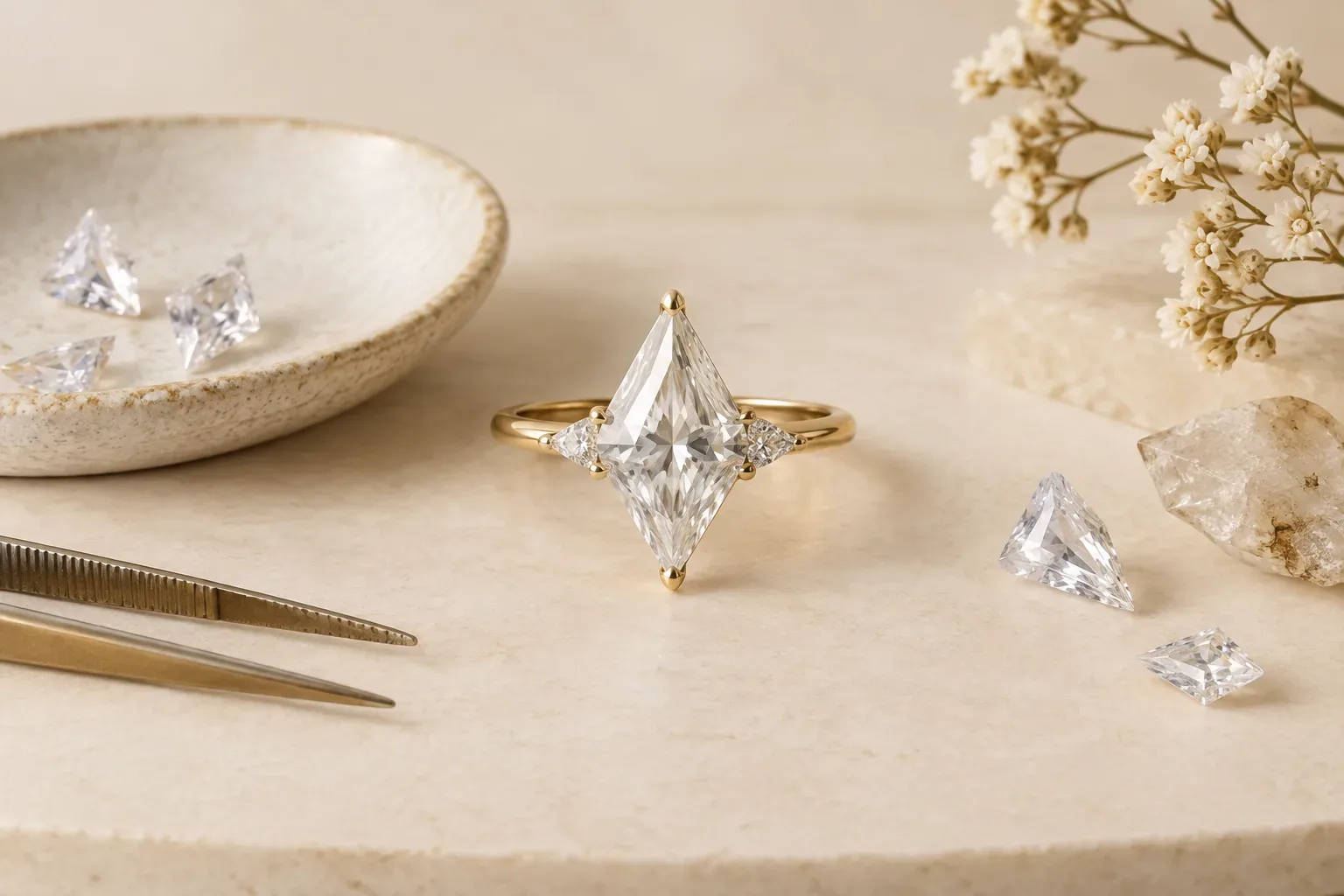
The kite cut describes a gemstone faceting style whose outline resembles a kite: two opposite acute angles and two opposite obtuse angles forming an elongated four-sided shape. Jewelers and designers use the term to describe a variety of proportions and faceting approaches rather than a single standardized ideal.
Designers employ kite cuts in diamonds and colored gemstones to create directional sparkle, accent pear and marquise stones, or serve as central stones for modern, geometric engagement rings. Contemporary industry commentary highlights interest in unusual and fluid forms, which helps explain why kite and other non-traditional shapes appear in current engagement-ring offerings (Jewelers Mutual; Imaginaire Digital).
Historical evidence and cultural context
There is limited documented historical evidence that the kite cut, as a named gemstone faceting, carries an established symbolic meaning in any specific historical period or culture. The available industry and consumer-facing sources used for this guide focus on modern demand and design trends rather than historical symbolism.
Kite-shaped motifs have appeared as decorative elements across many cultures and periods in architecture, textile patterns, and metalwork, but those motifs are not the same thing as a gem’s faceting style. Where cultural meanings exist for kite shapes in a particular community, those are motif-level traditions and should be treated separately from the modern commercial 'kite cut' in jewelry.
Documented historical meanings versus modern personal interpretations
Because the sources consulted here do not document a historical, cross-cultural symbolism tied to the gem 'kite cut,' any specific meaning attached to a kite cut engagement ring today is primarily a modern, personal, or designer-level interpretation rather than a long-documented cultural meaning.
Modern buyers and designers often assign meanings based on form: some may interpret the kite’s pointed geometry as directional energy, movement, or individuality. These are contemporary personal interpretations and should not be presented as universal or historically rooted without primary cultural evidence.
How the motif, gemstone, or tradition appears in jewelry
In practice, jewelers use the kite cut as a center stone or as accent stones flanking a larger gem, often arranged to emphasize directional lines. Common settings include bezel, prong, tension, and cluster arrangements that either showcase the kite profile or align multiple kite shapes for geometric patterns.
Kite cuts appear in diamonds and colored gemstones. Current market commentary notes strong interest in colored gemstones and gender-neutral styling, which supports using distinctive shapes like kite cuts in non-traditional engagement rings (Jewelers Mutual; Imaginaire Digital).
Pros: Why buyers choose a kite cut
Distinctive silhouette and contemporary style: Kite cuts stand out among standard shapes and pair well with modern, architectural settings. Their elongated profile can create the visual impression of length on the finger.
Versatility with mixed-stone designs: Kite cuts work well in asymmetrical rings or as paired accents around a central stone, enabling creative designs that appeal to buyers seeking a unique look.
Appeal for colored stones and gender-neutral styling: Industry trend reports show demand for colored gemstones and gender-neutral styles, which is a natural match for less conventional cuts like the kite (Jewelers Mutual; Imaginaire Digital).
Cons and trade-offs to consider
Durability and setting risk: Kite cuts often have sharp points or narrow ends that can be vulnerable to chipping if not well protected by the setting. Buyers should discuss appropriate protective settings with a jeweler.
Availability and price variability: Kite-cut stones are less common than round or oval cuts, so selection may be limited and prices vary widely according to cutter, carat weight, and whether the stone is natural, lab-created, or treated.
Resale and mainstream acceptance: Non-traditional shapes can be less liquid on the secondary market, and personal taste matters more; a kite cut that one owner adores might be harder to resell later.
Decision criteria: what to verify before buying
Stone identity and origin: Confirm whether the stone is natural, lab-created, treated, or an imitation. The Federal Trade Commission advises consumers to obtain clear written disclosures from the seller about these distinctions (Federal Trade Commission).
Treatments and durability: Ask for a written description of any treatments such as heat, fracture filling, diffusion, or coatings and how those treatments affect care and durability. The Gemological Institute of America explains how treatments influence detectability and care needs (Gemological Institute of America).
Grading and documentation: For diamonds, request a grade report from a reputable laboratory. For colored stones, ask for any available lab reports that describe origin and treatments. Understand that only a qualified gemological laboratory can perform definitive testing for many treatments and origin claims.
Setting construction and protection: Verify how the setting protects points and narrow ends. Consider bezel or protective prong work for vulnerable tips, or designs that tuck points into the band.
Care, maintenance, and long-term wear
Care needs depend on the stone type and any treatments. The Gemological Institute of America notes that treatments, disclosure, detectability, and durability create distinct consumer questions for gemstones; follow specific care instructions tied to the stone and its treatment history (Gemological Institute of America).
For everyday wear, discuss routine maintenance with the jeweler: periodic inspections of prongs and settings, professional cleaning appropriate to the material, and precautions against hard knocks that could chip points. Protective settings reduce risk but do not remove it entirely.
What only a jeweler or gem lab can verify
A qualified jeweler or a gemological laboratory is required to confirm many important facts: whether a stone is natural versus lab-created, the presence and nature of treatments, and the accurate identification of certain gem materials. The Federal Trade Commission advises getting written seller disclosures and recognizes lab reports as the reliable path to verification (Federal Trade Commission).
Laboratory analysis is also necessary to resolve origin claims for some colored stones and to detect treatments that are not visible to the naked eye. The Gemological Institute of America explains that detectability and disclosure are central concerns when treatments are involved (Gemological Institute of America).
Who the kite cut suits
People who prefer contemporary, architectural designs and want a distinctive silhouette often choose kite cuts. The shape appeals to buyers seeking a geometric statement rather than a traditional rounded look.
Buyers who like mixed-metal or mixed-stone compositions and those following modern, gender-neutral trends may find kite cuts especially appealing, in line with recent industry patterns for fluid forms and versatility (Jewelers Mutual; Imaginaire Digital).
Kite cuts are less suitable for buyers who prioritize maximum resale liquidity or who need a very low-maintenance, highly durable stone without any risk to sharp points.
Practical and respectful selection or gifting guidance
Start by learning the recipient’s style preferences: take note of their existing jewelry shapes, metals, and whether they favor minimalist or ornate pieces. When in doubt, choose settings that offer protection for points and consult the recipient or their close friends or family if surprise is a concern.
Request written disclosures and any available lab reports from the seller before purchase, and confirm return and resize policies. The Federal Trade Commission recommends clear, written disclosure about a stone’s origin and any treatments (Federal Trade Commission).
If gifting a kite cut to someone who values symbolic meaning, discuss the modern interpretation you intend—such as individuality or movement—so the recipient understands whether the meaning is personal rather than historical.
Final buying checklist
Verify natural versus lab-created status and documented treatments in writing; request lab reports where possible. Confirm setting design and how it protects the stone’s tips. Ask about routine maintenance, inspection intervals, and the seller’s return and repair policies. If you need definitive answers about origin or subtle treatments, plan for a laboratory report from a recognized gem lab. These steps follow consumer guidance highlighted by the Federal Trade Commission and the Gemological Institute of America and address contemporary market priorities noted by Jewelers Mutual and Imaginaire Digital.
Frequently asked questions
Is a kite cut as durable as a round cut?
Durability depends on the stone material, its treatments, and the setting. Kite cuts often have points that can be vulnerable to chipping; a protective setting reduces risk but does not eliminate it. For definitive guidance on durability relative to a specific stone, ask a qualified jeweler and consult any available laboratory reports.
Can I get a lab report for a kite-cut colored stone?
Yes—reputable gemological laboratories can issue reports for many colored stones, describing identity, treatments, and sometimes origin. If you need confirmation about treatments or origin, plan to obtain a lab report; the Federal Trade Commission emphasizes written disclosure and the Gemological Institute of America highlights detectability issues for treated stones.
Are kite cuts more likely to be lab-created or treated?
There is no inherent rule that kite cuts are more likely to be lab-created or treated; availability varies by market and gemstone. Sellers must disclose whether a stone is natural, lab-created, treated, or an imitation, and you should request those disclosures in writing (Federal Trade Commission).
How should I protect a kite-cut engagement ring for everyday wear?
Choose a setting that protects points (bezel, protective prongs, or recessed mounts), arrange for periodic inspections, and avoid hard impacts. Follow care recommendations specific to the stone and any treatments as outlined by a jeweler or in a lab report (Gemological Institute of America).
Will a kite cut affect resale value?
Non-traditional shapes can be less liquid on the secondary market because buyer preference is more personal. A well-documented stone with lab reports and a durable, well-crafted setting will hold value better than one without documentation.
Sources and further reading
- Imaginaire Digital — Imaginaire Digital
- Jewelers Mutual — Jewelers Mutual
- Gemological Institute of America — Gemological Institute of America
- Federal Trade Commission — Federal Trade Commission