Meaning at a glance
This checklist defines the hexagon cut and gives the questions to ask about stone type, treatments, certification, setting, durability, style trade-offs, care and verification limits so you can make an informed purchase and know what requires a gemological laboratory or qualified jeweler.
What ‘hexagon cut’ means in practical terms
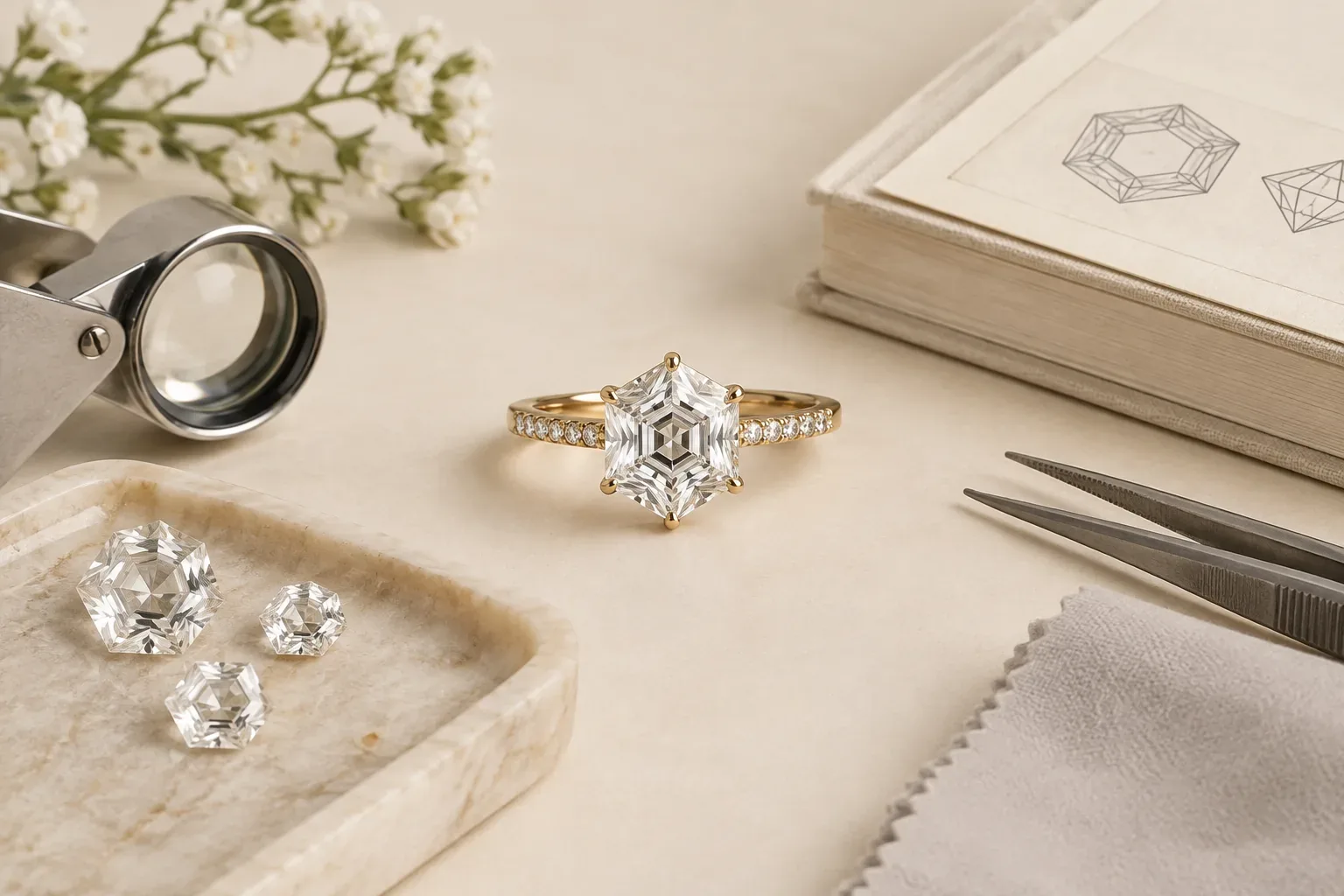
In jewelry, a hexagon cut describes a stone faceted with six-sided symmetry—either as a geometric outline (hexagonal girdle) or as a faceting pattern that creates a six-point star or radial symmetry. The cut alters light return, face-up appearance and how the stone sits in a setting. Because it departs from traditional round or oval outlines, the hexagon cut affects ring design choices such as bezel vs prong settings, halo shapes, and how accent stones align with the center stone.
Historical evidence and cultural notes (what the documentation supports)
Among the approved sources for this article there is no specific historic record or scholarly claim that ties the modern hexagon cut gemstone to a single culture or period as an established engagement-ring form. The approved sources focus on contemporary market behavior and consumer-protection rules rather than historical symbolism. For modern trend context, industry reporting shows rising demand for alternative shapes and gender-neutral styling, which helps explain the hexagon cut’s current popularity. Imaginaire Digital’s 2026 search estimates and Jewelers Mutual’s 2026 trends reporting document consumer interest in nontraditional shapes and versatility rather than establishing historical cultural origins.
Documented history versus modern personal interpretation
Because the approved evidence does not supply a verified historical tradition that assigns a particular symbolic meaning to the hexagon cut in engagement rings, any symbolic reading—such as linking the six sides to concepts like balance, harmony, or family—belongs to modern, personal interpretation. Distinguish between documented facts (sales trends, disclosures, treatment detectability) and subjective symbolism offered by designers, retailers or gift-givers. The seller’s marketing copy may assign meaning; that is a creative or personal interpretation, not an established historical fact.
How the hexagon motif and hexagon cuts appear in jewelry
Designers use hexagon cuts in two main ways: as the primary center stone shape and as a repeating geometric motif in settings, halos and side-stone arrangements. Jewelers may cut diamonds, sapphires and other transparent or translucent gems into a hexagon outline, or they may facet round stones to suggest sixfold symmetry. Hexagonal motifs also appear in metalwork—gallery patterns, engraved bezels or cluster layouts—so the term ‘hexagon’ in a ring description can mean either the actual faceted outline of the gem or the broader design theme.
Checklist: Questions to ask the seller before you buy
Stone identity: Is the center stone natural, lab-created, treated, or an imitation? The Federal Trade Commission requires clear distinctions and written disclosure among these categories, so ask for that in writing. Certification and reports: Does the stone have a reputable gemological laboratory report (for diamonds, a GIA or equivalent report; for colored stones, a noted lab report where available)? If the seller claims ‘certified,’ ask which lab and request a copy to verify specifics such as origin, treatments and weight. Treatments and detectability: Ask specifically whether the stone has undergone common treatments (heat, fracture filling, irradiation, coating) and whether those treatments are disclosed on the paperwork. The Gemological Institute of America emphasizes that treatments affect value, durability and care requirements. Settings and protection: Which setting is recommended for a hexagon-cut center stone—a bezel, partial bezel, or six-prong design—and how well will that setting protect sharp corners or facets from knocks? Metal choice and maintenance: Which metals are offered and which are easiest to repair or resize later? Think about scratch resistance for active wearers. Measurements and proportions: Request exact measurements, carat weight, and a top‑view photo or video that shows the hexagon profile so you can evaluate symmetry and table size. Matching and accent stones: If the ring includes accent stones, ask whether they are a color and clarity match and whether their cuts complement the hexagon profile. Return, resizing and upgrade policy: Clarify return windows, resizing costs and upgrade options in writing before purchase. Insurance and appraisal: Ask whether the seller’s appraisal is replacement‑value or retail‑value and whether an independent appraisal is recommended for insurance. Care instructions: Request written care recommendations for the specific stone and setting.
Practical trade-offs to weigh
Sparkle versus crisp geometry: Hexagon cuts can emphasize geometric outline at the expense of the scintillation pattern seen in rounds. If bright, distributed sparkle is your priority, compare a hexagon-cut sample to a round or brilliant-cut stone in person. Durability versus aesthetic: A hexagonal outline can create edges or corners that are more exposed; settings that shield those points (bezels, corners with prongs or stepped galleries) add protection but change the ring’s appearance. Cost and rarity: Nonstandard cuts sometimes cost less per carat because they are less in demand or require different labor, but high-quality, well-cut hexagon stones from reputable cutters command premiums. Resizing and repairs: Complex geometric settings or integrated side-stone layouts may increase resizing difficulty and cost. Versatility: Hexagon rings photograph distinctively and may not always sit flush with wedding bands that are curved or differently angled, which affects stacking choices.
Safe care, insurance and verification limits
Care: Follow the stone- and metal-specific care instructions supplied by the seller. The Gemological Institute of America notes that treatments and material durability affect cleaning methods. Avoid ultrasonic cleaners for stones with fracture-fillings or unstable treatments unless a qualified expert confirms it is safe. Insurance and appraisal: Obtain an independent replacement-value appraisal for insurance; Jewelers Mutual and similar carriers recommend insuring significant purchases and documenting condition with photos. Verification limits: You cannot reliably determine certain things—such as whether a stone’s color origin or specific treatment history is fully disclosed—without a gemological laboratory’s testing. For natural versus lab-grown origin, for some colored stones’ geographic origin, or for detecting subtle treatments, a lab report from a recognized laboratory is the definitive evidence. The Federal Trade Commission requires seller disclosure of categories (natural, lab-created, treated, imitation), but a label alone should be backed by documentation you can verify.
Selection and gifting guidance (practical and respectful)
Match the ring to the recipient’s daily life: If the wearer has an active job or hobby with frequent hand impact, choose a protective setting and consider harder gem materials. Respect personal taste: If you’re unsure about a bold shape like a hexagon, consider temporary or lower-cost options that allow for an exchange or upgrade later. Communicate about budgets and preferences when possible; if the engagement is intended as a surprise, consult close friends or family for style clues and request a generous return or resizing policy. When gifting an uncommon shape, accompany the ring with written documentation that explains material origin, care instructions and the seller’s return and upgrade policies so the recipient can make informed decisions later.
Final purchase checklist before checkout
Obtain written disclosure of stone identity and any treatments. Ask for and verify any gemological report or certificate by checking the lab’s report number and details. Confirm the return, resizing and warranty policies in writing. Get clear written care instructions and recommendations for cleaning and for avoidable exposures (chemicals, heat, impact). Arrange for an independent appraisal for insurance and photograph the ring from multiple angles. Verify any verbal claims in the product description against the paperwork before payment is made.
Frequently asked questions
Is a hexagon cut less durable than a round brilliant?
Durability depends on the stone’s hardness and the setting. A hexagon outline can create exposed edges or corners that are more vulnerable to knocks; a protective setting such as a bezel or corner prongs reduces that risk. The cut alone does not determine durability—material and setting do.
Can I tell if a hexagon-cut stone is lab-created or natural just by looking?
No. Visual inspection is not reliable for distinguishing lab-grown from natural stones or for detecting many treatments. The Federal Trade Commission requires seller disclosure, but definitive identification often requires a recognized gemological laboratory report.
Should I ask for a gemological report for a hexagon cut stone?
Yes for significant purchases. For diamonds and many valuable colored stones, request a report from a recognized lab (for example, GIA or an equivalent) and verify the report number with the issuing lab. Reports document treatments, weight and other factors that affect value and care.
What setting works best for protecting a hexagon cut center stone?
Settings that shield the corners—bezel settings, partial bezels, or prong designs that secure each corner—are commonly recommended. Your choice should balance protection with the desired aesthetic and ease of cleaning.
How should I clean and care for a hexagon-cut engagement ring?
Follow the seller’s written care instructions. Avoid ultrasonic cleaning for stones with unstable treatments or fracture fills unless an expert confirms it is safe. Use gentle soap and a soft brush for routine cleaning and have the setting inspected regularly.
Will a hexagon-cut ring stack well with a wedding band?
Stacking depends on the ring’s profile and the band’s shape. Hexagon outlines may not sit flush with curved bands, so plan for complementary shapes or custom matching bands if you want a flush stack.
Sources and further reading
- Imaginaire Digital — Imaginaire Digital
- Jewelers Mutual — Jewelers Mutual
- Gemological Institute of America — Gemological Institute of America
- Federal Trade Commission — Federal Trade Commission