Meaning at a glance
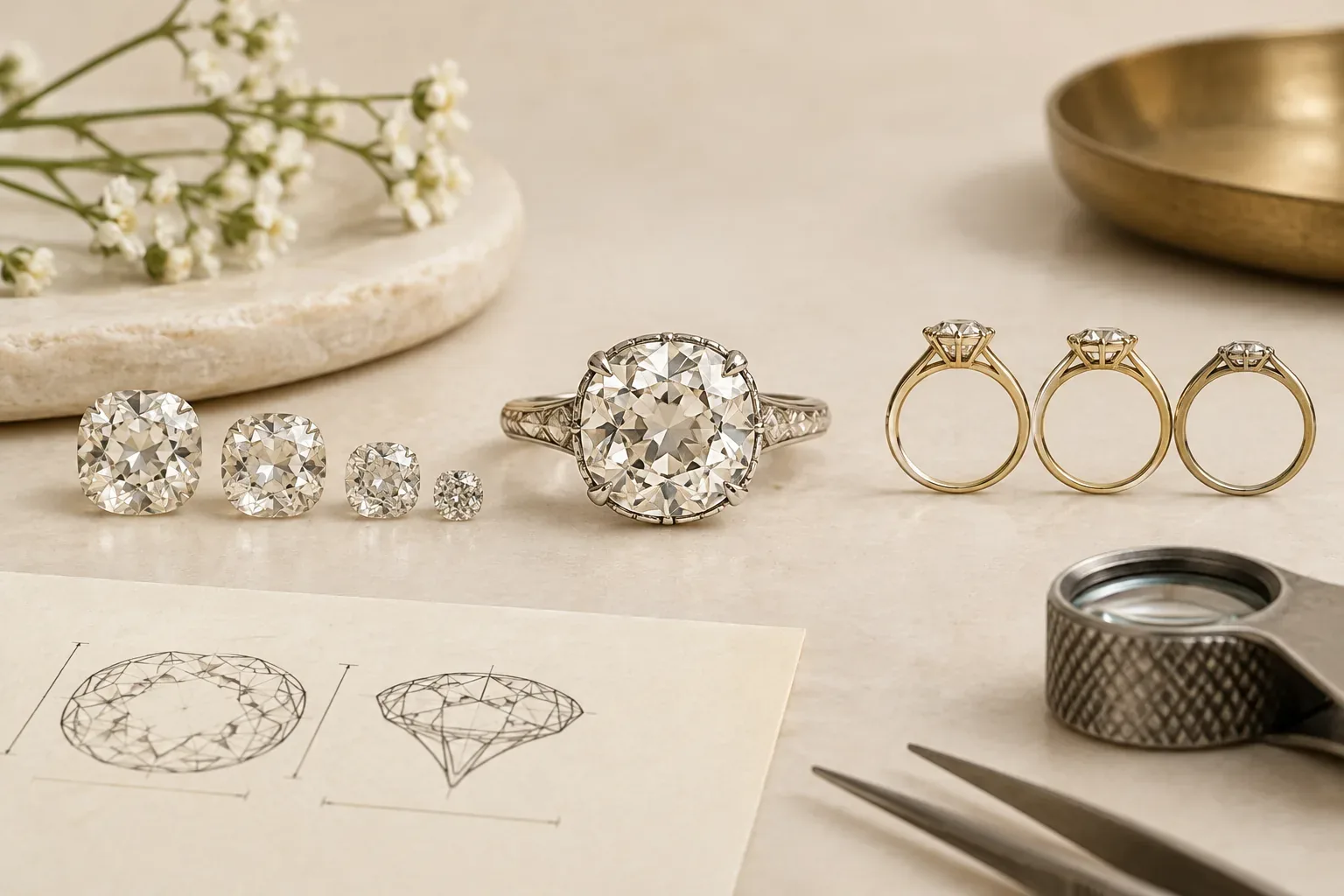
Old European Cut engagement ring styling centers on matching the cut's smaller table, deeper pavilion, and sometimes higher crown to the wearer's finger proportions; choose diameter, setting height, and halo or side-stone treatments to control visual coverage, and verify only dimensions and visible condition yourself while leaving origin, treatments, and precise grading to a qualified jeweler or laboratory.
What the historical record shows (periods and sources)
The Old European Cut (OEC) is documented in gemological and trade literature as an ancestor of the modern round brilliant and as a mainstream commercial cut from the late 19th century into the early 20th century. The Gemological Institute of America (GIA) and other gemological references describe the OEC as part of that transitional period when cutters shifted from table- and rose-style cutting toward brighter, faceted proportions.
Contemporary sources focused on the jewelry market and consumer demand, such as Jewelers Mutual and Imaginaire Digital, do not provide a historical narrative but document that vintage and craft aesthetics—of which Old European Cuts are a part—remain sought after in current engagement-ring trends. Use these publishers to contextualize how historical cuts appear in today's market rather than as primary historical archives.
Documented historical meanings versus modern personal interpretations
Documented historical meanings of an Old European Cut are primarily technical and commercial: the cut marks a stage in cutting practice and the trade's aesthetic preferences of its era. Historic documentation in gemological literature focuses on proportions and cutting technique rather than symbolic meanings.
Modern owners and designers frequently attach personal or contemporary meanings—vintage charm, timelessness, artisanal craft, or ‘something with history’—but these are individual or cultural interpretations, not universal or historically documented symbolism. Make a clear distinction between the documented role of the cut in lapidary history and the way people today project personal meaning onto vintage-style stones and settings.
How the Old European Cut appears in jewelry: motif, gemstones and traditions
As a motif, the Old European Cut most often appears as the center diamond in solitaire rings, three-stone rings, halos, and cluster settings. Jewelers commonly pair the cut with milgrain, filigree, and hand-engraving to emphasize its vintage provenance, and with colored accent stones where designers want a historical look combined with modern color.
Gemologically, Old European Cuts are a cutting style rather than a gemstone species; while most examples are diamonds, the same faceting approach may be applied to other transparent gems. Modern makers sometimes reproduce OEC proportions for lab-created or treated diamonds, so the appearance alone cannot prove natural origin or treatment status.
Finger coverage and proportion: practical styling rules
Start with measurable facts: the stone’s diameter in millimeters, the setting’s visible profile (height above the finger), and the width of the ring shank where it sits on the finger. Stone carat alone does not tell you coverage; two diamonds of the same weight can have different diameters depending on cut proportions, and an Old European Cut often has a smaller face-up diameter for a given weight than a modern shallow cut.
For narrow fingers, prefer a slightly smaller diameter or a low-profile setting that reduces perceived bulk and snagging. A thin, tapering shank emphasizes length while a rounder, uniform shank makes a ring read larger across the finger. For broad fingers or short fingers, increase apparent coverage with a halo or wide shoulders rather than dramatically upsizing the center stone.
Pay attention to setting height. Old European Cuts often have higher crowns and deeper pavilions than modern rounds. If you want the stone to sit closer to the finger for everyday wear, choose settings designed to seat the stone lower (bezel, low-profile prong cups, or modified low-bezel settings). If the vintage look is the priority, an open-cup setting that leaves the pavilion visible will be more authentic but sits higher.
Balance proportions between stone diameter and shank width. A typical visual harmony is achieved when the visible table (face of the stone) spans an appropriate portion of the finger within a context set by shank width and shoulder details. There is no single universal ratio; instead, compare actual millimeter measurements and try prototypes or mockups on the intended finger when possible.
Decision criteria and practical trade-offs
Trade-offs center on spread versus brilliance, profile height versus comfort, and authenticity versus optical performance. Choosing a larger-diameter OEC-like stone (or a modern round with OEC appearance) increases finger coverage but can reduce face-up light return if the depth is high. Conversely, a modern shallow cut may look larger face-up for the same weight but will not give the same vintage table-and-crown look.
A halo or side stones increase perceived center size and coverage with little effect on center stone weight, but they change the ring’s aesthetic from solitary vintage to a more ornate or contemporary hybrid. Wider shanks and greater shoulder ornamentation increase visual presence but may interfere with stacking bands.
If everyday wear and low maintenance are priorities, favor lower-profile settings and rings with secure prongs or bezel features. If historic authenticity and visible pavilion detail matter more, accept a higher setting and the greater need for careful handling.
What you can verify yourself and what needs professionals
Without a qualified jeweler or gemological laboratory you can measure visible and objective features: the millimeter diameter of the stone, the ring size, the setting height, the presence of chips or large abrasions, the quality of mounting and prong security, and whether the jeweler has provided any paperwork or seller disclosures.
You cannot reliably determine origin (natural vs lab-grown), undisclosed treatments, internal clarity grades, or precise historical age by sight alone. For disclosures about treatments and origin, consult sellers’ written statements and, for certainty, obtain testing from a reputable gemological laboratory. The Federal Trade Commission requires clear distinctions among natural, lab-created, treated, cultured and imitation materials, so insist on written disclosure and proper documentation before purchase or gifting.
Safe care guidance
Treatments and care considerations vary by material; consult the Gemological Institute of America (GIA) for authoritative guidance on treatments, detectability and durability. As a general rule, avoid high-heat home cleaning, and be cautious with ultrasonic cleaners because older cuts, fracture-filled stones, or certain treated gems can be harmed by mechanical vibration or temperature changes.
Clean an Old European Cut gently with a soft toothbrush, warm water, and a mild detergent, rinse well, and dry with a soft cloth. When in doubt about a stone’s treatment history or the setting’s resilience, have a jeweler inspect the mounting annually, and send the stone to a lab for verification before any major repair or resizing that could stress the gem.
Respectful selection and gifting guidance
Match the ring’s ergonomics to the recipient’s lifestyle. For active wearers or those who use their hands frequently, prioritize low-profile, secure settings and sturdy shanks. For wearers who prize vintage aesthetics, choose authentic Old European Cuts or faithful modern reproductions and consider displaying provenance or a certificate from a trusted lab.
Ask for clear written disclosures and any available paperwork, and consider an independent appraisal or laboratory report for high-value pieces. When gifting, include care instructions and, if provenance is part of the appeal, the seller’s documentation about the ring’s age or previous ownership. If you plan resizing, confirm that the design and side stones allow for alteration without compromising the look or structural integrity.
Putting it together: a short styling checklist
Measure the stone’s millimeter diameter and the ring’s profile height. Compare those numbers to the recipient’s finger width and ring size. Decide whether you want authentic vintage proportions or a modern round with vintage details, and choose halo, shoulders or shank width to control coverage and balance. Verify visible condition yourself and request lab verification for origin or treatments when needed. Finally, align setting choice with daily lifestyle to ensure comfort and longevity.
Frequently asked questions
How does an Old European Cut compare to a modern round brilliant for finger coverage?
Old European Cuts typically have smaller face-up diameters for a given weight because of their deeper pavilions and smaller tables; that means a modern shallow round with the same weight may appear larger face-up. To increase finger coverage with an OEC without adding weight, use a halo, wider shoulders, or a ring setting that visually amplifies the table.
Can I tell if an Old European Cut diamond is natural or treated by looking at it?
No. Visual inspection cannot reliably determine whether a stone is natural, lab-grown, or treated. The Federal Trade Commission requires written disclosure of such differences, and for certainty you should obtain testing from a reputable gemological laboratory.
What measurements should I request when shopping for an OEC engagement ring?
Ask for the stone’s millimeter diameter, approximate depth, table size, carat weight, and any documentation on treatments or origin. Also request clear photos showing the crown and pavilion, and measurements of setting height and shank width so you can judge finger coverage and comfort.
Are Old European Cuts harder to care for than modern cuts?
Care differences usually relate to treatments and setting style rather than cut alone. Because older proportions and open-cup settings may expose the girdle or pavilion, take extra care against knocks and avoid ultrasonic cleaning if the stone’s treatment history is unknown; consult GIA guidance for treatment-specific care.
Should I choose a halo or solitaire to maximize coverage?
A halo increases perceived center size and finger coverage without increasing the center carat weight, while a solitaire keeps the look simple and emphasizes the center stone itself. Choose based on desired coverage, aesthetic, and whether the recipient prefers a vintage or cleaner modern silhouette.
Sources and further reading
- Imaginaire Digital — Imaginaire Digital
- Jewelers Mutual — Jewelers Mutual
- Gemological Institute of America — Gemological Institute of America
- Federal Trade Commission — Federal Trade Commission