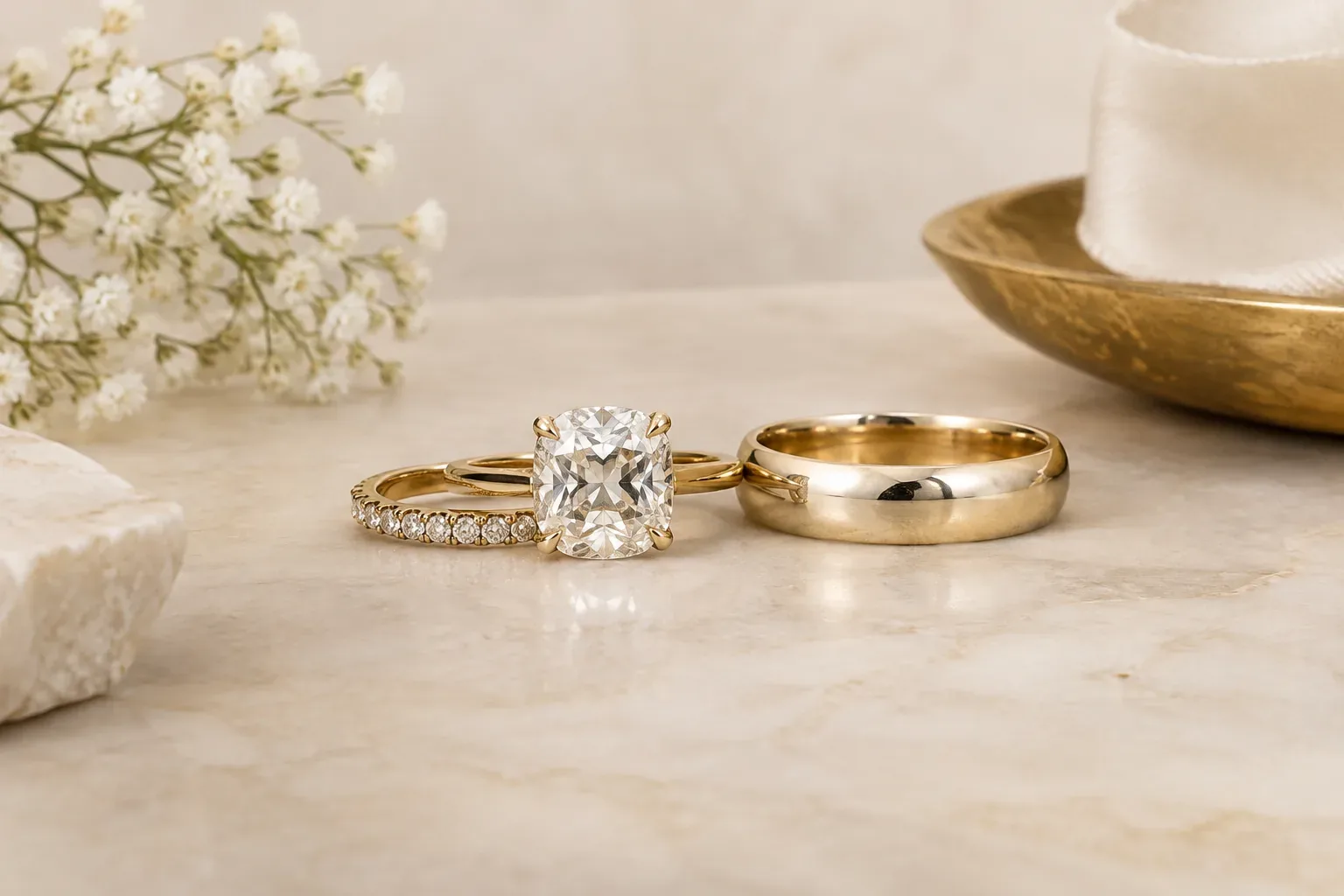
Meaning at a glance
Pairing a wedding band with an old mine cut engagement stone requires matching the ring profile and curvature, planning for any setting gap or bezel, and choosing a metal that balances wear, color harmony, and maintenance; verify any age, treatment, or alloy claims through a qualified jeweler or a gemological laboratory.
What an 'old mine cut' is for pairing purposes
For pairing and practical decision-making, treat an old mine cut as a pre-modern, hand-faceted diamond shape that typically presents a compact, somewhat rounded outline with a higher crown and smaller table than modern brilliant-cut stones. Those visual and structural traits influence how a wedding band will sit and wear next to the engagement ring: the crown and girdle profile determine needed clearance, while the stone’s visible outline guides whether a straight, contoured, or notched band will look harmonious.
Because the 'old mine cut' label is used in both historical descriptions and contemporary trade, shoppers should use visual inspection and exact measurements of the ring (not only the stone) when planning a band, and remember that original, hand-cut stones often vary from one piece to the next in proportions and setting style.
Historical evidence and limits of the supplied sources
The sources provided for this article focus on modern market trends, care and disclosure practices for gems, and consumer protections rather than primary historical documentation of the old mine cut’s origins. Imaginaire Digital and Jewelers Mutual document current consumer demand and stylistic movement, such as interest in fluid forms, stacking and vintage-inspired looks, which helps explain why old mine cut pairings remain fashionable in 2026. The Gemological Institute of America (GIA) and the Federal Trade Commission (FTC) supply authoritative guidance on treatment disclosure and what consumers can verify about gemstones and metals.
Because the approved evidence set does not include specialist historical texts, this article does not attempt to establish a precise cultural origin or single historical meaning for the old mine cut. Many jewelry historians and trade references describe old mine cuts as hand-cut styles associated broadly with the 18th and 19th centuries in Europe and the Americas, but those provenance claims are outside the scope of the supplied sources and should be verified through dedicated historical scholarship or museum catalogues when provenance is critical.
Documented historical meanings versus modern personal interpretations
The supplied sources do not document specific cultural meanings historically attached to the old mine cut. That means any symbolic claim that an old mine cut universally signified a particular social idea in a named culture or period is not supported here.
In contrast, modern buyers and designers often layer personal and contemporary meanings onto old mine cuts: they may value the cut for perceived authenticity, handcraft, or a vintage aesthetic. Market research summarized by Imaginaire Digital and Jewelers Mutual shows a consumer preference in 2026 for craftsmanship, vintage-inspired pieces, and gender-neutral styling, which explains why shoppers select old mine cuts for emotional or stylistic reasons today rather than for any documented historical symbolism.
How the old mine cut style and related motifs appear in jewelry
In practice, the old mine cut appears as a diamond cut with a rounded, often squarish outline and a distincted old-world sparkle that differs from modern brilliances. Jewelers commonly set these stones in low-profile collet or closed-back settings to protect the stone and emphasize the faceting. The setting type affects how a wedding band must be shaped to sit cleanly.
Besides the center stone, the overall motif—vintage profile, hand-finished bezel edges, and milgrain detailing—carries into matching bands. Some wedding bands replicate the engagement ring’s milgrain or engraving for visual continuity, while others use complementary motifs such as a plain polished band or a delicate pavé to contrast texture while preserving the vintage center stone’s presence.
Practical pairing decisions: shape, gap, and metal choices
Shape: Start by looking at the engagement ring’s outline and the portion of the setting that sits over the finger. If the engagement ring has a rounded old mine cut with a low bezel, a gently curved band or a band with a rounded notch will sit flush. If the setting is higher (for example, a cathedral or raised prong style), a straight band may require a small visible gap or a contoured companion band that follows the setting’s shoulders.
Gap (clearance): Measure the physical gap between the engagement ring’s underside and where the band would meet. A zero-gap flush fit usually requires a custom-contoured or notched band, while a small intentional gap can be acceptable for stacking looks but will collect dirt and may require more frequent cleaning. The nature of an old mine cut’s crown and setting can create asymmetric contact points, so confirm fit on the actual rings rather than relying on diagrammatic photos.
Metal choices: Match metal color and hardness to how you plan to wear the set. Yellow or rose gold can emphasize vintage warmth, while platinum or white gold complements cooler palettes and adds durability for everyday wear. Be aware of trade-offs: higher hardness metals like platinum resist wear but can show surface scratches differently than gold alloys; gold alloys are available in different purities and will wear at different rates. Jewelers Mutual’s 2026 trend guidance indicates demand for versatile, gender-neutral styling, so consider metal that suits intended long-term wear across styles.
Practical trade-offs and maintenance considerations
Comfort and wear: Narrower bands may be more comfortable for daily wear and pair better with many old mine cuts, but extremely narrow bands can appear visually lost next to a substantial vintage center stone. Wider bands offer balance but increase contact area against settings and may accelerate metal wear where the rings meet.
Cleaning and durability: An old mine cut’s setting—particularly closed-back or collet settings—may trap debris at the junction with a wedding band. Expect more frequent cleaning if the fit is tight. The GIA notes that treatments and durability affect care needs, and the FTC requires disclosure of treatments. If the center stone has been treated or is a non-diamond material, follow the specific care advice for that material rather than assuming diamond-level hardness or chemical resistance.
Resizing and future adjustment: If you plan for a flush fit, factor in potential future resizing. Contoured or notched bands and rings with heavy engraving are more complex to resize. Discuss resizing limits with a jeweler before purchasing.
What you can and cannot verify without experts
You can verify visual fit, comfort, and metal color by trying rings together on the finger and by requesting clear photos or in-person inspection. You can observe how a band sits relative to a setting and whether a contour or notch is required.
You cannot reliably determine treatments, laboratory origin, exact alloy content, or historical dating without a qualified jeweler’s inspection or a gemological laboratory report. The GIA explains how treatments affect detectability and durability, and the FTC requires sellers to disclose whether gemstones are natural, lab-grown, treated, or imitation. For definitive claims about age, provenance, or technical grading, obtain a written laboratory report or appraisal from an accredited lab or a qualified independent appraiser.
Selection and gifting guidance (practical and respectful)
If you are selecting a band as a gift, confirm the engagement ring’s setting profile and encourage a try-on if possible. If gifting without a fit check, choose a classic, slightly adjustable option such as a slim band or a channel-style ring that can be resized, and keep receipts and resizing policies accessible.
Respect personal meaning: Some recipients prize the old mine cut specifically for perceived age, handcraft, or family significance. Ask gentle, open questions about preferences for metal color, texture, and the desire for a flush fit versus a stacking look. When unsure, lean toward neutral metals and mid-width bands that balance presence with comfort.
Get disclosures in writing: For any pre-owned or vintage engagement ring, request written information about treatments, repairs, and any known provenance. The FTC’s guidance makes clear that disclosure protects both buyer and seller; insist on transparency and a return or appraisal option before completing a purchase.
Care and long-term stewardship
Routine cleaning and inspections: Because settings for old mine cuts can trap dirt, schedule periodic professional cleanings and annual inspections, especially if the set is worn daily. Jewelers Mutual’s trend notes on craftsmanship and versatility underline how maintenance preserves both appearance and structural integrity.
Treatment awareness: If the stone is treated or is a near-colorless material rather than diamond, follow care instructions specific to that treatment or material. The GIA provides resources on treatments and their implications for care and detectability.
Storage and daily wear: When not wearing the set, store rings separately or in a band divider to avoid metal abrasion. For active work or tasks that risk impact, remove the rings to prevent damage to hand-cut facets or delicate settings.
Decision checklist before purchase or customization
Confirm the engagement ring’s exact profile and measure the clearance where a band will sit. Decide whether you want a flush appearance or a visible gap and whether a custom contour or a standard straight band is appropriate. Ask the seller for written disclosure of treatments, metal alloy, and any known provenance; if provenance, age, or treatment status matters to you, obtain a gemological laboratory report. Consider future resizing needs and choose metals and widths that balance aesthetic preference with long-term wear and maintenance.
Frequently asked questions
Can I fit a standard straight wedding band to an old mine cut engagement ring?
Possibly, but whether a straight band sits flush depends on the engagement ring’s setting profile and the stone’s crown and girdle shape. Try the rings together in person and measure the clearance; if a flush fit is required, a custom-contoured or notched band is often the safer choice.
Should my wedding band metal match the engagement ring metal?
Matching metal color creates a cohesive look and simplifies wear and maintenance, but contrasting metals can also be a deliberate aesthetic choice. Consider durability and maintenance: platinum is more durable but shows surface wear differently than gold alloys. Choose according to style preference and practical wear considerations.
How can I verify whether an old mine cut diamond has been treated or is vintage?
Request written disclosures from the seller and a gemological laboratory report for definitive verification. The GIA explains how treatments affect detectability and durability, and the FTC requires sellers to disclose whether gems are natural, lab-grown, treated, or imitation.
Is it better to have a tight flush fit or a small gap between rings?
A flush fit looks seamless but can accelerate metal wear where the rings meet and complicate cleaning. A small gap may be easier to clean and reduce abrasion but may collect debris. Decide based on daily wear habits and willingness to schedule regular professional cleaning.
What maintenance should I plan for with an old mine cut set?
Plan for more frequent cleaning and at least annual professional inspections. If the stone has been treated or is not a diamond, follow care guidance specific to that material; refer to GIA resources and ask the seller for care instructions.
Sources and further reading
- Imaginaire Digital — Imaginaire Digital
- Jewelers Mutual — Jewelers Mutual
- Gemological Institute of America — Gemological Institute of America
- Federal Trade Commission — Federal Trade Commission