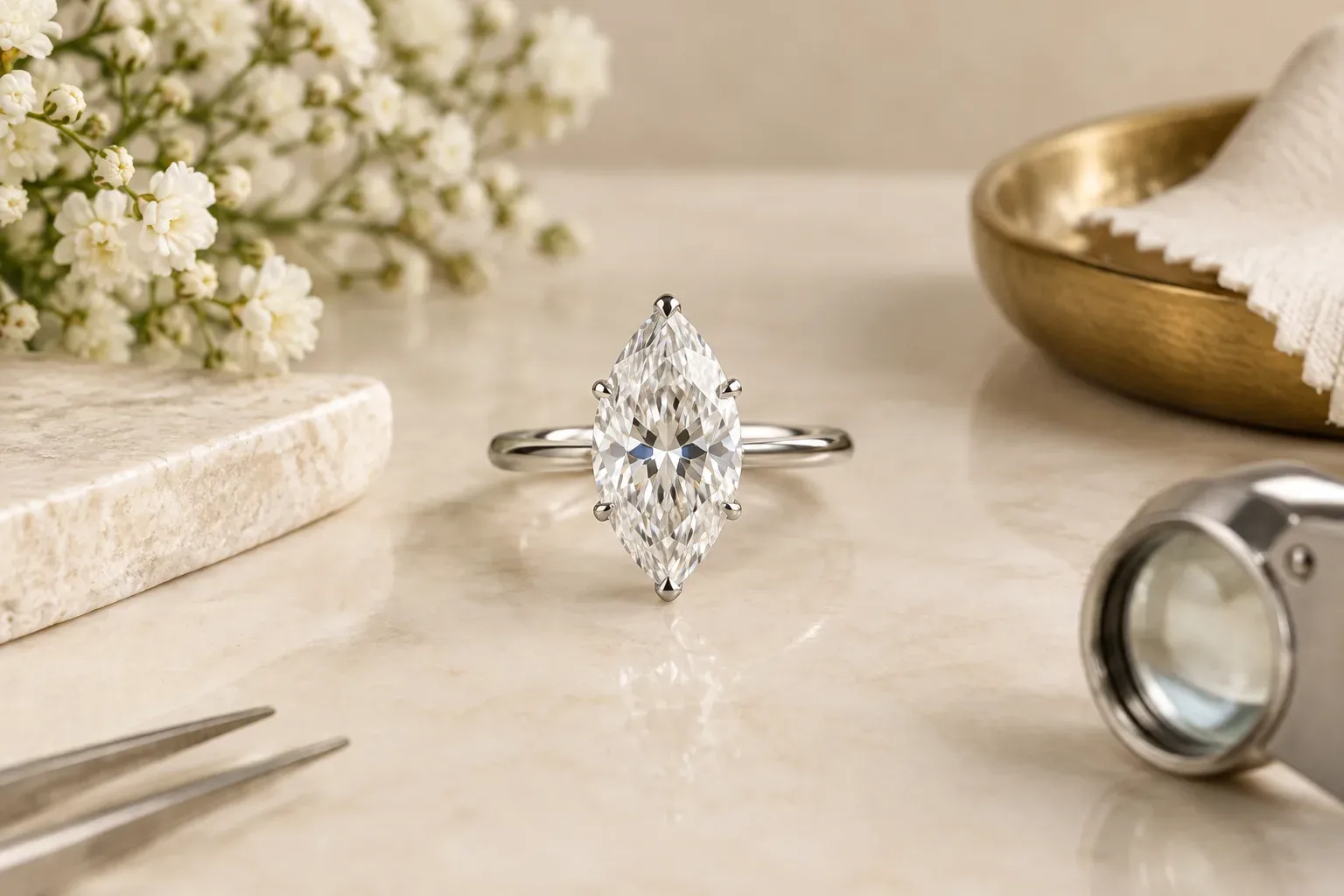
Meaning at a glance
Marquise cut engagement ring durability depends primarily on the stone material, the protection of the pointed ends, the setting style, and maintenance; practical trade-offs include greater risk of tip chipping and snagging in exchange for an elongated silhouette, and some durability questions require inspection by a jeweler or gemological lab to answer definitively.
Historical evidence and what we can say with confidence
Approved source material supplied for this article does not provide a primary documentary history for the marquise cut’s origin. Because the sources in our brief focus on modern industry trends, consumer protection, and gem treatment principles, there is no verified, source-backed chronology here that attributes the cut to a specific culture or date.
What follows separates commonly repeated origin stories from the historically documented record. Many retail histories and popular accounts present origin stories for specific cuts as part of marketing, but those narratives are not documented in the four approved sources for this piece. For that reason, any specific cultural or period claim about the marquise cut should be treated as a modern interpretation unless you consult specialized historical scholarship or primary archival sources.
Documented meanings versus modern personal interpretation
Documented meanings: the approved sources do not record a historically documented symbolic meaning tied specifically to the marquise cut. The Gemological Institute of America (GIA) materials we cite concentrate on treatment, disclosure, and care rather than symbolism, while the Federal Trade Commission emphasises clear labeling and consumer information.
Modern personal interpretation: today many people choose a marquise cut for its visual impact, finger-flattering elongation, or personal aesthetics. Contemporary trend reporting from Jewelers Mutual and Imaginaire Digital shows demand for versatile, modern styles and craftsmanship, which helps explain why elongated cuts like marquise appear in current engagement ring collections. Those reasons are modern preferences rather than evidence of a historic cultural meaning.
How the marquise shape appears in jewelry and what that means for durability
The marquise cut is an elongated, symmetrical shape with two pointed ends and an oval-like centre. In rings, that silhouette is typically set with prongs or bezel elements and often paired with tapered side stones or halos to emphasize length. The pointed tips are a defining visual feature and the primary mechanical vulnerability.
In practice, the marquise is widely used for diamonds and other transparent gemstones. Industry coverage in our sources notes that contemporary demand favors fluid forms and versatility, which helps explain the marquise’s presence in modern engagement rings, stackable sets, and gender-neutral styling. The aesthetic trade-off for the slender, dramatic look is a need for more protective setting design and care than many round or cushion cuts require.
Daily wear: practical durability considerations
Daily durability is driven by four factors: the intrinsic toughness of the chosen gemstone, how well the two pointed ends are protected by the setting, the thickness and hardness of the ring metal in vulnerable areas, and the wearer’s lifestyle. The approved evidence emphasizes that treatments and disclosure can affect how a stone should be cared for and that modern consumers prioritize craftsmanship and versatility when choosing rings.
If you plan to wear an engagement ring continuously, expect the marquise to be more likely to snag on fabrics or to encounter edge impacts at its tips than a rounded stone. Snagging itself does not prove a stone will chip, but consistent catching increases exposure to forces that can cause chips or prong damage over time. Because these are mechanical risks, a protective setting combined with an appropriate metal and regular inspection is the practical route to reducing everyday damage.
Snagging and visible wear: how settings change the risk
Protective settings make the biggest difference for snagging and chipping risk. V-shaped prongs or partial bezels that wrap the tip area reduce sharp exposure and are commonly recommended by jewelers for pointed shapes, while thin or tall prongs leave tips vulnerable. Halo settings and side stones can also buffer lateral impacts but do not replace direct tip protection.
Because setting workmanship varies, inspection by a qualified jeweler is the only reliable way to evaluate whether the prongs are adequate, whether the metal around the tips is too thin, or whether the stone’s girdle or pavilion shows structural weakness. The Federal Trade Commission materials we reference stress the value of written disclosures and transparent seller information, which can help you assess workmanship and protective features before purchase.
Repair risk and common repairs
Common repairs associated with marquise cuts include prong re-tipping or replacement, resetting a chipped tip, and in some cases stone replacement if a chip is severe or extends into the pavilion. The extent and cost of repair depend on the metal, the nature of the damage, and whether the stone has been treated or is a weaker material.
The Gemological Institute of America underscores that treatments and their detectability affect durability and care instructions; likewise the FTC reminds consumers that disclosure is important. If a stone has a known treatment that affects toughness, that will change repair strategies. Only a qualified jeweler or lab can examine a damaged stone and say whether it should be re-cut, stabilized, or replaced.
Decision criteria for buyers: what to check before you buy
Ask the seller for clear, written information about the gemstone type, any treatments, and setting construction. The Federal Trade Commission guidance in our sources makes clear that consumers should obtain written disclosures for natural vs lab-created stones and for common treatments or enhancements.
Evaluate setting type and workmanship in person when possible. Look at how the prongs meet the stone at each tip, and ask whether the seller uses V-prongs or a partial bezel on marquise points. Consider a halo or bezel-style guard if you want extra protection, and discuss metal options and ring profile with the jeweler. Trend coverage from Jewelers Mutual suggests consumers are valuing craftsmanship and versatility, so prioritize build quality when durability matters most.
Care guidance to reduce risk
Regular inspection and preventive maintenance are the most effective steps to protect a marquise cut engagement ring. Have prongs checked and tightened periodically by a qualified jeweler. Remove the ring for rough work, heavy lifting, gardening, or sports where the tips could take an impact or be forced against hard surfaces.
Clean the ring according to the jeweler’s recommendations for the stone and metal. The Gemological Institute of America materials we cite note that treatments and care requirements vary by material, so follow the cleaning and care guidance appropriate to the specific gemstone and disclosed treatments.
Selection and gifting guidance—practical and respectful advice
If durability is a priority for the recipient, choose a setting known for tip protection and ask for documentation about the stone and setting. If you are gifting a marquise, ask the recipient’s preferences about low-profile designs and about whether they regularly remove jewelry for certain activities. When buying for someone whose lifestyle includes manual work or frequent hand use, a protective setting, a sturdier metal and a more conservative rise from the finger will reduce risk.
Be transparent about the ring’s care needs when gifting. Arrange for a warranty, inspection schedule, or insurance where appropriate, and encourage the recipient to have the ring checked by a qualified jeweler at regular intervals. Jewelers Mutual’s trend commentary supports choosing rings that combine craftsmanship with versatility, which aligns with durable everyday wear.
What a shopper cannot verify without a qualified jeweler or lab
You cannot reliably determine a stone’s internal treatments, its exact toughness, or microscopic damage from photographs or sales copy alone. The Federal Trade Commission emphasises that consumers should expect written disclosures and that certain material characteristics require expert testing. The Gemological Institute of America likewise notes that detectability and disclosure are central to understanding how a gem must be cared for.
If you need precise answers about repairability, whether a chip can be stabilized, or whether a stone is suitable for recutting, those questions require hands-on inspection and, in some cases, laboratory analysis. Treat any verbal claim about durability or treatment as provisional until confirmed in writing or by a qualified professional.
Bottom line
Marquise cut engagement ring durability is a function of the stone, the design choices that protect the pointed tips, the quality of craftsmanship, and ongoing care. The distinctive silhouette offers style benefits but brings predictable mechanical vulnerabilities that responsible consumers can manage by choosing protective settings, verifying disclosures, arranging inspection and insurance, and consulting a jeweler or gem lab for unresolved technical questions.
For modern shoppers who appreciate the marquise aesthetic, the practical path is straightforward: prioritize workmanship and protective settings, obtain written information about the stone and any treatments, and plan for regular maintenance so the ring can be enjoyed for years to come.
Frequently asked questions
Is a marquise cut more likely to chip than a round cut?
Relative risk: the marquise’s pointed tips create predictable vulnerable points that are more likely to chip or be damaged from edge impacts than fully rounded cuts. The actual risk depends on the stone material, how well the tips are protected by the setting, and wearer habits; only a jeweler can evaluate the condition and protective quality of a specific ring.
What setting reduces snagging and chipping risk for a marquise?
Settings that cover or shield the pointed tips, such as V-prongs or partial bezels, reduce snagging and chipping risk. Halo settings can provide lateral buffering but are not a substitute for direct tip protection. Ask the seller for written details about the setting construction and have a jeweler inspect prong thickness and security.
Can a chipped marquise tip be repaired?
Minor chips are often repairable by a qualified jeweler, typically by re-cutting or re-tipping the stone and resetting if possible, but severe damage may require stone replacement. Repairability depends on the stone’s condition, treatment history, and intrinsic properties; laboratory or in-person inspection is needed for a definitive answer.
Does a marquise cut require special cleaning?
Care instructions depend on the gemstone and any treatments it has received. The Gemological Institute of America materials emphasise that treatments and care requirements vary, so follow the jeweler’s or lab’s recommended cleaning method for the specific stone and disclosed treatments.
How can I be sure my marquise engagement ring is as durable as claimed?
Obtain written disclosures about the gemstone, any treatments, and the seller’s warranty. Have the ring inspected by a qualified jeweler who can assess prong and setting integrity, and consider laboratory testing for treatment verification if durability or authenticity is uncertain. The Federal Trade Commission advises consumers to request clear written information for gemstones and treatments.
Should I insure a marquise cut engagement ring?
If the ring has monetary or sentimental value, consider insurance or a jeweler’s warranty that covers theft, loss, or damage. Periodic inspection and documentation of condition also support repair and insurance claims. Jewelers Mutual’s trend coverage highlights that buyers increasingly value craftsmanship and protective measures—insurance is a practical complement to those choices.
Sources and further reading
- Imaginaire Digital — Imaginaire Digital
- Jewelers Mutual — Jewelers Mutual
- Gemological Institute of America — Gemological Institute of America
- Federal Trade Commission — Federal Trade Commission